A crystal where light lives longer express
A glowing spot in a crystal is like a lighthouse in fog: the longer it shines, the more reliable the signal. In quantum devices, ions of rare-earth metals embedded in a transparent lattice play the role of such a lighthouse. They absorb energy and release it as a flash of light. But if there are atoms with magnetic moments nearby, the flash quickly dies out.
Researchers took cerium oxide — a substance where all atomic nuclei are "magnetically silent." They added two types of ions to this film: erbium and thulium. Erbium glowed for 2.9–5.3 milliseconds, like a lamp that stays on while you read a paragraph. Thulium flashed and faded in 14–68 microseconds — faster than an eye blink.
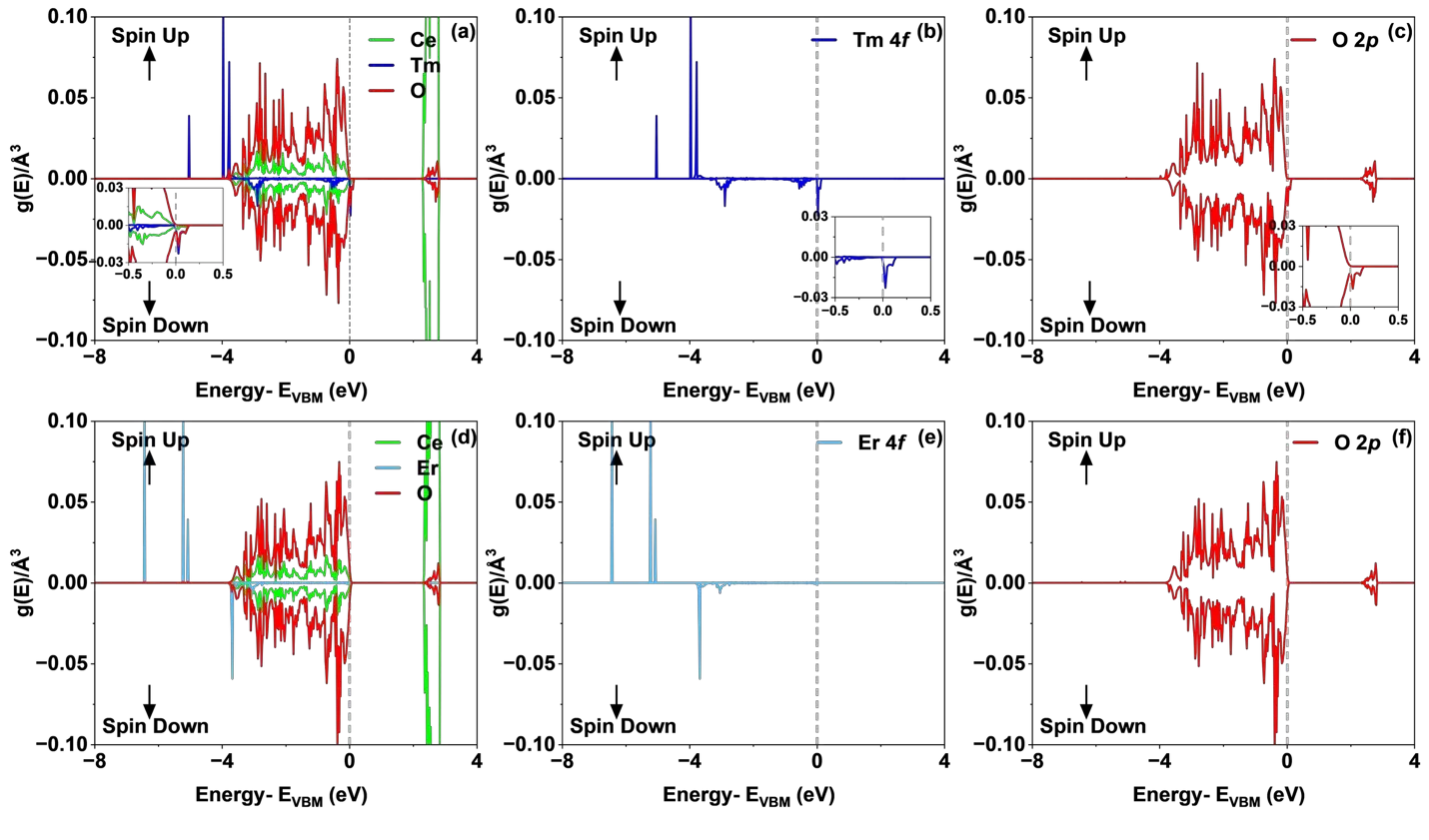
Calculations confirmed: in thulium, the electron clouds of oxygen and thulium overlap like two circles in a diagram. In erbium, the circles barely intersect. That is why erbium in cerium oxide is a promising candidate for quantum memory, where a photon must be stored for as long as possible.
Original abstract
as written by the authors arXiv:2603.25234
In highly purified host, the coherence of quantum emitters is ultimately limited by hyperfine interactions between the emitter and lattice nuclei possessing non-zero nuclear magnetic moments. This limitation can only be mitigated through isotopic purification. In this work, we investigate CeO2 as a host composed entirely of nuclei with zero nuclear moment. High-quality CeO2 thin films were grown by PLD and doped with Tm and Er ions. Structural characterization using X-ray diffraction, atomic force microscopy, and ion channeling confirms single-crystalline, atomically smooth films with dopants substitutionally incorporated at Ce lattice sites. Photoluminescence lifetime measurements show significantly longer lifetimes for Er-doped CeO2 (2.9 - 5.3 ms) compared with Tm-doped films (14 - 68 {\mu}s). Moreover, the Er-doped PLD films exhibit longer lifetimes at ~1% dopant concentration than previously reported for MBE-grown films. Density functional theory calculations reveal a substantial overlap between unoccupied O 2p and Tm 4f states near the valence band maximum, whereas Er 4f states remain well isolated. This electronic interaction likely introduces non-radiative recombination pathways in Tm-doped CeO2, explaining the reduced lifetimes. These findings highlight the importance of selecting appropriate dopant-host combinations and optimized growth conditions to minimize non-radiative channels for quantum applications.
Cerium oxide is one of the few substances where all naturally occurring isotopes have nuclei with zero magnetic moment. This "magnetic silence" allows quantum states to live longer.