Luminescence is the emission of light from a substance that does not arise from high temperature (incandescence). Instead, it occurs when energy is absorbed by a material and then re-emitted as photons, typically following electron transitions between energy levels. This phenomenon is central to many natural and technological processes, from the glow of fireflies and the phosphorescence of deep-sea creatures to the operation of LEDs, fluorescent lamps, and biological imaging probes. It provides a window into the quantum behavior of matter, as the color and intensity of emitted light reveal information about the electronic structure of the material.
History
The term 'luminescence' was coined by the German physicist Eilhard Wiedemann in 1888, although observations of the phenomenon date back centuries. The scientific understanding of its mechanisms developed with quantum mechanics in the early 20th century.
How it works
Luminescence begins when a substance absorbs energy—from light, electric current, chemical reactions, or mechanical stress—which excites electrons to higher energy states. When these electrons return to their ground state, they release the excess energy as photons. The specific wavelengths emitted depend on the energy gap between the excited and ground states, which is unique to each material. If the emission occurs within a very short time (nanoseconds), it is called fluorescence; if it persists for longer periods (milliseconds to hours), it is called phosphorescence, often involving a metastable state.
In practice
Luminescence is used in LED lighting, fluorescent and glow-in-the-dark materials, biological and medical imaging (e.g., fluorescent markers), and in scintillation detectors for radiation measurement.
Fun fact
The 'brain glow' sometimes reported in meditation or near-death experiences is not actual luminescence; it is a perceptual phenomenon, as no light is emitted from the brain.
A light field, like a neat waffle iron, presses a regular pattern of bright and dark regions into space. Atoms get stuck in the brightest spots as if in tiny dimples: that's an optical lattice. It's a favorite tool for physicists who want to study quantum behavior of matter in its pure form.
In a two-dimensional crystal of tungsten diselenide (WSe₂), light creates pairs — an electron and a hole that stick together. Such pairs are called excitons. Among them are "dark" ones: they barely emit, but they set the tone at low temperatures.
A beam of light enters frosted glass and fades — nothing unusual. But physicists have long known how to make light pass through without losing a single photon. This trick is called electromagnetically induced transparency: two light waves cancel each other at the right point, and absorption disappears. Now a similar feat has been pulled off with atoms.
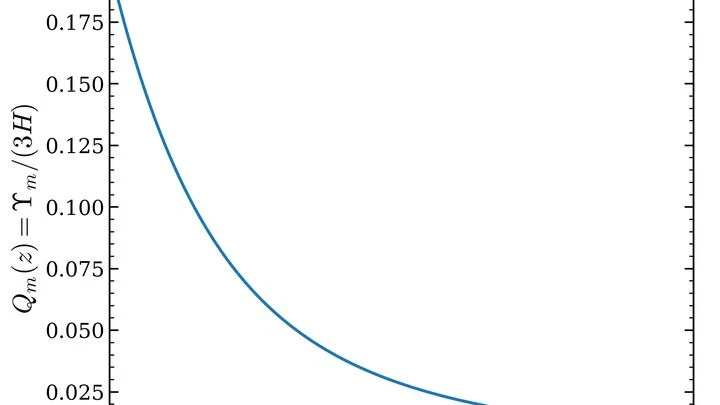
In the late 1990s, astronomers including Saul Perlmutter discovered that the universe is expanding at an accelerating rate. The cause was dubbed dark energy — an invisible force stretching the cosmos.
A candle flame flickers in a draft but doesn't go out — the tongue of fire briefly changes shape and then returns. Optical skyrmions behave much the same way — tiny vortices in a light beam, reminiscent of swirling eddies. Until recently, they were created only in the perfect, smooth light of a laser.
A quantum dot is like a tiny lamp that turns on and off at the command of a laser, emitting exactly one photon at a time. But this light has a quirk: the photons don't interact with each other; they fly independently, like random drops from a faucet.
Sunlight is a turbulent stream carrying inseparable pairs of droplets. That’s what quantum entanglement looks like: two particles are so connected that a fluctuation in one instantly resonates in the other. In the past, creating such pairs required a 'calm pool' — a perfectly tuned laser beam.
A sheet of graphene is a lattice of carbon atoms arranged like a honeycomb. Electrons in it zip around so fast they seem to have no mass, just like light. When a powerful laser pulse hits such a sheet, the electrons get a kick and start accelerating. Their path can be compared to a road with occasional barriers — the forbidden zones.
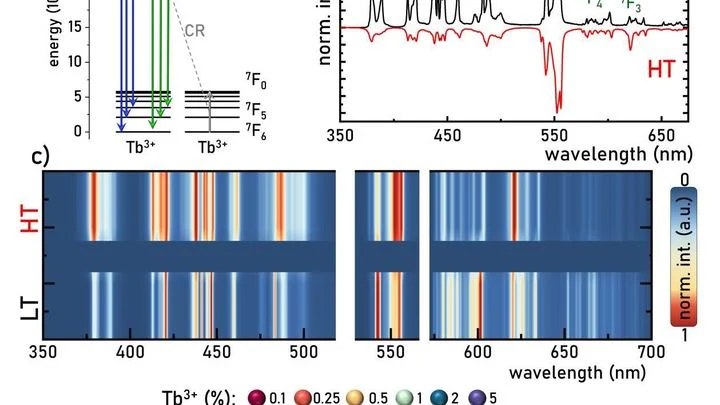
A piece of material glows blue. Heat it up, and the glow turns green, as if someone flipped a switch at a traffic light. That's how the new luminescent thermometer described in the paper works.
Inside the material are terbium ions — a rare-earth metal that knows how to shine. At room temperature, they emit blue light.
Superfluorescence is a crystal’s synchronized exhale of light. Researchers just witnessed its mirror image: superabsorption, a coordinated inhale. They zapped cheap perovskite nanocrystals with laser pulses (spectroscopy) and saw a time-reversed absorption burst.