Erbium is a rare-earth (lanthanide) element with the atomic number 68. In physics and materials science, it is prized for its optical properties: erbium ions embedded in crystals or optical fibers exhibit sharp, well-defined transitions in the infrared region, particularly around 1.5 micrometers. This wavelength is ideal for telecommunications because it matches the low-loss window of silica optical fibers, making erbium the key ingredient in optical amplifiers.
History
Erbium was discovered in 1843 by Carl Gustaf Mosander, who separated it from the mineral yttria. Its optical amplification properties were recognized in the 1980s, leading to the development of the erbium-doped fiber amplifier (EDFA).
How it works
Erbium ions have a partially filled 4f electron shell, which is shielded by outer electrons. This shielding makes the energy levels of the 4f electrons relatively insensitive to the surrounding crystal environment, resulting in narrow, stable optical transitions. When pumped with light at a specific wavelength (e.g., 980 nm or 1480 nm), erbium ions are excited to a higher energy state and can then emit at 1.5 μm through stimulated emission, amplifying an incoming signal.
In practice
Erbium-doped fiber amplifiers (EDFAs) are the backbone of long-haul fiber-optic communication networks, and erbium-doped crystals are used in quantum memories and solid-state lasers.
Fun fact
Erbium's name comes from the Ytterby mine in Sweden, which also gave names to yttrium, terbium, and ytterbium.
You can make light turn on command, like water in a hose — if you know where to squeeze. That's what electro-optic circuits do: they change the direction of a beam inside a chip using an electric field. The classic material for such tricks is lithium niobate, a crystal that responds to voltage like a string to a pluck.
Light passing through a glass of murky water dims — some of it is absorbed. That's how many liquid-analysis instruments work: they measure how much light was lost and infer the composition from that. But if the liquid is heterogeneous, like soup with chunks, a single number isn't enough: you need to know where exactly more absorption happened.
Deep beneath our feet, in the scorching mantle, iron leads a double life. It can be divalent or trivalent, like a coin that lands heads or tails. Which side dominates determines how much oxygen stays in the planet's rocky shell and how much sinks into the core.
A pendulum that swings almost half a quadrillion times per second. This isn't mechanics: it's the pulse of light trapped by ytterbium atoms. Instead of gears, there's an optical lattice — a standing wave that holds atoms at its nodes like peas in a pod.
Light passing through a transparent crystal can subtly change color. That's how many lasers work: a tiny addition of a rare-earth metal makes the crystal glow. But the same metal behaves differently in different crystals, and physicists have studied this quirk using ytterbium.
Holding a phone number in your head while people shout and slam doors around you is nearly impossible. That's roughly the life of a quantum bit, a qubit, in an ordinary material: the nuclei of neighboring atoms, like tiny magnets, constantly jostle it and erase information. To keep a qubit from forgetting, you need to find it a quiet spot.
An ordinary kitchen knife made of niobium would suddenly start conducting electricity with zero loss at −258 °C. That's how superconductivity works, and you can "switch it on" right at the metal's surface by blasting it with a laser in a nitrogen atmosphere.
Blue pixels in screens are like light bulbs that burn out fast. Conventional organic LEDs for blue are unstable: their light dims over time, and the color shifts. Chemists found a replacement — the rare metal europium.
The laser based on diamond converts almost half of the pump energy into bright yellow light — an efficiency of 47.7%, a record for such devices. But the main advantage is not the power, but the exceptional purity of the color: the beam is so monochromatic that it can be compared to a musical instrument playing just one note without the slightest wavering.
A solid electrolyte is like a sponge for lithium ions. In a regular lithium battery, ions float in a liquid, like fish in an aquarium. In a solid-state battery, they have to squeeze through the crystal lattice, like through narrow corridors.
In a sealed glass bulb the size of a finger, metallic vapor boils. The main component is cesium, but one percent rubidium hides within. A laser beam at 795 nanometers finds this impurity and makes it glow.
Rubidium alone would give a weak signal: atoms quickly fly through the beam.
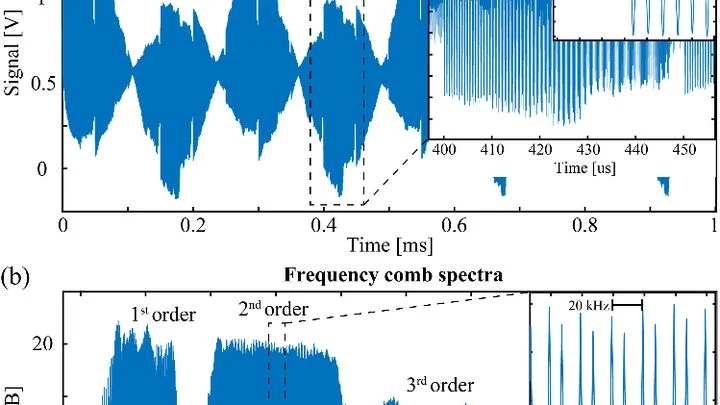
Ordinary white light is a jumble of all colors at once, like the noise of a crowd where everyone speaks at their own frequency. But scientists need light where frequencies are aligned with ruler-like precision, like piano keys, where each note sounds distinct and exact.
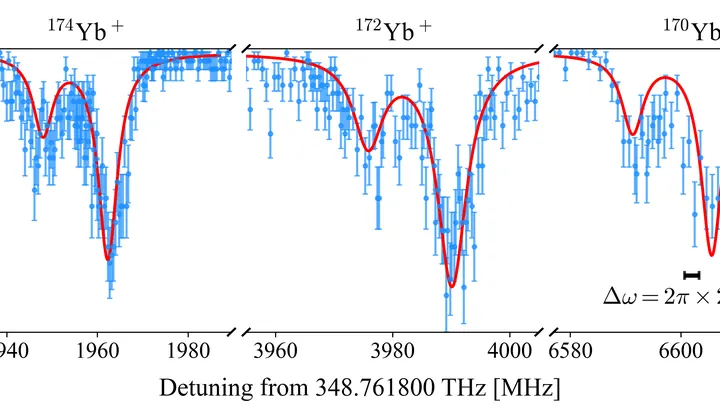
The light an atom emits or absorbs is like a fingerprint: each element has its own pattern of lines. In an ytterbium ion (an atom that has lost one electron), researchers have found three new lines that were previously unused. These lines are very narrow, like thin slits in a fence that let you see far and clearly.
An X-ray telescope captures light from hot gas around stars, but that light arrives 'blurred'—like a voice over a bad phone line. To make out the words, you need a dictionary of the exact frequencies at which atoms glow. Such a dictionary is written not only with calculations but also with direct experiments.
A tiny magnet made of layers of sulfur, chromium, and bromine sits on a microscope stage. Inside it, like unexpected guests, sit erbium atoms — a rare-earth metal. These atoms can glow when hit with a laser, and their light tells us what's happening around them.
Quantum devices usually live inside cryostats — giant thermoses where temperatures are colder than deep space. An erbium ion trapped in a tiny well on a silicon chip breaks that mold.
A quantum computer is like an orchestra that can only perform in complete silence. The slightest noise, and the delicate melody falls apart. For quantum devices, heat is that noise: even faint infrared radiation from nearby components heats up the qubits and erases their quantum states.