Gait as a Mirror of Health express
Gait is not just a way to get from point A to point B. Each step, arm swing, and torso tilt is like a signature the body leaves in space. Doctors have long noticed that disease alters gait, but they considered it merely a symptom of a specific problem: if you limp, your leg hurts. Now it turns out that gait is a whole book about health, and you can read it with an ordinary camera.
In the new study, 3414 adults performed five simple tasks in front of a camera: normal walking, turns, and getting up from a chair. A computer program turned their movements into a three-dimensional skeleton, like in movies where actors wear motion-capture suits, but without the suits. From this skeleton, the program learned to predict age to within a few years and even the amount of visceral fat, which is invisible from the outside and accumulates around organs. Visceral fat is more dangerous than subcutaneous fat, and it is usually measured with complex equipment, but here, a simple walk suffices.
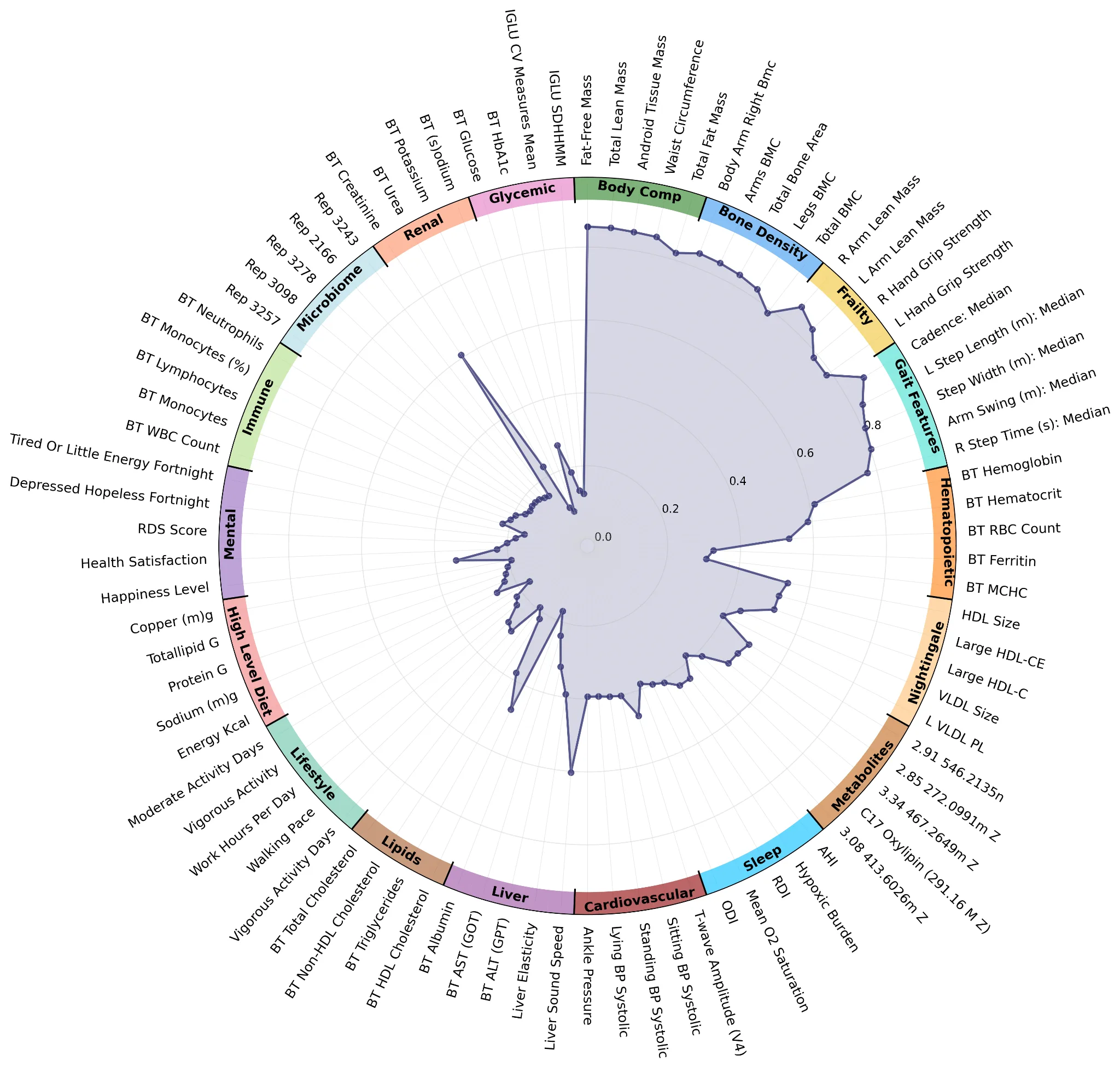
The most interesting part is how gait is structured. It turns out that the legs reveal the most about metabolism — how the body processes energy. Meanwhile, the torso and shoulders betray habits: how much a person sleeps, how active they are during the day. In other words, gait is not a single signal but an entire orchestra, where each body part plays its own part. And from this score, you can read far more than previously thought.
In the future, such models could run on ordinary smartphone cameras. Then gait would become an unobtrusive but constant health indicator: every day, without doctors or devices, just from a video in the hallway or on a walk. This is not a replacement for a doctor, but rather a smart assistant that notices changes before symptoms appear.
Original abstract
as written by the authors arXiv:2603.25283
Gait is increasingly recognized as a vital sign, yet current approaches treat it as a symptom of specific pathologies rather than a systemic biomarker. We developed a gait foundation model for 3D skeletal motion from 3,414 deeply phenotyped adults, recorded via a depth camera during five motor tasks. Learned embeddings outperformed engineered features, predicting age (Pearson r = 0.69), BMI (r = 0.90), and visceral adipose tissue area (r = 0.82). Embeddings significantly predicted 1,980 of 3,210 phenotypic targets; after adjustment for age, BMI, VAT, and height, gait provided independent gains in all 18 body systems in males and 17 of 18 in females, and improved prediction of clinical diagnoses and medication use. Anatomical ablation revealed that legs dominated metabolic and frailty predictions while torso encoded sleep and lifestyle phenotypes. These findings establish gait as an independent multi-system biosignal, motivating translation to consumer-grade video and its integration as a scalable, passive vital sign.
Gait predicts visceral fat almost as accurately as a specialized medical scan, and you don't have to undress or lie in an MRI machine.
In the series 'Westworld,' androids are recognized by their gait, but here, gait reveals the secrets of the human body.