Atomic Order Changes Crystal Color express
A crystal of germanium with tin is like a mosaic where each tile is an atom. If you lay the tiles randomly, the mosaic has one color, but if you arrange them in a pattern, it has another. Physicists measured how the atomic pattern changes a semiconductor's most important property: its band gap, that is, the energy needed to get an electron moving and creating current.
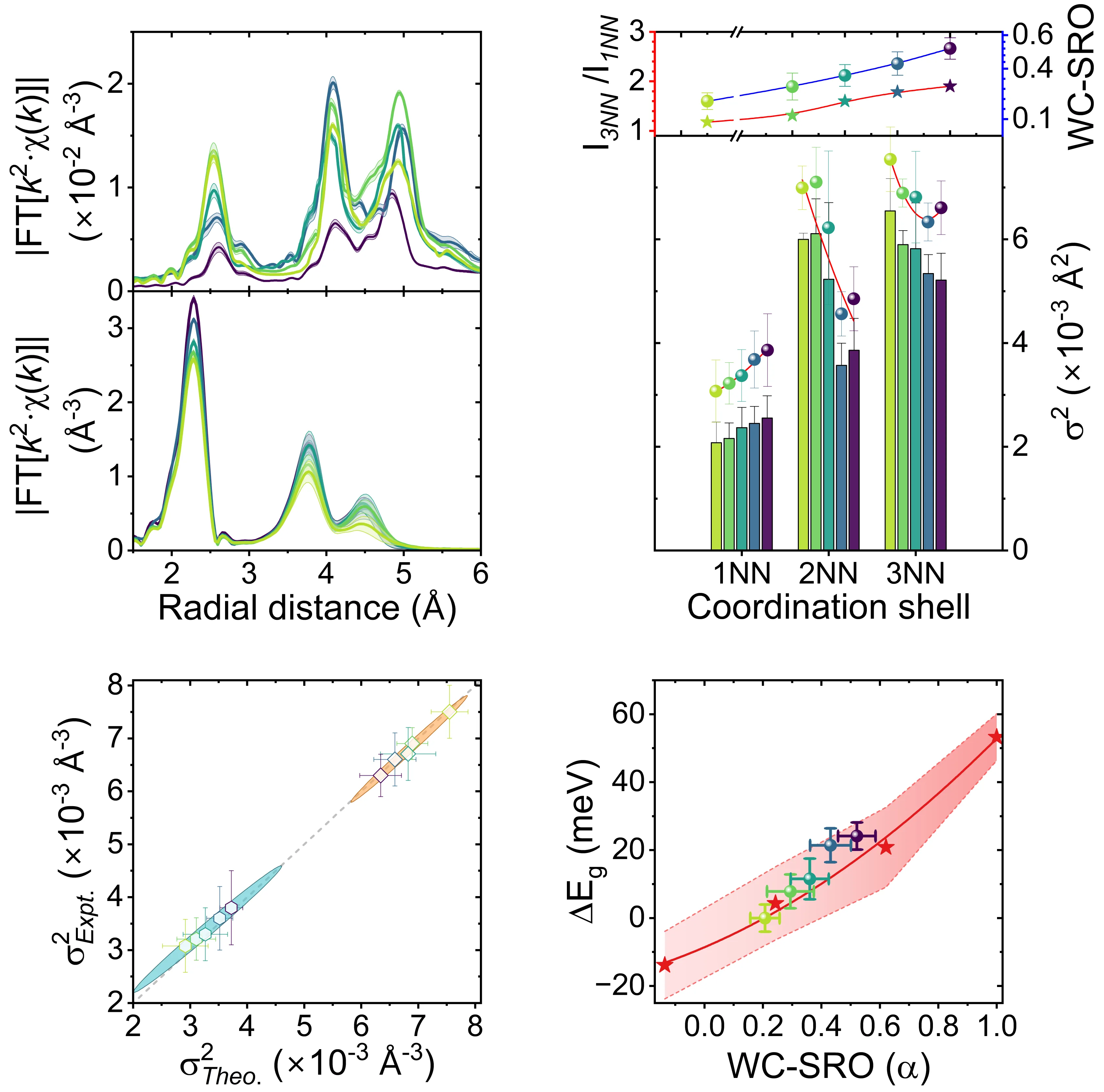
Until now, this step was adjusted in two ways: by changing the germanium-to-tin ratio or by stretching the crystal. The authors added a third way: they heated the crystal after growth, and the atoms rearranged themselves into a more ordered pattern. Using X-ray radiation and machine learning, they calculated how strongly the order affects the glow.
It turned out that ordering shifts the color of the glow — the crystal starts emitting light with a different energy. It's as if the same mosaic began to glow green or yellow depending on how the tiles are arranged. Now engineers have a new tool for fine-tuning semiconductor lasers and LEDs.
Original abstract
as written by the authors arXiv:2603.27876
The functional properties of semiconductors are typically controlled by tailoring their chemical composition and their state of strain, and by controlling their long-range structural order, including the presence of extended defects such as dislocations. In addition to these approaches, theoretical predictions suggest that short-range order (SRO) of atoms in group-IV semiconductor alloys can modify the bandgap, a defining property of any semiconductor. Herein, a new machine learning enabled, computation-guided methodology for extended X-ray absorption fine structure (EXAFS) analysis of SRO is used to quantify the effects of local atomic order on the bandgap of germanium-tin (GeSn) alloy single crystal nanostructures with well-controlled strain and composition. Correlative analysis of EXAFS and photoluminescence (PL) establishes the relationship between bandgap and the Warren-Cowley short-range order (WC-SRO) parameter of the GeSn alloys. It is further demonstrated that SRO can be tuned over a broad range by post-deposition annealing of the alloy crystals. This work establishes control of SRO as an important design parameter for semiconducting properties and suggests the potential for quantitative measurement and tuning of SRO in other semiconductor alloy systems.
Germanium and tin are neighbors in the periodic table, but their atoms differ greatly in size, so even small rearrangements in their positions noticeably affect properties.