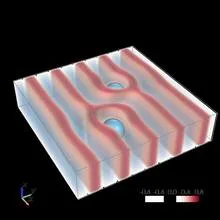
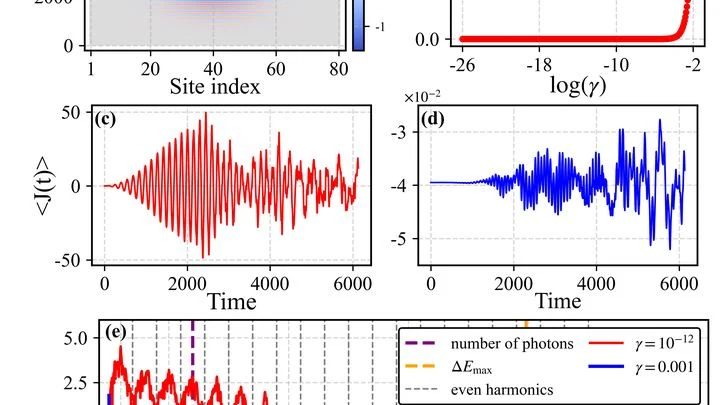
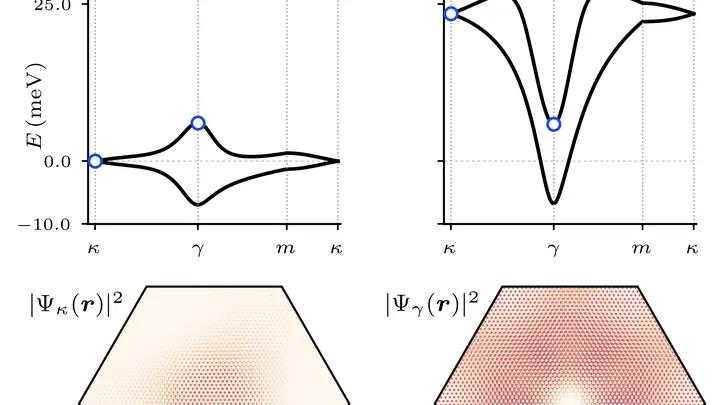
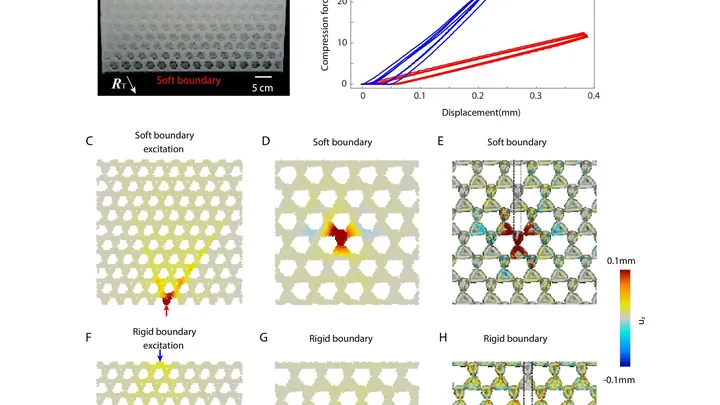
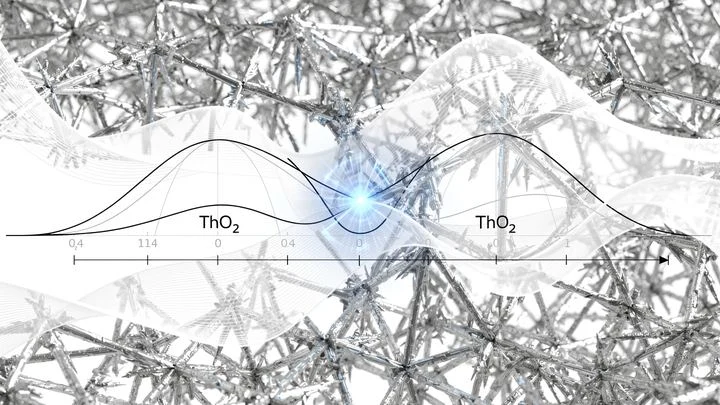
Imagine that electrons in a solid are like bees in a large hive. They can only fly on certain 'floors' or 'combs'. These allowed levels are called bands. The band structure is a map showing which energy floors electrons can occupy, and where they are forbidden to appear—these are forbidden bands. It's like in a multi-story building, some floors are occupied, and others are completely empty.
History
Felix Bloch in 1928, applying the Schrödinger equation to a periodic potential, derived the form of the wave function and laid the foundations of band theory. In the 1930s, Brillouin developed the concept of Brillouin zones. Later, W. Shockley, J. Bardeen, and others used band structure to explain semiconductor properties. Erwin Schrödinger, whose equation underlies the calculations, is a key figure.
How it works
Band structure arises from solving the stationary Schrödinger equation for an electron in a periodic crystal potential V(r)=V(r+R). The energy spectrum E(k) is a multivalued function in reciprocal space. Near band extrema, the energy is often approximated by a quadratic dependence: E(k) ≈ (ħ^2/2m*)(k - k0)^2, where m* is the effective mass. According to the Pauli principle, electrons fill states from low energies up to the Fermi level. Optical properties are determined by direct and indirect transitions across the band gap with absorption or emission of photons, which is described by conservation of energy and momentum.
Fun fact
Thanks to band structure, some materials shine like metals (they have no forbidden band), while others are transparent, like glass (the forbidden band is too large for visible light). That's why metals conductelectricity, and plastic doesn't.
A layered cake of molybdenum disulfide MoS2 sits on the lab bench. It is prepared in the usual way: adhesive tape peels off the top layers to obtain a thin sample. But beneath the tape remains an invisible cavity where the atomic floors are no longer pressed together. It is there that electrons begin to behave differently than in the crystal bulk.
In some crystals, electrons are not spread uniformly but arrange themselves into a strict checkerboard: one cell has more electrons, the neighboring cell has fewer. Such a pattern is called charge order, and for a long time it was considered something frozen, like a pattern on frosty glass.
Layered polymers resemble a multi-story building where each floor is painted a different color, and sometimes cracks appear between floors. These cracks are dislocation pairs, which are periodic irregularities that spoil the material. Engineers have long sought ways to control such defects without rebuilding the entire structure.
In a mountain range, there are trails that can be contracted to a point if you walk through a flat valley. But there are also loop routes that cannot be shrunk without crossing a ridge.
A cartographer receives a sheet with distances between hundreds of unnamed islands. No island is labeled, but the distances repeat, forming triangles and quadrilaterals. From these repetitions, the cartographer reconstructs the map of the archipelago, not knowing which island is which. This is roughly how the new work in molecular spectroscopy works.
Light born when a fast electron enters a material is usually assumed to be the same in all directions. But in crystals where optical properties depend on direction, that's not the case. Run your hand over velvet: one way it's smooth and shiny, the other — dark and rough. Similarly, a crystal responds differently to light depending on how it's oriented.
In a dark room, a spark jumps between two wires, and for an instant, there is light. Physicists have done something similar, but a million times smaller: at the boundary of two transparent crystals, they drew a conducting path and left a break just a few atoms wide. When a direct voltage was applied across this tiny gap, it began to glow.
In a narrow corridor, people walk in rows rather than as a crowd. The number of rows depends on the width of the passage. In graphene, this corridor is a quantum point contact — a constriction where electrons move ballistically without scattering.
In a pot of water, microscopic spheres, colloidal particles, are floating. Each sphere is coated with long polymer chains that look like a brush and carries an electric charge. If you get the temperature and solution composition right, the spheres start arranging themselves into ordered patterns — crystals.
An empty dance floor where people occasionally appear. Each moves on their own, chaotically, with no connection to the others. But when the right music starts and the hall cools down a bit, the dancers suddenly begin to form long chains and move in unison. That's roughly how electrons behave in a dilute three-dimensional gas.
A guitar string plucked exactly at its middle produces only odd overtones. The same prohibition holds in symmetric crystals: when light knocks out electrons, their re-emitted radiation contains only odd harmonics. But physicists have found a way to bypass this rule — without shifting a single atom.
The secret is electric current.
In a crystal, electrons are not distributed randomly. Their waves obey the lattice symmetry, like ripples on water taking the shape of a hoop thrown into it. The new work shows that at high-symmetry points, this ripple must have nodes — places where electron density is strictly zero.
Hit a table, and the sound quickly fades. Elastic waves in solids usually behave like ripples on water: they spread from the source and die out. But there is a way to make them freeze in place — by creating a 'flat band' in the frequency spectrum. This is a range where waves lose their speed and pile up, like cars in a traffic jam.
In an ultrathin sheet of four-layer graphene, electrons can behave like a frozen liquid. When cooled strongly and subjected to an electric field, they stop darting around and line up into a regular pattern — a Wigner crystal. It's similar to how water droplets on a frosty morning turn into ice honeycombs.
A tuning fork struck once rings pure and long. But if you shake the fork itself while it sounds, the tone wavers and dies out quickly. Something similar happens to electrons in any piece of matter. Atoms in a lattice never stay put: thermal vibrations keep them jittering.
A mosaic of squares and triangles covers the floor without gaps, yet it never settles into a simple repeating pattern. Such a pattern is a quasicrystal — a solid where atoms are arranged not periodically but according to a pattern of several waves of different lengths. These waves are incommensurate with each other, and together they create long-range order.
Bending a sheet of paper is easy. But compressing it by pushing from the edge is a different story: the paper will crumple but barely transmit the force further. That's how ordinary elasticity works — deformation depends on where and how you press. The new three-dimensional lattice pushes this contrast to the limit.
A honeycomb made not of wax but of atoms is graphene — a flat crystal just one atom thick. Electrons in it are like runners at an intersection: they speed up here, slow down there, but never get stuck at the edge. Physicists call such a sheet "topologically trivial," meaning its edges are perfectly ordinary, with no special properties.
Now, let's knock out a single atom from the honeycomb.
A city at night: lights on in some windows, dark in others. If you connect with lines the windows that light up simultaneously, you get a web of connections. Researchers studied such a web in tiny brain organoids — living clusters of nerve cells grown in the lab.
Two sheets of tungsten diselenide (not carbon, but a compound of tungsten and selenium) are rotated relative to each other by a tiny angle, about 5 degrees. This creates a moiré pattern: an enlarged periodic lattice where electrons behave very differently than in a regular crystal.
A guitar string keeps vibrating even after the musician lets it go, and that vibration changes the sound the listener hears. Magnetic moments in a crystal behave much the same way: they align into a strict antiferromagnetic order (neighbors point in opposite directions), but they never completely freeze.
Musicians in an orchestra each play their own part, not hearing the others. In a perfect crystal of tungsten disulfide on graphene, excitons, bound electron-hole pairs, behave the same way: they barely mix due to a hidden symmetry called the valley. The energy levels of such a system resemble notes sorted into separate folders — the chaos is incomplete.
An electron dives into a crystal, changing its energy as it goes. In an ordinary lattice, it encounters a sequence of allowed bands and forbidden gaps — this is the ABC of semiconductors. But in a quasicrystal, the pattern of atoms never exactly repeats.
A surfer glides across the ocean surface until a big wave comes, and then they're flying forward. Similarly, a free electron interacts with light: usually the energy exchange is barely noticeable, but if the surrounding medium begins to oscillate rhythmically, each wave crest pushes the particle harder and harder.
A sheet of paper with square grid, one with diamond grid, and one with honeycomb — three different universes for an ant. Change the sheet, and the rules of movement change. That's roughly how electrons experience the crystal lattice: geometry dictates whether they become little magnets, superconductors, or something else. In ordinary materials, the lattice is as rigid as if engraved.
In a long corridor, a crowd of people tries to keep as far apart as possible. In a spacious hall, they would simply spread out, but here the walls squeeze them so tightly that they have to move single file, coordinating every step. Electrons in graphene layers twisted by a tiny angle behave in a similar way.
Electrons in a crystal are like cars on city streets: some race down avenues, others get stuck in traffic jams. In certain lattices, motion freezes entirely — velocity stops depending on energy, and electrons become "flat." This isn't a traffic jam but a special rhythm of the network where waves cancel each other out.
Imagine a carousel with two types of seats: some spin clockwise, others counterclockwise. If you push all of them at once, the carousel jerks but stays in place. That's how a Weyl semimetal crystal works: electrons are born in pairs—'left' and 'right'—and their contributions to current cancel each other, like two identical motors running in opposite directions.
Light hits a crystal and knocks an electron out of its rightful place. A void remains — a hole that behaves like a positive charge. The electron and hole attract each other and circle around one another, like a pair in a slow dance. Such a pair is called an exciton (from the word "excitation").
But this dance is not in a vacuum.
A quantum particle traveling around a closed ring leaves two distinct 'records' along its path. The first is like a fingerprint on a doorknob: it remains unchanged no matter how many times you turn the knob, and it only tells you about the shape and material.
A rubber band that gets thicker the harder you pull it. In electricity, this behavior is called negative capacitance: the more charge accumulates on the plates, the lower the voltage. A regular capacitor works the opposite way — voltage rises with charge.
A crystal is like a row of soldiers on a parade ground: every atom is in its place, and electrons march through it in neat waves. An amorphous material is like a crowd at a train station, where there is no order, just a jostling throng. In such a crowd, an electron usually gets stuck quickly, like a person trying to push through a dense mass of people.
Sunlight hits a silicon wafer, and a current flows in the circuit. That's the familiar work of a solar cell: light knocks out electrons, and a p–n junction (the boundary between two layers with different conductivities) forces them to move in one direction. But in some crystals, current arises differently — without any junctions, purely from the material's internal structure.
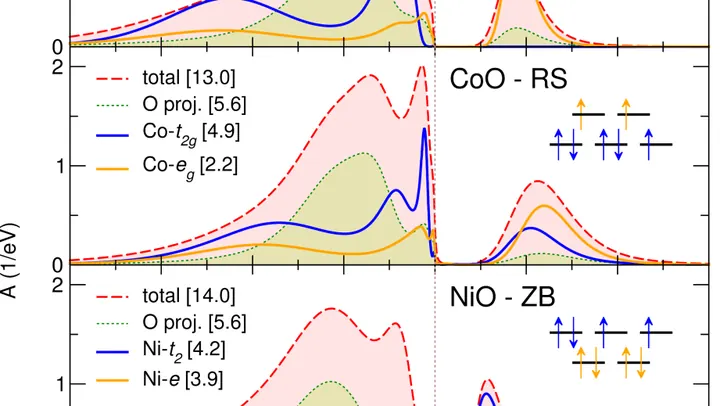
If you change not the composition but only the arrangement of atoms, you can make the same material conduct electricity or absorb light differently. That's exactly what the authors did with nickel and cobalt oxides. In one case, atoms are stacked like balls in a cubic box: each metal atom is surrounded by six oxygen atoms (rock salt structure).
The La3Ni2O7 crystal resembles a layered pie, where the filling of nickel and oxygen atoms alternates with lanthanum layers. At ambient pressure, it does not conduct without resistance, but squeeze it or grow it as a thin film, and high-temperature superconductivity emerges.
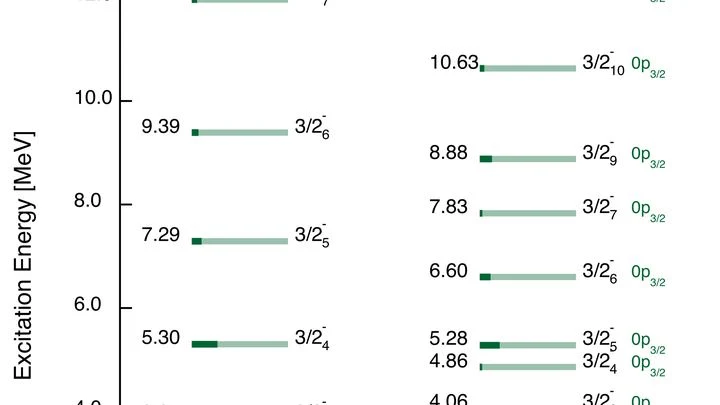
Imagine a multi-story building where protons and neutrons live on each floor. The floors are energy levels, and usually there's a stairwell of a certain height between the sixth floor and the one above — the so-called gap. In the oxygen-20 nucleus, this gap acts as a barrier that particles find hard to cross.
Hundreds of people on a dance floor stand at equal distances from each other — strict order, like in a crystal lattice. Slow music is thermal vibrations, making dancers sway slightly. If the music gets louder and faster, order collapses: everyone mixes. That's how thermal motion destroys ordered states of electrons in solids.
A single-atom-thick sheet of tungsten telluride is like thin foil: electrons can't pass through because there's a band gap between their possible states, like a moat you can't jump across. Add two more layers, and the moat disappears; the material becomes a metal, and current flows. Add more layers, and the properties change again, as if someone is flipping modes with a single button.
An ordinary crystal is like an apartment building: electrons move through shared hallways and staircases, influencing each other through the walls. Now, imagine removing all the walls, leaving just a single line of apartments. How would the residents behave?
Hydrogen has nothing to do with it, but the collective behavior of electrons takes center stage.