concept

long range order

A state where a property like magnetization is correlated over macroscopic distances in a material.
10 related articles

Description

Long-range order refers to a state in a material where a physical property, such as magnetization or atomic arrangement, is correlated over macroscopic distances — meaning the property at one point is linked to the property at a point far away, across the entire sample. This is in contrast to short-range order, where correlations decay quickly with distance. Long-range order is the defining feature of many phases of matter, including ferromagnets, crystals, and superconductors.

History

The concept was formalized in the early 20th century, particularly through the work of Landau on phase transitions and Onsager's exact solution of the 2D Ising model in 1944, which demonstrated how long-range order arises from microscopic interactions.

How it works

Long-range order emerges when interactions between particles (such as exchange interactions in magnets or interatomic forces in crystals) are strong enough to overcome thermal fluctuations. At low temperatures, the system collectively settles into a state where the order parameter (e.g., magnetization) is uniform across the sample. This collective behavior is described by spontaneous symmetry breaking, where the system chooses a particular orientation or arrangement even though the underlying laws are symmetric.

In practice

Long-range order is essential for technologies like magnetic storage (hard drives) and superconductors, where the macroscopic coherence of the order parameter enables practical applications.

Fun fact

In a ferromagnet, the magnetization direction is the same across the entire sample, but if you heat it above the Curie temperature, long-range order is destroyed and the material becomes paramagnetic.
Concept graph →

Related articles · 10

High Energy2026-08-082 minarXiv:2608.08243express
Radio Beacons with a Minute-Long Rhythm: Who Lights Them Up
A lighthouse that blinks not every second but once every few minutes or even hours. That is exactly how long-period radio transients behave — cosmic sources discovered only recently.
Strongly Correlated2026-06-252 minarXiv:2606.27422express
Magnetism on a Curved Sheet of Paper
A thin magnetic film is like a row of toy soldiers with tiny magnetic arrows. In the flat world, thermal jostling quickly disrupts this formation — even the slightest heating destroys the order. This is the Mermin–Wagner prohibition: in two dimensions, continuous symmetry cannot survive at finite temperature.
Quantum Physics2026-06-021 minarXiv:2606.03676express
Magnet in Superposition: Quantum Compass
An ordinary magnet is like a compass: its needle points north. But a quantum compass can look in both directions at once. If a magnet floating in a vacuum is gently spun, its electron 'tops' synchronize so the whole piece of metal starts living by the rules of the microworld — freezes in a superposition, like a split pointer.
Quantum Physics2026-05-141 minarXiv:2605.15200express
An Ordered Crystal That Can't Be Assembled from Bricks
An infinite chain of atoms spaced at equal intervals. Shift the entire chain by one step, and the picture doesn't change. That's translational symmetry: the world looks the same wherever you look. You'd think such a simple rule would give rise to simple states, like a crystal lattice assembled from identical building blocks. But the authors counted those blocks anew.
Materials2026-03-291 minarXiv:2603.27876express
Atomic Order Changes Crystal Color
A crystal of germanium with tin is like a mosaic where each tile is an atom. If you lay the tiles randomly, the mosaic has one color, but if you arrange them in a pattern, it has another. Physicists measured how the atomic pattern changes a semiconductor's most important property: its band gap, that is, the energy needed to get an electron moving and creating current.
Materials2026-03-221 minarXiv:2603.21207express
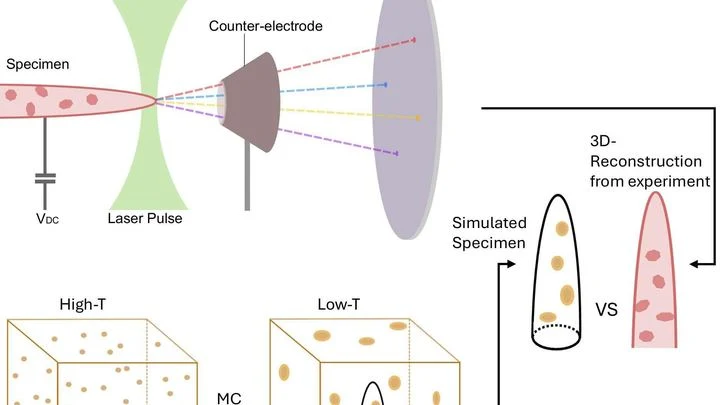
How a Seven-Metal Alloy Develops a Memory
A seven-metal alloy is like a team where every player is pulling the blanket their own way. Atoms of iron, cobalt, nickel, aluminum, titanium, tantalum, and vanadium can either fall into a strict pattern or scatter into random positions. This determines whether the material will be as strong as steel or as light as aluminum.
Mesoscale2026-03-191 minarXiv:2603.18823express
Current flows one way without a magnet
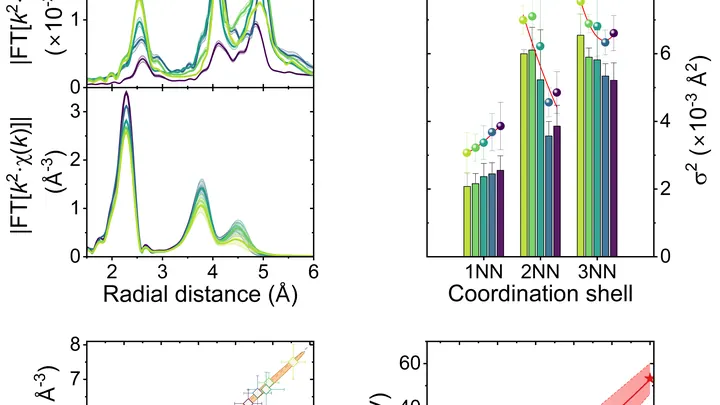
Normally, current flows equally well in both directions if there's no magnet. A magnetic field or magnetic material breaks that symmetry: electrons start to prefer one direction. But in a new study, physicists found a way to do without magnets. In a crystal, atoms may not sit perfectly ordered but with some disorder.
Materials2026-03-192 minarXiv:2603.18906express
Magnetic Islands Inside a Crystal
A crystal does not grow as a single whole but like a city of neighborhoods — grains. In each neighborhood, atoms are arranged in their own way, and the boundaries between them are like streets.
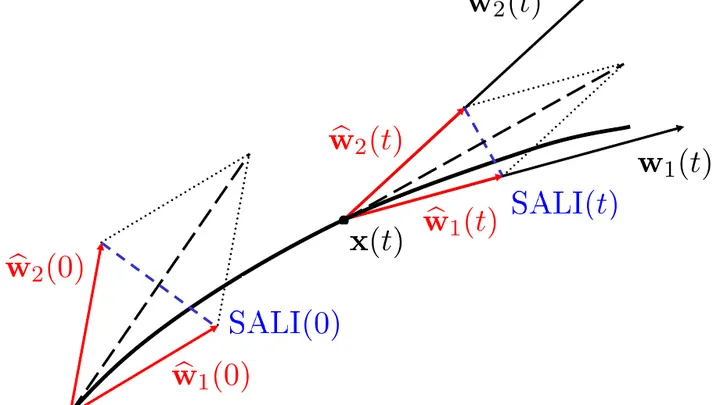
Chaotic Dynamics2026-02-072 minarXiv:2602.07660express
How to Tell Chaos from Order by a Particle's Trail
Drop a stone into a calm pond — the ripples spread evenly. Drop it into a churning stream — the water swirls unpredictably. Scientists have long wrestled with a similar question: how can you tell from a single particle's path whether its motion is chaotic? Previously, this meant comparing the particle's path with neighboring ones, which is complicated and time-consuming.
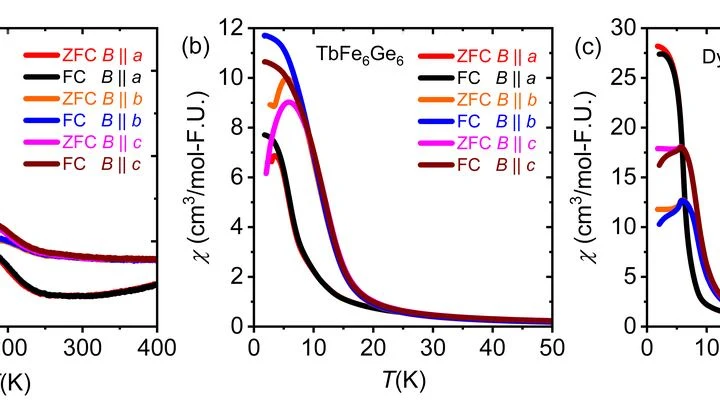
Materials2025-11-211 minarXiv:2511.17398express
Magnetic Lego: Unexpected Flexibility in Atomic Layers
Imagine a stack of pancakes where each pancake is magnetized, but the magnetization directions in adjacent pancakes are opposite. That's exactly how this new magnetic material is arranged: in each atomic layer, all magnetic moments — the atom's 'arrows'—point in one direction, while the next layer is magnetized in the opposite direction.