An order parameter is a physical quantity that characterizes the degree of order in a system and distinguishes different phases of matter. It is typically zero in a disordered, high-symmetry phase (like a liquid) and non-zero in an ordered, low-symmetry phase (like a crystal). The concept is central to the theory of phase transitions, where the order parameter changes continuously or discontinuously as the system transitions between phases. Examples include magnetization in ferromagnets, density difference in liquid-gas transitions, and the superconducting gap in superconductors.
History
The concept of an order parameter was formalized by Lev Landau in the 1930s as part of his theory of phase transitions, which he developed to describe second-order transitions. Landau's phenomenological approach was later extended by Vitaly Ginzburg and others to include spatial variations, leading to the Ginzburg-Landau theory of superconductivity.
How it works
The order parameter is defined so that it captures the essential symmetry breaking that occurs at a phase transition. For instance, in a ferromagnet, the order parameter is the net magnetization, which is zero above the Curie temperature (random spins) and non-zero below it (aligned spins). In a superconductor, the order parameter is a complex number representing the macroscopic wavefunction of Cooper pairs; its magnitude is zero in the normal state and non-zero in the superconducting state. The behavior of the order parameter near the critical point determines the universality class of the transition.
In the 2012 Nobel Prize-winning discovery of the Higgs boson, the Higgs field's vacuum expectation value acts as an order parameter for the electroweak symmetry breaking, giving mass to elementary particles.
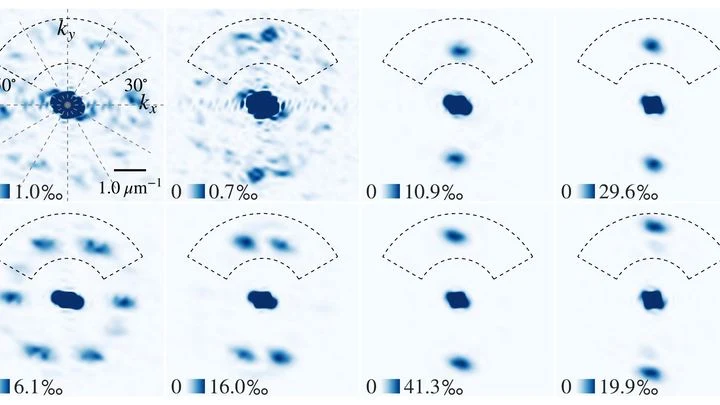
Two dancers on one stage: the triangle and the stripe. In a quantum gas of dysprosium atoms cooled to 62 nanokelvin, these two spatial structures have met for the first time in a single experiment. The gas is held in a trap shaped like a surfboard, and its atoms are among the most magnetic in the periodic table.
In quantum field theory, there is a long-standing mystery: infrared divergences. Usually they are seen as an annoying technical nuisance that must be carefully 'papered over' in calculations. But what if this is not a bug, but a feature?
If you carry a cup of coffee slowly and steadily around a room and then return to the same spot, nothing happens to the drink. But in the quantum world, things are different: a particle that makes such a loop comes back not quite the same. It picks up an elusive 'extra'—the geometric phase, which physicists call the Berry phase.
If you check where an electron is every second, its quantum properties change. It's like a child playing hide-and-seek but constantly being called by name: they freeze and stop running. In the particle world, such a "caller" is a measurement. It prevents particles from freely forming a shared quantum state, or entanglement.
If you drop an ice cube into a glass of water, it will float until it melts. But if you cool the water slowly, at some point it all freezes at once: that's a first-order phase transition: abrupt, with a clear boundary.
An orchestra without a conductor is playing, and suddenly, without any visible cue, the violins grow louder and the woodwinds shift slightly in time. From the outside, nothing seems to have changed, but inside the ensemble, a regrouping has occurred. This is roughly how small physical systems behave during so-called third-order pseudotransitions.
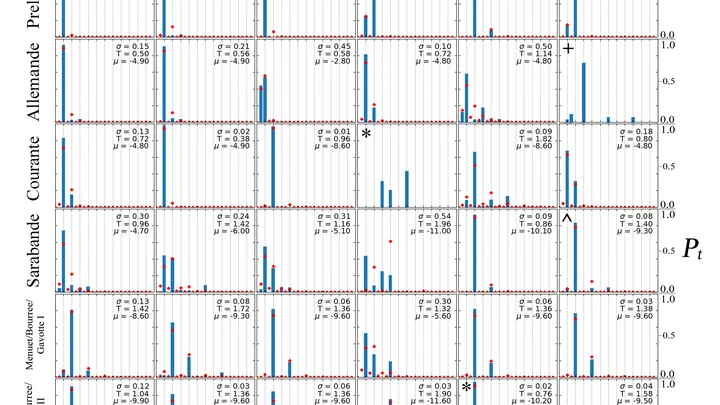
Music relies on repetition: we expect the beat to return, like a chorus coming back. But if you repeat the same thing for too long, it gets boring. The composer seems to walk a tightrope between the familiar and the unexpected.
Scientists translated this balance into the language of physics.
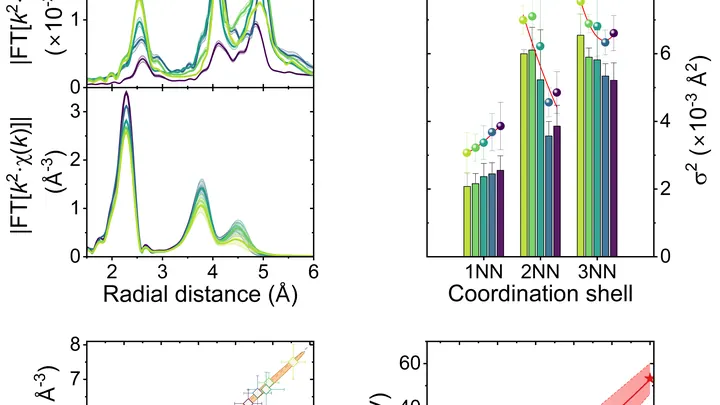
A crystal of germanium with tin is like a mosaic where each tile is an atom. If you lay the tiles randomly, the mosaic has one color, but if you arrange them in a pattern, it has another. Physicists measured how the atomic pattern changes a semiconductor's most important property: its band gap, that is, the energy needed to get an electron moving and creating current.
The quantum world loves order, but reality often brings disorder. In this work, physicists study one-dimensional chains of spins — tiny magnetic arrows that can point up or down. Usually, topological phases (stable states protected by symmetry) are defined for pure states, where each arrow is precisely known.
Cells on the surface of an embryo resemble grains of rice that can align in one direction. This order is called nematic. It arises when cells start acting in concert, like a school of fish swimming in the same direction.
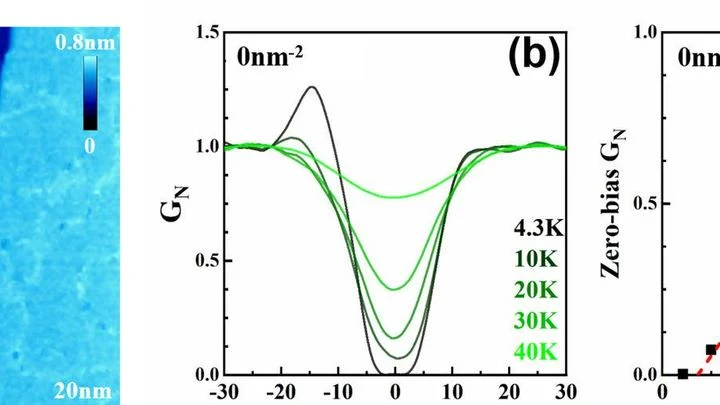
A superconductor carries current without loss, like a perfectly smooth road where cars glide with no friction. But what if you scatter rocks and potholes across that road? Scientists decided to find out by adding disorder to a superconducting material just one atom thick.
A magnetic film divided into tiny arrow-shaped cells behaves like a crowd in a square. While it's cold, all arrows point in the same direction — perfect order. Heat the film, and the arrows start darting around like pedestrians who have lost their purpose. Somewhere between these extremes, there is a moment when the system stops being uniform but hasn't yet dissolved into random noise.
The crystal CeRh₂As₂ behaves like a switch: cool it down and it becomes a superconductor, then bring a magnet close and it abruptly jumps to another superconducting state. Such behavior is rare: most superconductors have only one state, but here there are two, separated by a sharp boundary.
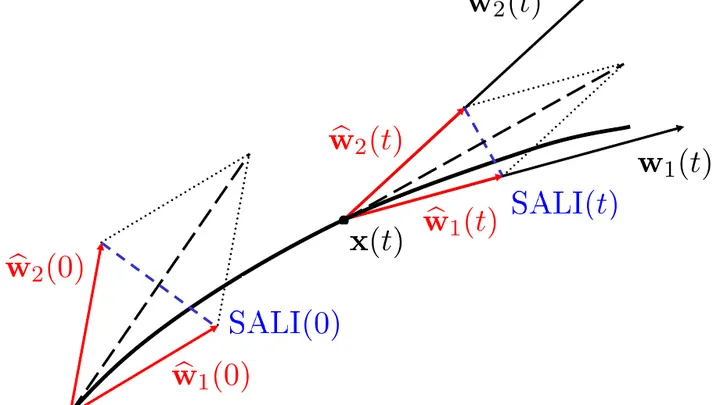
Drop a stone into a calm pond — the ripples spread evenly. Drop it into a churning stream — the water swirls unpredictably. Scientists have long wrestled with a similar question: how can you tell from a single particle's path whether its motion is chaotic? Previously, this meant comparing the particle's path with neighboring ones, which is complicated and time-consuming.
An orchestra without a conductor plays a complex piece. The listener hears the overall music but wants to understand who leads the melody and who merely echoes it in unison.