A Rocky Planet Around a Red Dwarf express
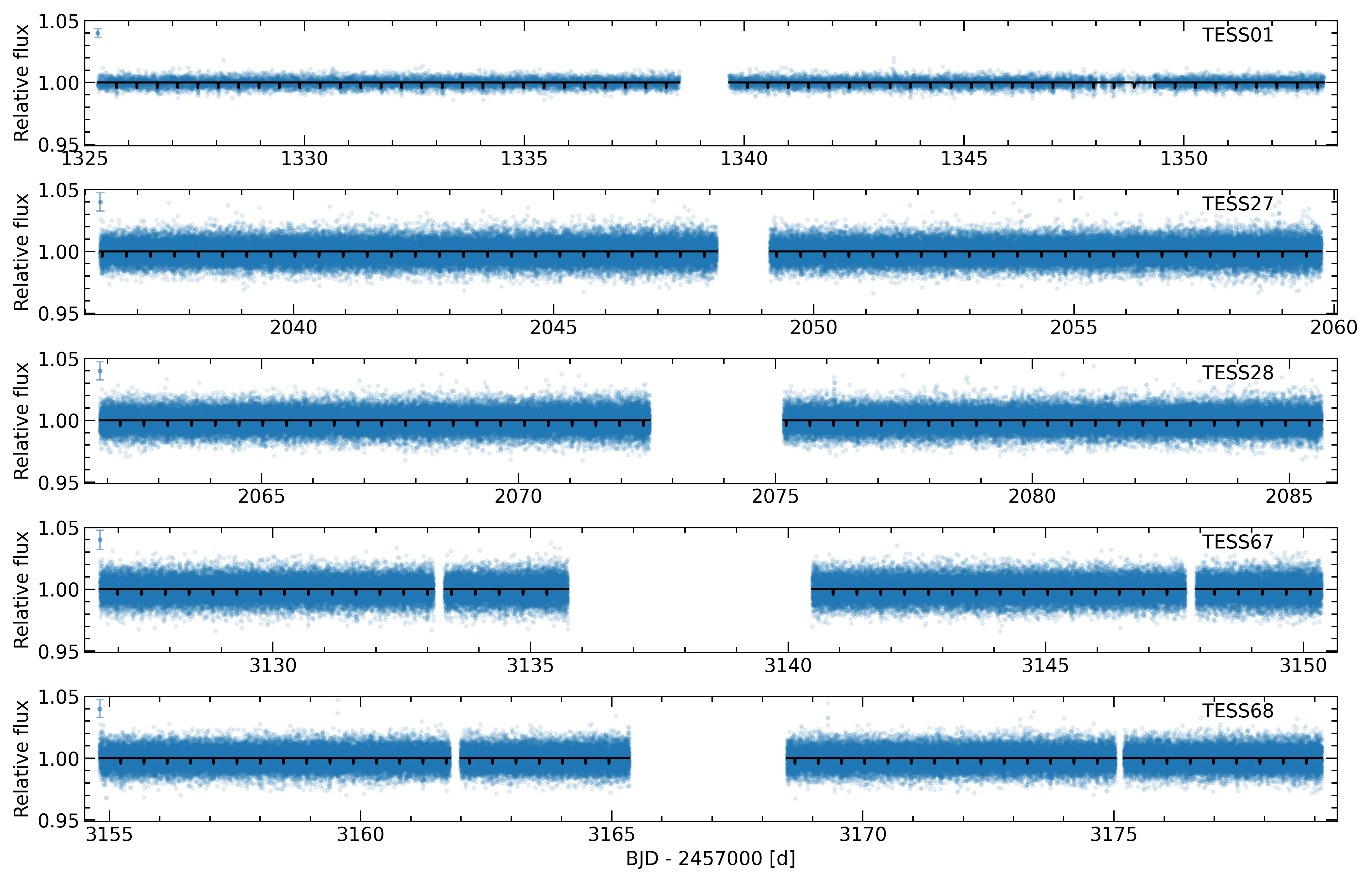
The tiny star LHS 3844 is trembling. The invisible culprit is a rocky planet that whips around it every 11 hours. The planet pulls on the star, and the star responds with a barely perceptible wobble. Detecting that wobble is like noticing a 100-kilogram weightlifter step forward when a fly lands on his palm.
To sense such a tremor, astronomers used the new CRIRES+ instrument on the Very Large Telescope in Chile. It observes in infrared light — the invisible heat radiation in which cool red stars like LHS 3844 shine brightest. The instrument tracks how lines in the star's spectrum shift back and forth, just as an ambulance siren changes pitch as it speeds past. From these shifts, they calculated that the planet weighs as much as 2.37 Earths and is only 29% larger in size. That means it's dense and rocky inside, like Earth, not a gas ball.
But there's a mystery: the star wobbles slightly more than a single planet should cause. Perhaps a second rocky world, completing an orbit every 6.88 days, is hiding nearby. For now it's just a hint, but if confirmed, the system becomes even more intriguing.
The real value of this discovery lies elsewhere. LHS 3844 b is the best known target for the James Webb Space Telescope. With no thick atmosphere, the telescope could directly observe its surface — what kind of rock it's made of. That would be the first time we see minerals on another planet. So a star's wobble turns into a map of a foreign world.
Original abstract
as written by the authors arXiv:2603.28238
We present the first planet mass measurement obtained with CRIRES+ radial velocity (RV) observations using the K-band gas cell. Our target, LHS 3844 b (TOI-136), is a transiting super-Earth with radius $$R_b=1.286^{+0.043}_{-0.044}R_\oplus$$ and an orbital period of $$P_b = 0.462929709^{+0.000000044}_{-0.000000042}$$d, placing it in the class of ultra-short-period (USP) planets. The host star LHS 3844 is an old ($$7.8\pm1.6$$Gyr), slowly rotating ($$P_{rot} = 130.0^{+16.9}_{-13.4}$$d) M5.0 dwarf with $$M_\star = 0.151\pm0.014M_\odot$$ at a distance of 15pc (V=15.2mag, K=9.2mag). Combining our CRIRES+ RVs with archival ESPRESSO spectra, and confirming the signal in each dataset independently, we detected periodic RV variations with a semi-amplitude $$K_b=6.95^{+0.55}_{-0.60}$$m/s, implying a planetary mass of $$m_b = 2.37\pm0.25M_\oplus$$ and a bulk density of $$\rho_b = 6.15^{+0.60}_{-0.61}$$gcm$$^{-3}$$, consistent with a predominantly rocky composition. We further found excess RV variability that may be attributed to stellar jitter or to an additional planetary signal, for which we identified a tentative super-Earth candidate with a period of $$\approx6.88$$d. Owing to its proximity to its M-dwarf host, LHS 3844 b experiences intense irradiation and is unlikely to retain a substantial H/He envelope. Interior modeling places an upper limit on the iron-core mass fraction, which is consistent with an Earth-like rocky composition. With an emission spectroscopy metric of 28, LHS 3844 b is a prime JWST target for atmospheric and surface characterization and the most promising surface-characterization target known. Phase-curve spectroscopy may reveal its surface mineralogy and enable the first robust detection of exoplanet surface spectral features. Our results demonstrate that near-infrared RVs obtained with CRIRES+ enable robust mass measurements of super-Earths orbiting late M dwarfs.
A year on LHS 3844 b lasts 11 hours and 6 minutes — shorter than a full workday with lunch break on Earth.
In Stanislaw Lem's novel Solaris, a planet-ocean also torments researchers — though there, it's the ocean studying humans, while here we may finally study a rocky surface.