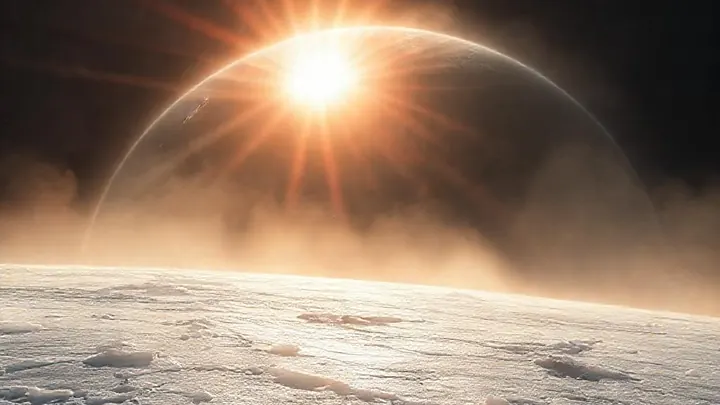
TRAPPIST-1 is an ultracool dwarf star, a type of star much smaller and cooler than the Sun, located about 40 light-years away in the constellation Aquarius. It is famous for hosting a remarkable system of seven Earth-sizedplanets, all of which orbit very close to the star. This makes the system a prime target for studying rocky worlds beyond our solar system, especially their atmospheres and potential habitability.
History
The system was discovered in 2016 by a team led by Michaël Gillon using the TRAPPIST telescope in Chile. The name TRAPPIST comes from the telescope's acronym, which stands for TransitingPlanets and Planetesimals Small Telescope.
How it works
The star is so dim and small that its habitable zone — the region where liquid water could exist on a planet's surface — lies very close to it. The seven planets are packed into a region smaller than Mercury's orbit around the Sun. Because the star is faint, the planets are not overwhelmed by its light, allowing telescopes to analyze their atmospheres by studying starlight that passes through them during transits.
In practice
The system is a key target for the James Webb Space Telescope, which can search for atmospheric molecules like water, methane, and carbon dioxide on these planets, helping to assess their potential to support life.
Fun fact
All seven planets in the TRAPPIST-1 system are in a resonant chain, meaning their orbital periods are linked in exact ratios, so they regularly align in a repeating pattern.
The orchestra is playing fortissimo, and someone in the third row is whispering. Hearing that whisper is the challenge astronomers face at the star HR 8799: four bright giant planets drown out the faint light of a possible fifth, hidden very close to the star.
The HR 8799 system is a proving ground for direct exoplanet imaging.
In a dense cloud of gas and dust where massive stars are born, two young stars recently passed very close to each other. Their dance has lasted only about sixty years, and astronomers have now seen it in detail for the first time.
Every five hours in the binary system IPHAS J190812.63+045728.1, one star completely hides the other. For 18 minutes, the white dwarf and its scorching disk vanish from sight, leaving only a modest red neighbor in the dark. This is a natural shutter that switches off the spotlight to reveal what usually hides in its glare.
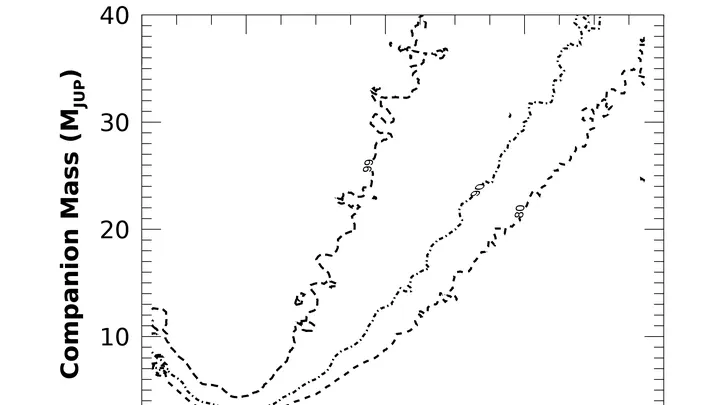
The family album of this stellar pair has been filling up for 45 years, but the pictures were blurry and the captions contradictory. Now astronomers have pulled out the old photographs, taken new sharp shots, and put everyone back in their proper places. Gamma Cephei is a bright star visible to the naked eye, and it has an invisible companion that orbits it every 70 years.
In the stellar family of the Phoenix galaxy, there are five old globular clusters, and the sixth child was long considered a foundling. The object Fornax 6, located just 270 parsecs from the galaxy's center, looked like a random clump of field stars or a compact group of distant galaxies. Astronomers argued over whether it deserved to be called a cluster.
Forty light-years away lives a star that went unnoticed for a long time: TRAPPIST-1 emits two thousand times less light than the Sun. But it turned out to have seven Earth-sized planets, three of which orbit in the zone where water could remain liquid. Yet little was known about the star itself, about its chemical kitchen.
On a sunny street, there's a house with a big family: a giant father who always sits by the window and a small child running around the yard. That's the TOI-4468 system: a gas giant hot Jupiter hugs the star, while a bit farther out circles a sub-Neptune — a planet smaller than Neptune but larger than Earth.
In the dense galaxy cluster Abell 2744, where gravity bends light like a lens, the James Webb Space Telescope spotted a new point of light. It appeared in images from 2023 and then began to change brightness. It was a supernova, the explosion of a dying star, but not just any kind: a Type IIP.
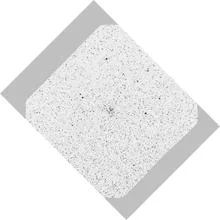
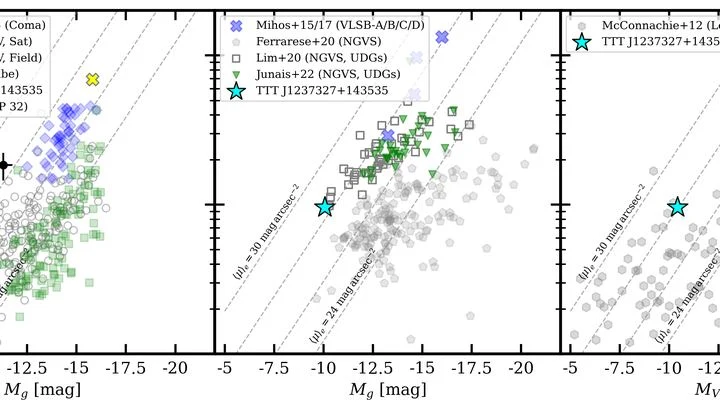
The night sky only looks black: telescopes reveal millions of galaxies, but some are so dim they blend into the background. Astronomers caught just such a "nearly invisible" one by chance while observing the Virgo Cluster with the two-meter telescope at Teide Observatory.
The galaxy is named TTT J1237327+143535.
Two stars, AF Lep A and ε Indi A, have become the focus of close attention. Using the GHOST spectrograph on the Gemini telescope, astronomers split their light into colors and, from absorption lines, determined how much carbon, oxygen, sulfur, and thirteen other elements are in the stars' atmospheres.
The night sky seems unchanging, but galaxies constantly exchange matter. The Milky Way, like a great river, absorbs smaller streams — dwarf galaxies. Along with their stars, planets may also come to us.
A distant light in the fog looks tiny and reddish: you'd think it's miles away. But then the light shifts sideways, and it becomes clear: it's a cyclist twenty steps away, just with a nearly dead rear light. That's how, in 2025, astronomers stumbled upon 'Capotauro'—a compact red source in images from the James Webb Space Telescope.
The night sky is like an ocean: the longer you stare, the more faint lights you notice in the depths. That's how astronomers, peering into the outskirts of the Milky Way, found Aquarius IV — a tiny stellar system that had been hiding in the dark until now.
The system was spotted in images from an early survey by the future Vera Rubin Observatory.
A star wrapped in an invisible blanket warms up more than it should. That's exactly how ten red dwarfs look, which astronomers from the Hephaistos project have been monitoring. These stars lie within 300 parsecs (about 1000 light-years) of us and emit far more infrared energy than their modest sizes can explain.
Edge of the spotlight. Remove the dazzling light of the central star, and a theater of shadows emerges. The James Webb coronagraph, like a dense curtain, hid the star TW Hydrae — and on a stage 120 astronomical units long (four times the distance to Neptune), its protoplanetary disk came alive.
Tabby's Star, a beacon in the cosmic sea, has baffled astronomers since 2015. Its light flickered not in the rhythm of planets, but as if scattered by a storm — deep dips, sharp spikes. But amid this chaos, a smooth, nearly perfect dip was found. The eye of the storm.
Every 165 days, the giant planet dives toward its star, nearly grazing its fiery corona, then flies off into the icy void. This is TIC 241249530 b — an exoplanet with a record eccentricity of 0,94.
A quarter-century ago, Michel Mayor and Didier Queloz discovered the first hot Jupiter, and shattered all the rules of planet formation. A gas giant on a days-long orbit couldn't have formed next to the star: it's far too hot and lacks building material. So, it must have been born far away and then migrated.
In 2024, the Hephaestus project sifted through millions of stars and flagged a few dozen suspicious ones: they shone brighter in the mid-infrared than a normal red dwarf should. Two of these candidates, labeled D and E, looked especially tantalizing, as if an invisible heater were working next to the star.
The light of a distant star is no perfect beacon. Passing through the gravitational field of another star, it bends, splits, and magnifies, creating a fleeting Einstein ring in the sky. This is how gravitational microlensing manifests, predicted by Fritz Zwicky back in the 1930s.
A ball, almost weightless for its size, circles its star every four days. Planet TOI-2195 A b is a real riddle: by mass it's slightly heavier than Neptune, yet bloated to Jovian volumes. If there were an ocean big enough, this exoplanet would float on its surface like a giant inflatable ball.
When a star dies, it turns into a white dwarf — a dense ball of carbon and oxygen the size of Earth. Predicted by Subrahmanyan Chandrasekhar, these objects were long thought to be lifeless graveyards.
The James Webb Space Telescope has peered into a strange binary world. Here, a dead star, a white dwarf, slowly roasts its companion, a brown dwarf. The object, named ZTFJ0038+2030, completes a full orbit in just a few hours. One side of the brown dwarf always faces the white dwarf, much like the Moon faces Earth.
Some 158 light-years away, around the dim star TOI-6894, a red dwarf, a planet moves leisurely. Its year lasts less than two Earth days, yet it is a cool world with an equilibrium temperature around 420 K, just a bit warmer than a sauna.
Using James Webb, astronomers 'fished out' a third giant planet from the murky dust disk of the star β Pictoris. Two others were already known, but this one was hiding in the bright light, like a fish in muddy water.
The planet WASP-121 b is a gas giant, heated to 2500°C. It always faces its star with one side, like a globe frozen under a lamp. But as it passes in front of the star's disk, its rotation reveals different facets to us — as if that globe were slowly turned, letting us peer into every corner.
A planet glides across a star's disk, and for a moment becomes a flashlight. It blocks a tiny patch of surface, revealing details that otherwise escape our view. That's exactly how astronomers peered into the dark spots on V1298 Tauri, a young twin of our Sun. They were aided by the James Webb Space Telescope JWST and three giant planets in orbit.
The atmosphere of Titan, discovered by Christiaan Huygens, is opaque to ordinary telescopes. But spectral analysis finds 'windows' of transparency — narrow regions where the haze parts.
Red dwarfs are tireless blacksmiths of planetary fate. Their radiation, like a hammer, beats off gas envelopes, leaving only naked rocky cores.
In the depths of the constellation Hercules, around the dim M-dwarf GJ 3929, orbits a world one-and-a-half times Earth's size, like a billet on an anvil.
In the orchestra of interstellar life search, every note counts. And the score here is dictated not by man, but by a distant star. For the planet TRAPPIST-1 e, one of seven in the system of an ultracool red dwarf, the conductor's baton is harsh ultraviolet light.
Astronomers using the JWST (James Webb Space Telescope) have for the first time studied in detail the atmosphere of a young exoplanet, V1298 Tau c. This super-Earth, a planet more massive than Earth but less so than gas giants, is only 23 million years old.
The cosmos is full of mimicry. The clearwing moth wears a wasp's mask, a harmless fly buzzes like a bee. And in the world of gravity, the role of impersonator is perhaps played by boson stars — colossal clumps of scalar field, indistinguishable from black holes.
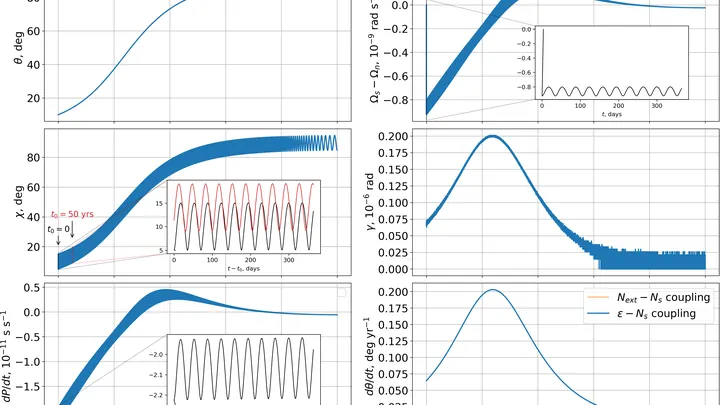
A spinning top that wobbles as it rotates: that's roughly how astronomers picture the neutron star in the binary system Hercules X-1. It completes one full turn on its axis every second, but its axis slowly traces a cone with a period of 35 days.
Planet WASP-121 b always shows the same face to its star, like a rock in a campfire. The dayside is so hot that ordinary hydrogen, the very stuff most of the universe is made of, can't take it: its molecules tear apart into individual atoms, and the temperature flips upside down: the higher you go, the hotter it gets.
A spinning top launched into weightlessness doesn't just rotate around its axis: it also wobbles, like a drunken sailor. That's exactly how the asteroid Apophis behaves: it doesn't spin neatly but tumbles through space. On April 13, 2029, this celestial wanderer will whiz past at about 38,000 kilometers from Earth — closer than communications satellites.
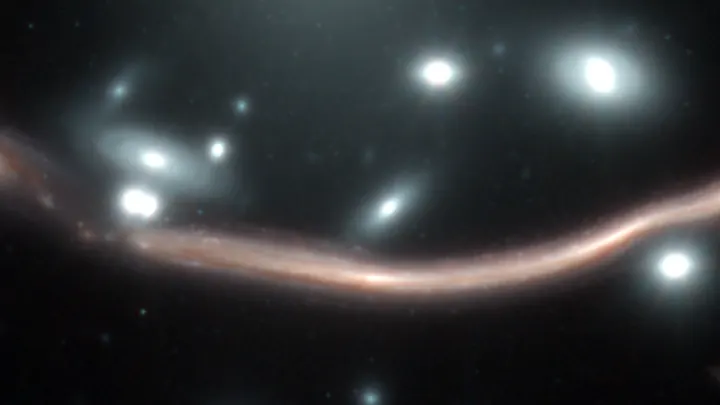
Light from the distant Dragon Galaxy has been traveling toward us for more than seven billion years. On its way, it passes by a huge galaxy cluster whose gravity bends the path of light like a lens. As a result, the galaxy appears brighter and larger than it really is, just as a magnifying glass enlarges fine print.
The carousel spins all the horses in one direction, but one stubbornly gallops against the flow. That's exactly how the planet TOI-1710 b behaves around its star. Using the HARPS-N and GIANO-B instruments, astronomers measured its tilt at 149 degrees. That's nearly a 180-degree flip, meaning the planet orbits "backward" relative to the star's rotation.
The TESS telescope photographed the sky for a full year, but its standard pipeline skipped over dim stars. The T16 project took the same images and cleaned them from scratch — resulting in 83,717,159 light curves, like EKGs for every star. Planets passing in front of their star briefly dim it, and these dips in the EKGs are what we look for.
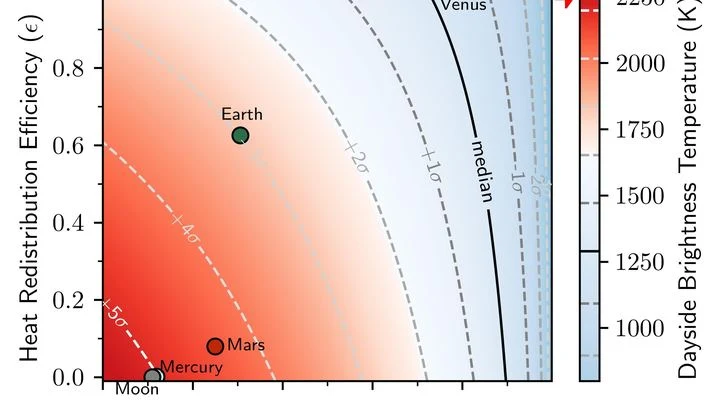
A hot skillet on the stove glows in the dark, but if you cover it with a lid, the heat escapes more slowly and the surface doesn't look as bright. That's roughly the situation on planet HD 3167 b: it always shows the same face to its star, and the dayside is heated to temperatures that melt rock.
In the open cluster Trumpler 5, where hundreds of stars move together, one star behaves like a teenager among elders. It pulsates — expanding and contracting, changing brightness every few hours.