Imagine you're standing on a platform and a train with a siren rushes past. When the train approaches, the siren sounds higher pitched, and when it moves away, lower. That is the Doppler effect! The frequency of sound changes due to the motion of the source. The same happens with light: if a star is moving toward us, its light 'blueshifts', and if it moves away, it 'reddens'. This is how scientists learn where distant galaxies are moving.
History
In 1842, Austrian physicist Christian Doppler theoretically described the dependence of frequency on the motion of the source and observer for sound and light in his work 'On the Color of Double Stars'. He mistakenly believed that all stars are white and their color is determined by motion. In 1845, Dutchman Buys Ballot experimentally confirmed the effect for sound using a locomotive and musicians. For light, the effect was first detected by William Huggins in 1868 by measuring a shift in the spectral lines of Sirius. The relativistic formula was derived by Albert Einstein in 1905 as a consequence of special relativity.
How it works
The effect arises because wave crests reach the receiver at different intervals during their mutual movement. In radar, a transmitted pulse reflects off a moving target — the speed is calculated from the frequency shift. In astrophysics, Doppler shift of spectral lines is the main method for measuring radial velocities. Limits of applicability: for sound — speeds much less than the speed of sound, otherwise shock waves occur; for light — the relativistic formula works at any speed up to the speed of light. At speeds close to the speed of light, transverse Doppler shift due to time dilation becomes significant.
Fun fact
The Doppler effect is used not only by astronomers but also by traffic police in radar guns! The device sends a radiowave, it reflects off the car, and by the change in frequency, they calculate the speed. If the frequency returns higher, you've exceeded the limit.
A spotlight with an adjustable beam width sweeps along the shore. Its light is the long ocean waves that are born in the surf zone and spread in both directions: toward the beach and out to the open sea. Previously, this spotlight was considered a point source, but the actual breaking zone, where short waves break, has a finite width, and it changes as the wave front advances and retreats.
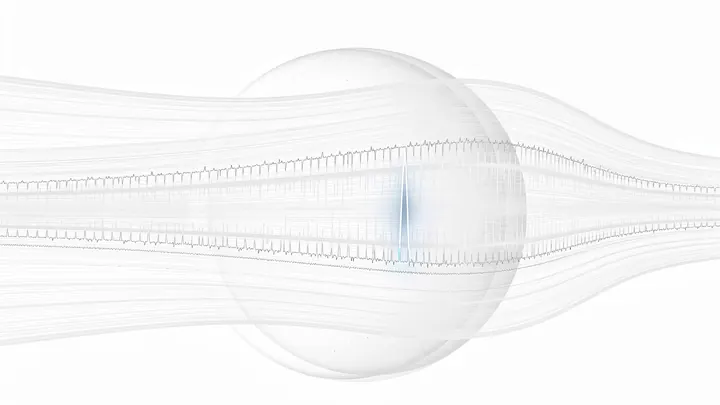
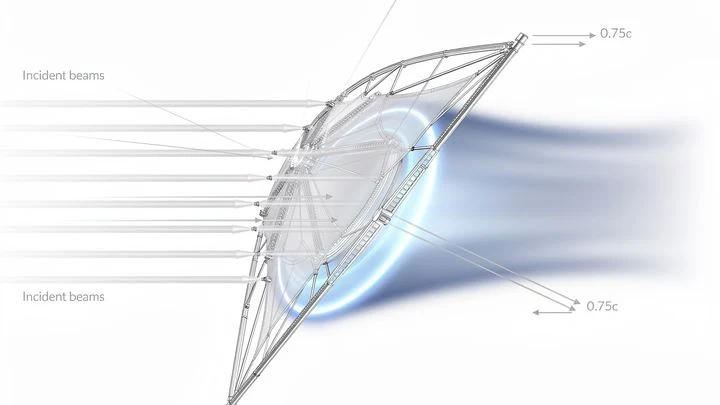
The mirror races along at nearly forty thousand kilometers per second. Light that strikes it bounces back, but changed, like a ball volleyed by a racket in mid-swing. That's exactly the kind of mirror scientists have built inside an ultra-thin glass thread filled with hydrogen.
First, a powerful laser pulse is sent down the fiber.
A cloud of waves collapses under its own gravity. While it's loose, everything goes by the book: the field oscillates gently in nearly flat space, and approximate formulas work perfectly. But add just a bit more energy, and the picture changes.
Physicists used a numerical model to catch the moment when simple calculations stop describing reality.
A planet in the habitable zone is no guarantee of life. Like a conductor leading an orchestra, a star dictates the tempo and character of planetary atmosphere evolution over billions of years.
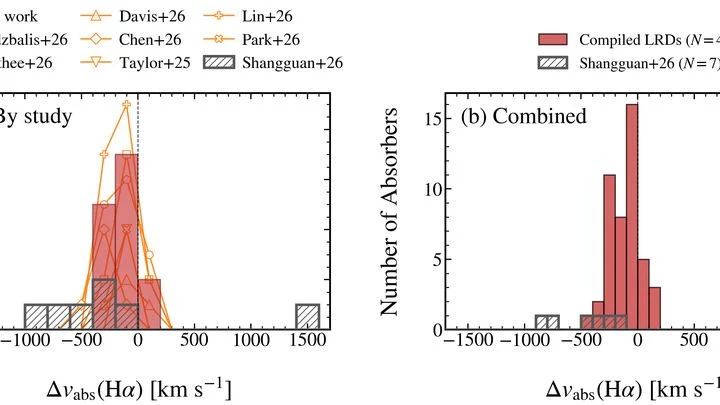
Forty reddish sparks frozen in the images from JWST. The telescope spotted them in the depths of space, at distances where the Universe was less than two billion years old. These objects are active galactic nuclei — very compact and unusually red. Their color earned them the nickname 'little red dots' (LRDs).
14 seconds. That’s all it takes for a new code to weave the full spectrum of a star, from ultraviolet to near-infrared. This spectrum is not just a rainbow but a detailed tapestry of thousands of dark absorption lines, each left by a specific atom in the star's atmosphere.
In 1,433 pairs of galaxies scattered across the sky, astronomers noticed an unusual pattern. Neighbors located 'above' or 'below' a massive stellar system contain up to a quarter more oxygen than those lying in the plane of its disk.
In the deep field of JWST, among thousands of galaxies, astronomers zoomed in on the source JADES-GS 209777 – and saw a cosmic chick. Its "shell" is a thick cocoon of gas and cosmic dust that long hid the growing black hole at its center. But at a redshift of 3,711 (1,8 billion years after the Big Bang), the shell began to crack.
Seventy-two protoplanetary disks, swirling cocoons of cosmic dust and gas, came under the gaze of the MIRI instrument on JWST. Most of them shoot outflows into space: dense conical structures and narrow, high-speed jets. They blast like fountains. This process is not accidental.
Light from quasar J0744+2052 traveled to us for almost 12 billion years. Along the way, it bumped into hydrogen clouds that snatched individual lines from the spectrum — like a comb sifting through delicate frequencies. Astronomers call this pattern the Lyman-alpha forest in spectroscopy.
The JWST spectrograph caught a barely perceptible dip in the spectrum of a distant galaxy — two lines, like shadows cast by cold gas. These are the sodium lines, the very yellow light of streetlamps. Here, at the edge of the visible Universe, they betray the slow exhalation of a galaxy returning matter to space.
Tabby's Star, a beacon in the cosmic sea, has baffled astronomers since 2015. Its light flickered not in the rhythm of planets, but as if scattered by a storm — deep dips, sharp spikes. But amid this chaos, a smooth, nearly perfect dip was found. The eye of the storm.
Ten billion years ago, the universe was speckled with strange crimson sparks. The JWST spotted them in images at distant redshifts — compact sources blazing like entire galaxies yet no larger than a tiny central region. Astronomers nicknamed them “little red dots.” Their nature long defied explanation.
An artist makes a quick charcoal sketch, and the face in the portrait is already recognizable. Astrophysicists face a similar challenge: the spectrum of a star is its individual portrait, revealing temperature, composition, and gravity.
For thirteen billion years, light battled through cosmic emptiness. It bent around massive galaxy clusters that, as Einstein predicted, acted as giant lenses — amplifying and distorting the distant glow. In 2023, the NIRSpec instrument on the James Webb Space Telescope captured this light and spread it into spectra.
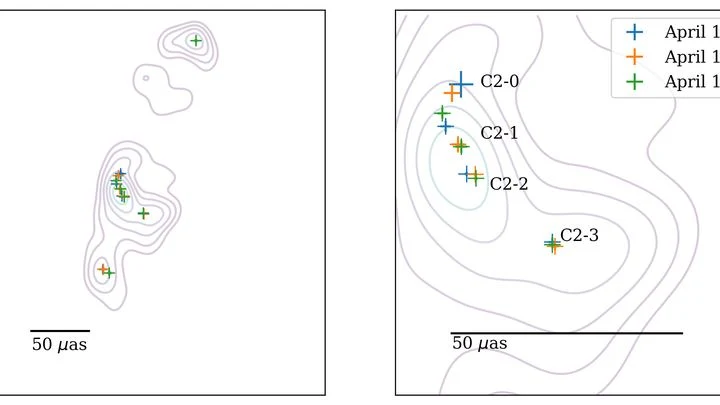
In April 2021, the antennas of the Event Horizon Telescope (EHT)—a global network of millimeter-wave radio telescopes — zeroed in on a tiny spot in the constellation Virgo.
A star's age is the key to the galaxy's history. But prying that key from nature is no simple task: unlike a tree, a star doesn't grow annual rings. Yet, its atmosphere holds a chemical code — the ratio of elements that slowly shifted as generations of stars died and new ones were born.
Communicating with a satellite is like trying to hear a whisper in a storm: the signal drowns in noise. Engineers have created an AI algorithm that runs directly on the satellite and, with minimal power consumption, detects distortions more accurately than previous methods.
Among the scorching exoplanets that circle perilously close to their stars lies the secret of their birth. Nearly three decades ago, Michel Mayor and Didier Queloz discovered the first such world, and since then astronomers have been tormented by the question: how does a gas giant end up pressed against…
In 2024, the team led by David Charbonneau pointed the Magellan telescope with the WINERED spectrograph at LHS 1140. During transit, high-resolution spectroscopy caught the absorption line of metastable helium at 10833 Å.
The light of a distant star carries within it the silent hum of the atmospheres of planets orbiting it. For a long time, capturing it was like trying to make out a whisper over a roaring waterfall. But with the advent of the 39-meter Extremely Large Telescope (ELT) and the ANDES spectrograph with a resolution of 100,000, this task is no longer hopeless.
A quarter-century ago, Michel Mayor and Didier Queloz discovered the first hot Jupiter, and shattered all the rules of planet formation. A gas giant on a days-long orbit couldn't have formed next to the star: it's far too hot and lacks building material. So, it must have been born far away and then migrated.
Gravitational waves from merging black holes sound like bass chords, pulsars tap out a rhythm, and the cosmic microwave background carries echoes of the Big Bang. But there is a silent player — dark matter, whose presence is betrayed only by gravitational effects.
The Orion Nebula is a showcase of astrophysics, a laboratory for studying star formation right in our backyard. For over a century, its light has been split into spectra, and each forbidden line whispers its own version of how many electrons per cubic centimeter.
Imagine an artist whose canvas is an entire planet, and whose palette is molecules drinking starlight. His brush is billions of years of evolution, and his painting is a spectral portrait visible even from another star system.
A tiny star spirals around a giant rotating black hole. Slowly, it moves closer in a spiral, and this dance lasts thousands of years. All the while, waves ripple through space, like ripples on water, but these are gravitational waves. They can be "heard" with special detectors.
The early Universe is often imagined as a nursery: most galaxies there are amorphous blobs, rowdy and irregular, choking on gas and bursts of star formation.
Massive gas outflows from active galactic nuclei are a key regulator of galactic evolution. They sweep out the interstellar medium, quench star formation, and dictate the growth of supermassive black holes.
Imagine a three-faced dancer on the crest of a light wave. One face is a catcher, absorbing incoming photons. The second is a perfect mirror, throwing light back. The third is frosted glass, scattering rays in all directions. As long as speed is low, the dance is harmonious. But at near-light speeds, the choreography breaks.
This is like a surfer chasing a wave.
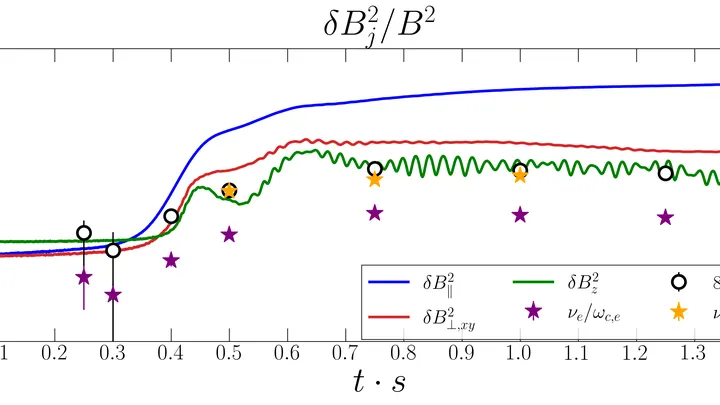
A crowd is trapped in a narrow corridor between two rows of mirrors. Every now and then, someone shoves the wall hard, and a rumble rolls down the corridor — similarly, in the plasma of galaxy clusters, whistler waves and ion-cyclotron waves appear.
Light loves symmetry: in an open channel, it flows equally both ways. To steer it one way, physicists often use magnets. A new approach does without, using rotation — just the speed of a vinyl record — and interference from two atoms. Rotation changes the “pitch” of light for different directions, just as a siren’s tone shifts when a car approaches or recedes.
An ordinary photometry detector can't tell a left photon from a right one. But let it start moving, and everything changes.
Imagine a rower moving between two flutists playing the same note. His ear is perfectly tuned to that note and ignores all others. As he moves, the pitch from the flutist ahead sounds higher, and from the one behind sounds lower.
A stone drops into a pond, and ripples spread across the water. If a protruding branch blocks the ripples' path, part of the wave reflects, and part bends around the obstacle. Gravitational waves, ripples in spacetime itself, behave similarly when passing by galaxy clusters or black holes.
In a water vortex swirling toward the drain, the flow speed near the center can exceed the speed of sound. Sound gets trapped: waves cannot escape back, forming a silent region — a sound shadow. Half a century ago, William Unruh realized that this is an exact copy of a black hole, but for sound instead of light.
A pebble tossed into a pond sends ripples spreading in all directions. Now imagine the pond itself suddenly turning into jelly — instantly, faster than the wave can complete a single crest. Some ripples would keep spreading but change their spacing, while others would unexpectedly turn around and run back toward the point of impact, as if time were flowing backward for them.
Cosmology holds that on large scales, the Universe is a calm ocean without storms or currents. This is the cosmological principle, the foundation of the standard ΛCDM cosmological model.
A swimmer cutting through water at the speed of the waves running on it finds themselves in a strange position: the waves they themselves generate can neither overtake them nor fall behind. They pile up at the swimmer's bow and freeze. A similar phenomenon occurs when a light source moves inside a medium at a speed matching the speed of energy transfer of the waves.
Above the Sun's surface hang long ribbons of glowing gas — streamers. They look like giant harps stretched across the corona. When a wave runs along such a ribbon, it trembles and bends like a string after being plucked.
For a long time, it was thought that only a very fast ejection of material, one traveling at more than 500 kilometers per second, could launch such a wave.