Red dwarfstars are the most common stars in the galaxy, and their planets are prime targets for exoplanet searches. These planets often orbit very close to their dim, cool parent stars, resulting in short orbital periods of days or even hours. Because the habitable zone around a red dwarf is so close, planets there are frequently tidally locked, with one hemisphere permanently facing the star and the other in eternal darkness. This creates extreme temperature contrasts and unique atmospheric circulation patterns.
History
The first confirmed exoplanet around a red dwarf, Gliese 876 b, was discovered in 1998 by a team led by Geoffrey Marcy and Paul Butler. Since then, surveys like MEarth and TRAPPIST have revealed many more, including the famous TRAPPIST-1 system with seven Earth-sizedplanets.
How it works
Red dwarfs are small and faint, so their gravitational pull is weaker than that of Sun-like stars, allowing planets to orbit very close without being destroyed. The close orbit means the planet's year is short, and tidal forces from the star can cause significant internal heating, a process called tidal dissipation. This heating can melt planetary interiors, drive volcanic activity, and even sustain subsurface oceans, as seen in some of the most intriguing exoplanet models.
In practice
Red dwarfplanets are the primary targets for upcoming missions like the James Webb Space Telescope, which will analyze their atmospheres for biosignatures, and they are also studied to understand tidal heating and orbital dynamics in extreme environments.
Fun fact
Because red dwarfs are so dim, a planet in their habitable zone would have its star appearing as a large, glowing red disk in the sky, and the planet would be in perpetual twilight on its day side.
Every five hours in the binary system IPHAS J190812.63+045728.1, one star completely hides the other. For 18 minutes, the white dwarf and its scorching disk vanish from sight, leaving only a modest red neighbor in the dark. This is a natural shutter that switches off the spotlight to reveal what usually hides in its glare.
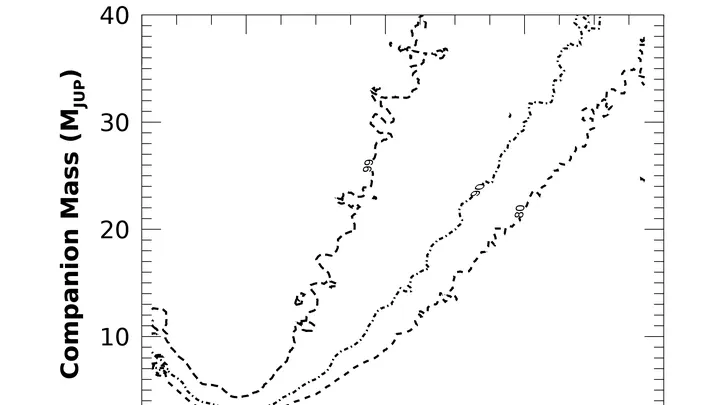
The family album of this stellar pair has been filling up for 45 years, but the pictures were blurry and the captions contradictory. Now astronomers have pulled out the old photographs, taken new sharp shots, and put everyone back in their proper places. Gamma Cephei is a bright star visible to the naked eye, and it has an invisible companion that orbits it every 70 years.
Twelve stars have received X-ray passports. Now, for each of them, we know the exact radiation dose received by a planet in the habitable zone, the region where liquid water is possible.
In a quiet back alley of a galaxy, where stars are rare and old, a light suddenly flares up, brighter than an entire galaxy. This is a Type Ia supernova: a thermonuclear explosion of a white dwarf that astronomers use as a standard candle to measure cosmic distances.
On a sunny street, there's a house with a big family: a giant father who always sits by the window and a small child running around the yard. That's the TOI-4468 system: a gas giant hot Jupiter hugs the star, while a bit farther out circles a sub-Neptune — a planet smaller than Neptune but larger than Earth.
Faint galaxies scattered across the Perseus cluster are like ghosts among their bright neighbors. They are so diffuse that distant objects shine through them, and they contain hundreds of times fewer stars than our Milky Way.
Two stars, AF Lep A and ε Indi A, have become the focus of close attention. Using the GHOST spectrograph on the Gemini telescope, astronomers split their light into colors and, from absorption lines, determined how much carbon, oxygen, sulfur, and thirteen other elements are in the stars' atmospheres.
The night sky seems unchanging, but galaxies constantly exchange matter. The Milky Way, like a great river, absorbs smaller streams — dwarf galaxies. Along with their stars, planets may also come to us.
Two glowing embers left over from a fire whirl in the darkness, gradually drawing closer. With each turn, they lose tiny bits of energy that seep into the invisible ripple of space. That is exactly what the system eRASSU J060839.5−704014 looks like — a pair of white dwarfs (superdense stellar remnants) separated by a distance comparable to Earth's diameter.
A lighthouse that blinks not every second but once every few minutes or even hours. That is exactly how long-period radio transients behave — cosmic sources discovered only recently.
A star is not just a distant sun. It's a cradle for planets, and its light carries the birth story of the entire system. The chemical composition of a star is its DNA. Astronomers peer into this DNA to understand why some stars host rocky worlds like Earth, while others host gas giants.
A balloon that lets out air in bursts zips around the room — the jet blasts first one way, then another. A dying star behaves the same way as it sheds its bloated shell. Only instead of air, it's superheated gas, and instead of a balloon, it's a future white dwarf (the dense stellar remnant about the size of Earth).
A stellarator fusion reactor resembles an intricately twisted magnetic cocoon. Its job is to confine superheated plasma so that hydrogen nuclei fuse and release energy. But the cocoon's three-dimensional shape creates gaps: some particles escape, especially the fastest ones, which carry most of the heat.
Tabby's Star, a beacon in the cosmic sea, has baffled astronomers since 2015. Its light flickered not in the rhythm of planets, but as if scattered by a storm — deep dips, sharp spikes. But amid this chaos, a smooth, nearly perfect dip was found. The eye of the storm.
Every 165 days, the giant planet dives toward its star, nearly grazing its fiery corona, then flies off into the icy void. This is TIC 241249530 b — an exoplanet with a record eccentricity of 0,94.
A quarter-century ago, Michel Mayor and Didier Queloz discovered the first hot Jupiter, and shattered all the rules of planet formation. A gas giant on a days-long orbit couldn't have formed next to the star: it's far too hot and lacks building material. So, it must have been born far away and then migrated.
The gravitational dances of celestial bodies long remained silent to astronomers. We learned to catch the shadows of planets against stars with the transit method — a breakthrough that delivered thousands of worlds thanks to William Borucki and his Kepler telescope.
Every star is a living archive, and its spectrum a multilayered manuscript. Over billions of years, the history of the galaxy is written into it: the galactic chemical evolution of the Milky Way leaves a smooth trace in elemental abundances.
Like an exquisite clockwork mechanism, a multi-planet system responds sensitively to the slightest nudge. And when the star at the heart of this mechanism dies, shedding its envelope and turning into a white dwarf, even a modest kick at a speed of 0.75 km/s can trigger a cascade of events, flinging entire worlds into interstellar emptiness.
In deep space, 95 parsecs from Earth, nature is assembling a planetary clock. The model HD 114082 is a prototype, only 15 million years old. Two massive pendulums — exoplanets b and c — are already swinging with periods of 225 and 314 days, but the whole mechanism is still covered in the construction dust of a debris disk.
A ball, almost weightless for its size, circles its star every four days. Planet TOI-2195 A b is a real riddle: by mass it's slightly heavier than Neptune, yet bloated to Jovian volumes. If there were an ocean big enough, this exoplanet would float on its surface like a giant inflatable ball.
Every fast radio burst is like a resounding strike of a bell in the void. And in its fading ring, the entire structure of space is encoded: over billions of light-years, the radio pulse is slightly delayed by every free electron it meets.
Some 158 light-years away, around the dim star TOI-6894, a red dwarf, a planet moves leisurely. Its year lasts less than two Earth days, yet it is a cool world with an equilibrium temperature around 420 K, just a bit warmer than a sauna.
Using James Webb, astronomers 'fished out' a third giant planet from the murky dust disk of the star β Pictoris. Two others were already known, but this one was hiding in the bright light, like a fish in muddy water.
A planet the size of Neptune wandered too close to its star. The star begins to pull the planet's outer layers onto itself — gas streams off the planet like water from an overflowing bucket. This process is called Roche-lobe overflow (astronomers use this term for the boundary beyond which a star can tear material away from a planet).
Red dwarfs are tireless blacksmiths of planetary fate. Their radiation, like a hammer, beats off gas envelopes, leaving only naked rocky cores.
In the depths of the constellation Hercules, around the dim M-dwarf GJ 3929, orbits a world one-and-a-half times Earth's size, like a billet on an anvil.
In the constellation Scorpius, 3,000 light-years from Earth, a dead star steals matter from a living one. A white dwarf in the system IGR J17014-4306 — a superdense carbon-oxygen ball with the mass of the Sun but the size of Earth — siphons hydrogen from a normal companion star.
In 2022, astronomers began discovering strange cosmic beacons — long-period radio transients. Unlike fast pulsars, discovered by Jocelyn Bell Burnell in 1967, these objects flared with periods of tens of minutes and hours.
Among the hundreds of moons in the Solar System, Nereid dances the most desperate dance: diving toward Neptune as close as 1.4 million kilometers, then soaring away to 9.7 million — all within less than an Earth year. An eccentricity of 0.75 — the brand of a captured wanderer.
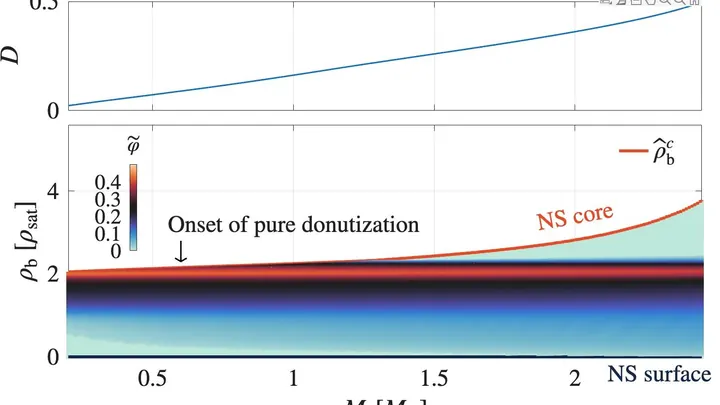
Neutron stars are super-dense spheres of the remnants of exploded stars. Some of them we see as pulsars — cosmic lighthouses sending out radio bursts. What's inside them long remained a mystery. Physicists assumed that hidden fields could affect their structure, but it was believed that if the field is short-range, its effect is negligible.
A streetlamp flickers as someone walks past. That's roughly how our nearest star, Proxima Centauri, behaves: it flares in response to the motion of its planets.
Astronomers observed the star with a highly sensitive instrument, the ESPRESSO spectrograph. It captures light and splits it into colors, much like a prism.
A spinning top whirls at great speed and, instead of a steady hum, emits a quiet buzz — because it is slightly dented. Neutron stars work much the same way: city-sized spheres compressed to such density that a teaspoon of their material weighs as much as a mountain.
The first exoplanet was discovered around an unusual cosmic lighthouse — a neutron star known as a pulsar. These ultra-dense remnants of dead stars spin at tremendous speeds and emit precise radio pulses.
Astronomers pointed JWST at a planet near the star Epsilon Indi — a giant gas ball resembling Jupiter, just 12 light-years away. In thermal images, the planet shone like a lantern. But nearby they noticed a faint dot — like a firefly. Calculations showed that two objects describe the picture better than one. However, it's most likely a lens flare — like a ghost of a lamp.
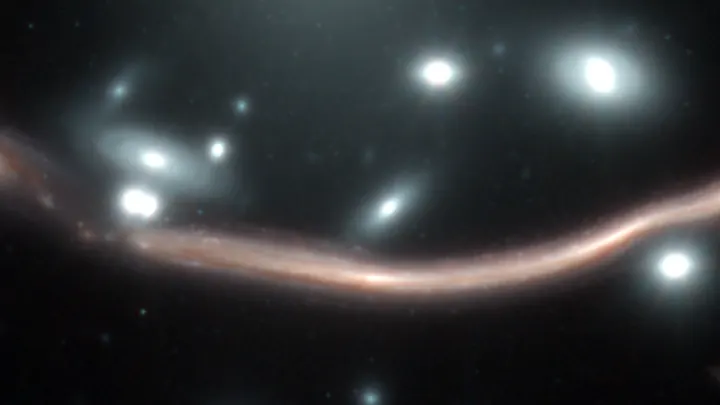
Light from the distant Dragon Galaxy has been traveling toward us for more than seven billion years. On its way, it passes by a huge galaxy cluster whose gravity bends the path of light like a lens. As a result, the galaxy appears brighter and larger than it really is, just as a magnifying glass enlarges fine print.
A handful of coins accelerates to one-fifth the speed of light. That's what Coracle interstellar probes will be like — tiny spacecraft weighing just a few grams, each with an ultrathin sail film. A powerful laser beam pushes them forward: light presses on the sail like wind fills a yacht's sails, except instead of air, it's a stream of photons.
Around small, cool, but extremely restless red dwarfs, planets the size of Earth often orbit. Such a star is like a temperamental stove that intermittently erupts flares: powerful streams of light and particles batter the planet's atmosphere, as if someone splashed fire into a simmering soup pot.
The carousel spins all the horses in one direction, but one stubbornly gallops against the flow. That's exactly how the planet TOI-1710 b behaves around its star. Using the HARPS-N and GIANO-B instruments, astronomers measured its tilt at 149 degrees. That's nearly a 180-degree flip, meaning the planet orbits "backward" relative to the star's rotation.
The TESS telescope photographed the sky for a full year, but its standard pipeline skipped over dim stars. The T16 project took the same images and cleaned them from scratch — resulting in 83,717,159 light curves, like EKGs for every star. Planets passing in front of their star briefly dim it, and these dips in the EKGs are what we look for.
In the open cluster Trumpler 5, where hundreds of stars move together, one star behaves like a teenager among elders. It pulsates — expanding and contracting, changing brightness every few hours.