The Magnesium Nucleus as a Musical Box express
The atomic nucleus is like a musical box: inside, nucleons (protons and neutrons) move along their orbits, like pins plucking the comb. But in some nuclei, such as magnesium-32, this box plays a tune you wouldn't expect from the usual shell-filling scheme. Physicists call such regions 'islands of inversion.' To understand how a neutron 'sounds' when it collides with such a nucleus, you need to describe their interaction, and until now, that meant relying on crude global models fitted to average data.
In the new work, an optical potential (a mathematical representation of how the nucleus scatters a neutron) has been built for magnesium isotopes 24, 26, 28, and 32 directly from nuclear structure. Instead of fitting parameters, the researchers used first-principles calculations: the symmetry-adapted no-core shell model (SA-NCSM) provides translationally invariant densities that describe both structure and reaction on equal footing. This approach requires no free parameters — everything is determined by the fundamental interactions of nucleons.
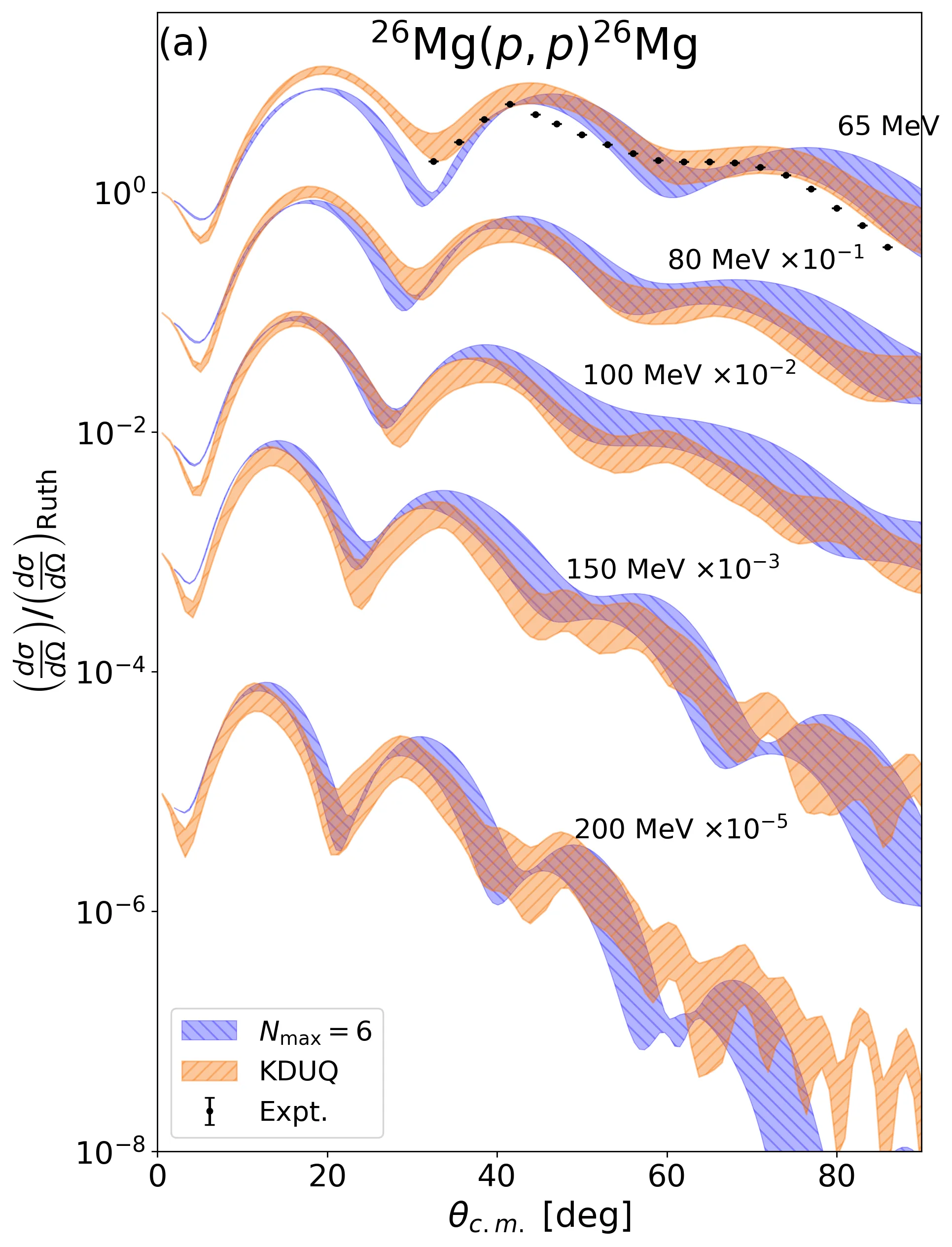
The result for stable magnesium-24 matched experimental data for total, reaction, and elastic neutron scattering at energies from 65 to 250 MeV. It's as if the melody predicted from the box's blueprint matched the actual sound. Then the same 'melody' was played for heavier isotopes: magnesium-26 and 28, as well as the unstable magnesium-32. Comparison with popular global potentials (Koning-Delaroche and Weppner-Penney) and ENDF evaluations showed where these models go wrong, especially near the island of inversion at N=20.
This first-principles approach opens the way to more accurate descriptions of nuclear reactions for exotic isotopes, which are important in astrophysics (for example, in nucleosynthesis in stars) and in nuclear technologies. Now, instead of trusting a universal 'average melody,' you can calculate an individual score for each nucleus.
Original abstract
as written by the authors arXiv:2603.28978
We present the first calculations of ab initio nonlocal optical potentials for $$^{24,26,28}$$Mg and $$^{32}$$Mg isotopes using the leading-order term of the spectator expansion of multiple-scattering theory. We use the structure input from the ab initio symmetry-adapted no-core shell model (SA-NCSM), which provides translationally invariant, off-shell scalar and spin-projected densities so that structure and reaction inputs are treated on equal footing with no adjustable parameters. This leading-order potential reproduces $$^{24}$$Mg neutron total, reaction, and elastic-scattering data at energies between 65 and 250 MeV and provides predictions for $$^{26,28}$$Mg and $$^{32}$$Mg. We compare our prediction with those from uncertainty-quantified Koning-Delaroche (KDUQ) and Weppner-Penney global optical potentials, and with the ENDF nuclear data evaluations. These comparisons highlight some of the limitations of the global models, while also validating their use in reaction modeling near the N=20 island of inversion.
Magnesium-32 lives for only about 0.1 seconds before decaying, but in that time it manages to show that the familiar nuclear shell scheme fails.
The idea of the 'island of inversion' echoes fictional worlds where the usual laws of physics break down in isolated anomalous zones — for example, in the novel 'Roadside Picnic' by the Strugatsky brothers.