First-principles calculations are computational methods that solve the fundamental equations of physics — such as the Schrödinger equation or the Dirac equation — without fitting to experimental data or using empirical parameters. They aim to predict the properties of a system from scratch, using only the laws of quantum mechanics and the known constants of nature. This approach is powerful because it can describe materials, molecules, and even exotic systems like black branes without prior knowledge of their behavior, making it a cornerstone of modern computational physics and chemistry.
History
The field began in the 1920s with early quantum mechanical calculations on atoms, but it became practical in the 1960s after Walter Kohn and Pierre Hohenberg established the theoretical foundation of DFT, and later with the development of efficient algorithms in the 1980s and 1990s.
How it works
The most common implementation is density functional theory (DFT), which approximates the many-body quantum problem by focusing on electron density rather than individual wavefunctions. The equations are solved iteratively on a computer, often using a self-consistent field method: start with a guess for the electron density, compute the potential, solve for new wavefunctions, update the density, and repeat until convergence. For more exotic systems, such as black branes in holographic gravity, first-principles calculations may involve solving Einstein's equations numerically without assuming a specific solution form.
In practice
First-principles calculations are used to design new battery materials, predict the properties of catalysts, and simulate the behavior of matter under extreme conditions, such as in planetary interiors or inertial confinement fusion.
Fun fact
First-principles calculations can predict the existence of new materials before they are ever synthesized, guiding experimentalists toward promising candidates.
A hunter sets snares in the woods. They know the animal's habits but not whether it will ever show up. In much the same way, physicists set up detectors in hopes of catching particles of dark matter — the invisible substance thought to make up most of the Universe's mass.
A new study offers hunters an unusual tool: not a trap, but a measuring tape.
The brain doesn't just react to the world: it's constantly guessing what will happen next. This principle is called predictive coding: neurons compare expectations with reality and update their internal picture when an error occurs. But how such a complex system could be wired into the living tissue of the cortex remained unclear.
The standard approach to a certain class of machine learning problems is like a spring that's been stretched and then forgotten: standard methods artificially inflate the problem's size, turning computations into a black hole for memory and time.
In 1981, Alan Guth proposed a scenario of cosmological inflation — a lightning-fast expansion of space that stretched quantum fluctuations to the scale of entire galaxies. Since then, cosmologists, like archaeologists, have been excavating this event from the structures of the Universe.
The cosmic microwave background is the first light that pierced the dense fog of the early universe. Its spectrum, like a frozen score of a cosmic symphony, preserves the tiniest density fluctuations from which galaxies grew.
A tightrope walker steps onto the wire. Every move is a calculation: shift your weight just right, or you’ll fall. In the world of quantum particles described by the Dirac equation, there’s a different kind of abyss — the wave function’s furious oscillations.
Gold doesn't lie on the surface: it's hidden in tons of barren rock. To extract a gram of precious metal, prospectors sift through cubic meters of dirt.
Strike a tuning fork. The frequency is 440 Hz. That's the note A — the standard of sound.
In the world of numbers, there's a standard too. It's tuned not to sound, but to prime numbers. Though their distribution seems random, it obeys strict laws. All primes resonate together. There's just one value: λ∞ ≈ 0,674036.
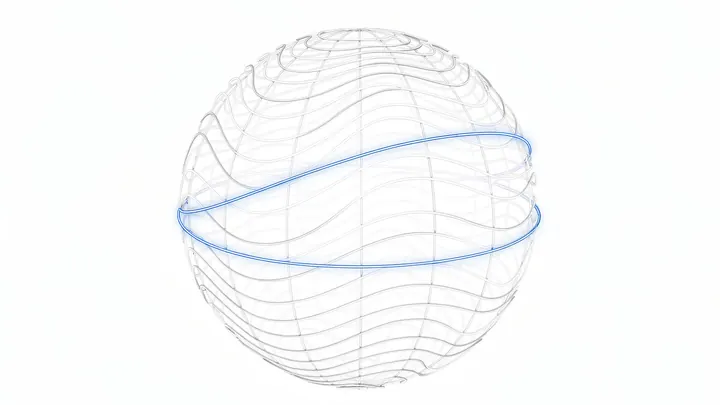
Black holes can emit heat. They have a temperature, entropy (a measure of disorder), and other thermodynamic properties. Usually, to compute these, you first have to construct the black hole itself — solve the complicated equations of curved spacetime.
In the kitchen cupboard sits a jar of sugar. If you shake it, the grains will spread almost evenly — no need to place each one with tweezers. In much the same way, tiny black holes could have appeared in the first moments after the Big Bang. Their mass is like that of an asteroid, their size smaller than an atom.
Conventional neural networks learn from thousands of examples, burning hours and gigawatts. Physicists have found a quantum workaround. As early as Max Planck showed the discreteness of energy, today this allows generation without training.
A black hole is not a frozen sphere. It's more like a soap bubble, whose walls can expand and contract. It even has two layers: the outer horizon, beyond which light cannot return, and the inner one, hidden deeper. When the hole swallows matter or loses energy, both layers shift, like the film of a bubble changing size.
Quantum computers promise to solve problems that regular computers can't. But where is the line? The authors of a new study stumbled upon a surprising case: electrons paired up behave like a well-behaved orchestra. Even if you add a bit of "magic"—a special quantum resource: their behavior remains predictable.
For 800,000 years, ice ages have occurred every 100,000 years. The rhythm matches the elongation of Earth's orbit. But the orbit changes the flow of solar heat so subtly — as if the conductor barely moved the baton, yet the orchestra thundered. It remained a mystery how this weak signal controls the ice sheets.
In everyday life, time flows on its own, like a river past its banks. But in quantum gravity, things are different: time does not flow; it emerges from relations between objects, like a pattern in a carpet that is only visible when viewed from a certain spot.
In the first moments after the Big Bang, the universe expanded faster than light could cross it. This expansion left a subtle ripple in the distribution of matter, like the rings on water from a thrown stone. Traces of that ripple are visible today in how galaxies cluster into groups and filaments.
When a typical computer searches for a law of nature from data, it tries to guess a complete formula in one go. It's like a cook who, without knowing the recipe, dumps all the ingredients into a pot at once and hopes for soup. Most often, the result is an inedible mess: the formula is long but meaningless, and it fails on new data.
The number 551 looks harmless, but finding the two primes that multiply to give it is no easy task. A classical computer tries options one by one, like someone searching for a key on a keyring. A quantum processor works differently: it tries all possibilities at once, but you need a way to steer it toward the right answer.
A crystal without a center of symmetry is like a staircase where all the steps are tilted in the same direction: electrons, given a kick by light, roll predominantly in one direction. This is how a direct current is born — the photogalvanic effect.
In 1935, Einstein, Podolsky, and Rosen proposed a thought experiment that, in their view, exposed the incompleteness of quantum mechanics. Two particles fly apart after interacting, and measuring the momentum of one instantly gives exact knowledge of the other's momentum.