Magnesium is a chemical element with symbol Mg and atomic number 12. It is a shiny gray solid that is highly reactive, and it is the eighth most abundant element in Earth's crust. In astrophysics and spectroscopy, magnesium is significant because it produces strong characteristic spectral lines in the visible and ultraviolet ranges, making it a key tracer of stellar composition and interstellar matter.
History
Magnesium was first isolated by Humphry Davy in 1808, who electrolyzed a mixture of magnesia and mercuric oxide. Its spectral lines were studied in the 19th century as spectroscopy developed.
How it works
When magnesium atoms are heated or excited—for instance, in a star's atmosphere or in a laboratory flame—their electrons jump to higher energy levels. When they fall back, they emit photons at specific wavelengths, producing emission lines. Conversely, cool magnesium gas absorbs those same wavelengths, creating absorption lines in spectra. These lines act as fingerprints, allowing astronomers to identify magnesium in distant objects and measure its abundance.
In practice
Magnesium is used in lightweight alloys for aerospace and automotive industries, and its spectral lines are used in astronomy to study stellar evolution and the chemical composition of galaxies.
Fun fact
Magnesium is the central atom in chlorophyll, the molecule that allows plants to photosynthesize, and its spectral lines are used to detect the presence of life-supporting planets indirectly.
Forty light-years away lives a star that went unnoticed for a long time: TRAPPIST-1 emits two thousand times less light than the Sun. But it turned out to have seven Earth-sized planets, three of which orbit in the zone where water could remain liquid. Yet little was known about the star itself, about its chemical kitchen.
In 1,433 pairs of galaxies scattered across the sky, astronomers noticed an unusual pattern. Neighbors located 'above' or 'below' a massive stellar system contain up to a quarter more oxygen than those lying in the plane of its disk.
For thirteen billion years, light battled through cosmic emptiness. It bent around massive galaxy clusters that, as Einstein predicted, acted as giant lenses — amplifying and distorting the distant glow. In 2023, the NIRSpec instrument on the James Webb Space Telescope captured this light and spread it into spectra.
A star's age is the key to the galaxy's history. But prying that key from nature is no simple task: unlike a tree, a star doesn't grow annual rings. Yet, its atmosphere holds a chemical code — the ratio of elements that slowly shifted as generations of stars died and new ones were born.
For years, the Sun teased astrophysicists. In its atmosphere, refractory elements, like spices in a basic recipe, were slightly less abundant than in nearly identical twin stars. Suspicion arose: could our star be modest, skipping the planetary "dessert" that others devour with gusto?
Deep beneath our feet, in the scorching mantle, iron leads a double life. It can be divalent or trivalent, like a coin that lands heads or tails. Which side dominates determines how much oxygen stays in the planet's rocky shell and how much sinks into the core.
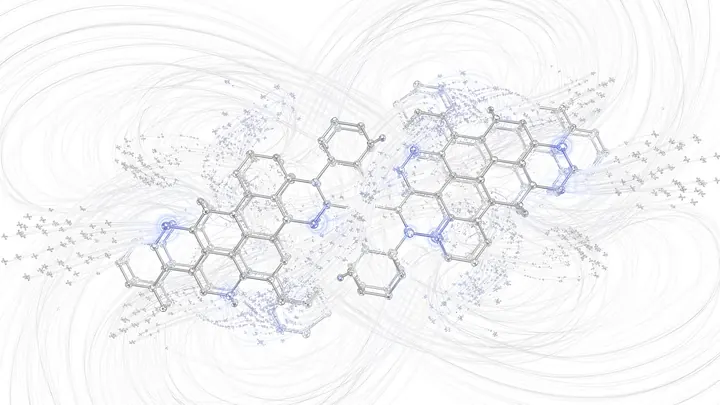
In cold molecular clouds, where temperatures drop to 10 K, chemistry does not freeze. It turns into a slow, error-free dance. Invisible ions, like nocturnal bees, carry carbon 'pollen grains' from molecule to molecule. They stitch aromatic rings into intricate polycyclic structures.
The young super-Jupiter TWA5B, a scorching ball 25 times Jupiter's mass, floats just fifty light-years away. Its faint infrared glow long hid its chemical makeup. Now, high-resolution spectroscopy with CRIRES+ has registered the ghostly trace of SiO — silicon monoxide.
For nearly half a century, astronomers have been searching for glycine, the simplest amino acid and one of the fundamental building blocks of proteins, in the interstellar medium.
Nitrogen, the very gas we breathe, behaves like a finicky metal under a million atmospheres of pressure. In a diamond anvil cell, it is squeezed to 78–98 gigapascals and heated with a laser to 1800–2500 kelvin. Under these conditions, N₂ molecules rearrange into crystals that can store energy more densely than explosives.
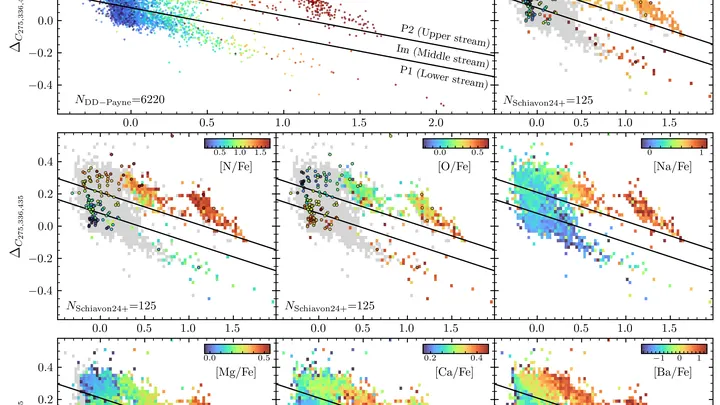
At the heart of Omega Centauri, the most massive globular cluster in our Galaxy, thousands of stars are packed so tightly that their light merges into a single glowing blob when seen from Earth. Separating this swarm into individual stars and determining the composition of each is a task akin to sorting through an overfilled anthill.
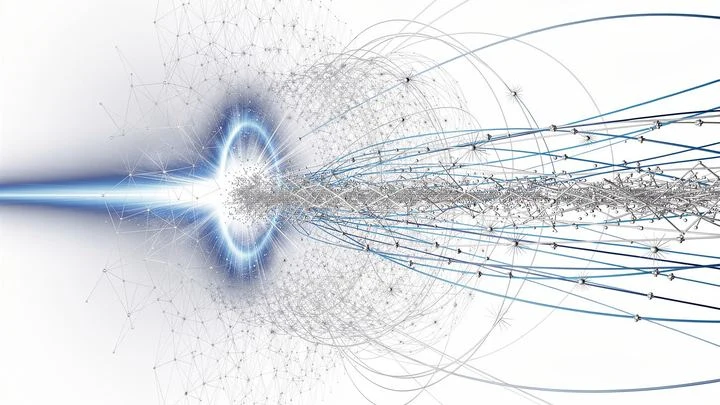
A football kicked with spin doesn't fly straight: it bends to the side. A tightly focused beam of light does something similar: it starts pushing an atom not just forward but also sideways. Physicists measured this shift on a single calcium ion trapped in a light trap.
The beam was aimed at the atom like a spotlight on a grain of sand.
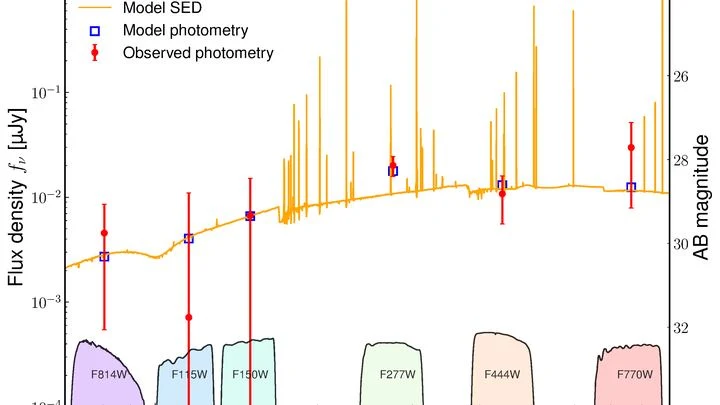
In the deep cosmos, more than 12 billion light-years away, the James Webb Space Telescope has spotted a galaxy that looks like a visitor from the dawn of creation. Its light has been traveling to us since the universe was only about two billion years old — a time when galaxies were growing especially vigorously, a period astronomers call the cosmic noon.
In the stream of charged particles flying toward us from the depths of the Galaxy, iron turned out to be the odd one out. The ATIC-2 instrument, lifted on a balloon over Antarctica, compared how the fraction of nuclei from sulfur to chromium relative to iron changes with energy.