Nucleons are the collective name for protons and neutrons, the particles that make up the atomic nucleus. They are not fundamental particles but are themselves composed of quarks held together by the strong nuclear force. The number of nucleons determines the mass number of an atom, while the number of protons specifically determines the element's identity. Understanding nucleons is essential for explaining nuclear stability, radioactive decay, and the energy released in nuclear fission and fusion.
History
The term 'nucleon' was introduced by the physicist Werner Heisenberg in 1932, shortly after the discovery of the neutron by James Chadwick. Heisenberg proposed that protons and neutrons are two states of the same particle, which he called the nucleon.
How it works
Nucleons are bound together in the nucleus by the residual strong force, a short-range interaction that overcomes the electrostatic repulsion between positively chargedprotons. Each nucleon is made of three quarks (two up and one down for protons; one up and two down for neutrons) held together by gluons. The strong force also manifests in the exchange of pions between nucleons, which is the residual effect of the quark-gluon interaction. The balance between the attractive strong force and the repulsive electromagnetic force determines whether a nucleus is stable or radioactive.
In practice
Nucleon properties are exploited in nuclear reactors and medical imaging (e.g., proton therapy for cancer), and neutron scattering is used to probe the structure of materials.
Fun fact
The mass of a nucleon is about 1,836 times the mass of an electron, yet most of that mass comes from the energy of the quarks and gluons inside, not from the quarks themselves.
Inside an atomic nucleus, protons and neutrons don't sit still like peas in a pod. Each particle occupies its own orbit — a region of space where it can be found. The larger the orbit, the more 'smeared out' the particle is.
When a heavy atomic nucleus splits into two fragments, an invisible quantum thread remains between them. This thread is entanglement: the state of one fragment is instantly linked to the state of the other, as if they were still a single whole. For the first time, physicists have precisely calculated how long and strong such a thread can be, tracing the fission process step by step.
The atomic nucleus is not a bag of marbles but an ordered structure where protons and neutrons fill shells, much like electrons in an atom. When a shell is filled, the nucleus becomes especially stable, and the number of particles is called magic. For calcium with 20 protons, the classic magic neutron numbers are 20 and 28.
The atomic nucleus isn't always round like a billiard ball. Some nuclei stretch out like a rugby ball, while others become pear-shaped — with one end thicker than the other.
In nuclear physics, a puzzle has long been nagging: why among elements lighter than bismuth, only technetium (No. 43) and promethium (No. 61) have no stable isotope at all? All their neighbors in the periodic table can boast at least one long-lived variant, but these two seem to fall out of the general pattern.
A handful of sand in your fist: the grains press against each other, and your hand can't squeeze any further. Ordinary matter behaves similarly. But in a neutron star, compression is billions of times stronger — atoms are crushed, electrons are squeezed into protons, and nearly all space is filled with neutrons.
A billiard ball clicks against another in complete darkness. The sound of the impact and the clatter of balls dropping into pockets: that's all you hear. This is roughly how physicists study the interactions of elementary particles at energies that no terrestrial accelerator can reproduce.
A heaping teaspoon, and the scale reads a billion tons. That's roughly what a teaspoon of neutron star matter would weigh if you could scoop it up and put it on a scale. Such objects are born after a supernova explosion: the star's core collapses into a sphere the size of a city, and the density exceeds that of an atomic nucleus.
At the center of every atom lies a nucleus — a dense ball of protons and neutrons. These particles don't just crowd together randomly; they fill strict energy levels, much like floors in a skyscraper. When a floor is completely filled, the nucleus becomes especially stable — physicists call this a magic number.
The interiors of neutron stars are a realm of degenerate matter. Here, protons condense into a superconducting condensate, threaded by quantum vortices. Imagine tiny magnetic tops: each carries a quantum of magnetic flux and glides through the electron fluid.
An atomic nucleus is not just a ball of protons and neutrons. It has a shape, and that shape can change. The tin-116 nucleus was long considered almost perfectly spherical: it has 50 protons — a 'magic' number that usually gives a nucleus spherical symmetry. But a new ultra-precise measurement showed otherwise.
In nuclear physics, the belief long reigned that two neutrons cannot form a bound state — they attract too weakly and immediately fly apart. However, on the surface of neutron-rich nuclei, where the matter density drops to a thousandth of normal nuclear density, the situation changes dramatically.
At accelerators, by smashing heavy nuclei, physicists briefly create a quark-gluon plasma — a state of matter where quarks and gluons are not confined inside particles but are free. For a long time, it was imagined as a gas, but experiments showed it's an almost perfect liquid.
Imagine a perfectly tuned orchestra, where every instrument is adjusted with flawless precision, trying to play in a noisy hall. That noise is quantum gravity — the microscopic ripples of spacetime. It constantly threatens to throw the musicians off.
A neutron star is a gravitational lens that focuses our attempts to glimpse dark matter. Through its ultra-dense matter, like exotic glass, we search for the axion — an elusive particle that could explain the hidden mass of the universe.
Somewhere in the galactic bulge, a massive star lies dormant, ready to trade quiet burning for collapse. Its core will exhaust its fuel, and in a fraction of a second, a neutron star or black hole will be born, releasing 10⁵⁸ neutrinos — almost all the energy of the explosion.
The Universe is a genius chef, and the Big Bang is its perfect recipe. Hydrogen rose fluffy, helium melted tender, but lithium-7 seems oversalted: theory predicts three times more than astronomers find in the oldest stars. This imbalance, the 'lithium problem,' has spoiled cosmologists' appetite for decades.
Atomic nuclei are not always like billiard balls. Some are elongated, like cigars, others are flattened. But xenon-129 resembles a potato — a bumpy triaxial ellipsoid.
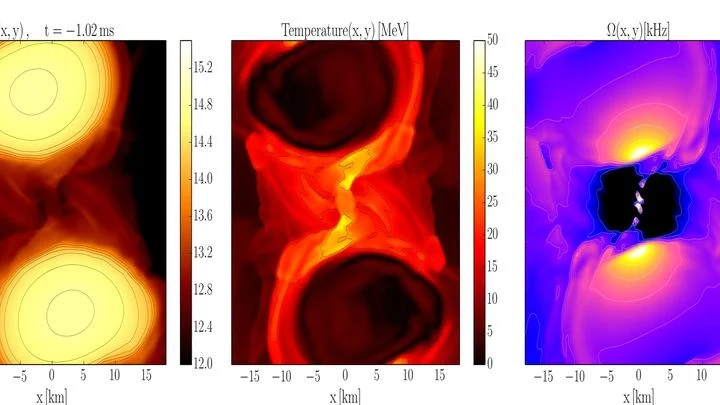
In 2017, detectors picked up a tremor in space — gravitational waves from the merger of two neutron stars. Telescopes immediately found a flash of light: a cosmic explosion astronomers dubbed a kilonova. In that fiery cauldron, it turned out, the heaviest elements of the periodic table are born — gold, platinum, uranium.
The atomic nucleus is a natural spring of colossal power. When the protons and neutrons inside it rearrange, it enters a special long-lived state — a nuclear isomer. It stores energy like a spring compressed to its limit.
At first glance, the atomic nucleus is a cramped communal apartment where protons and neutrons (together called nucleons) live by strict rules. Each occupies its own orbit, like electrons in an atom, and on average everything looks orderly.
The Standard Model is a set of rules for all known particles. But it says nothing about dark matter, which makes up a quarter of the Universe. To find it, you don't need to build city-sized colliders. Radioactive molecules act like sniffer dogs: their incredible 'scent' picks up the faintest traces of unknown forces that slip past giant machines.
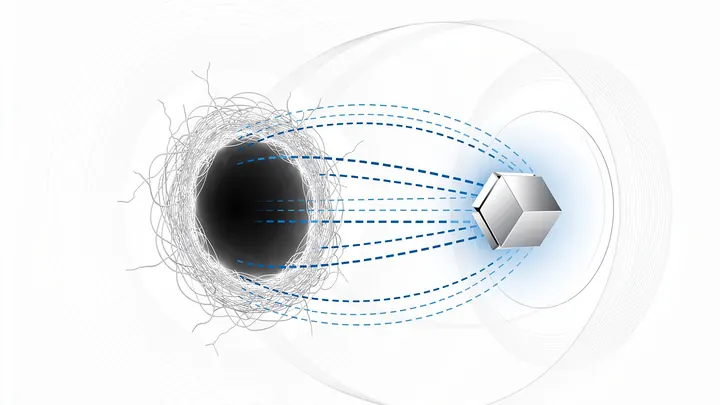
In the searing plasma of the newborn Universe, when space itself still rang with the echo of the Big Bang, objects may have emerged that challenge gravity itself. Not ordinary black holes — but electrically charged giants, astrons.
A pot of boiling soup bubbles away, and you'd love to know how hot individual droplets are inside. But you can only dip your thermometer at the edge, where things are calmer. Laser fusion is a bit like that: a powerful laser pulse hits a target, creating a cloud of fast protons.
The atomic nucleus is not a solid ball but a dense swarm of tiny particles called quarks, glued together by a special glue (the strong force). In light nuclei, such as calcium, this swarm is simply arranged: the numbers of the two quark types, up and down, are almost equal, like the white and black keys in an octave.
If you try to break a proton apart and pull out a quark, you're in for a surprise. Ordinary forces, like the electric force, weaken as particles fly apart. Here, it's the opposite. The farther a quark gets from its neighbors, the harder it's pulled back.
An atomic nucleus is like a droplet with a thin coating — a neutron 'skin.' Inside the droplet, protons and neutrons are mixed evenly, but on the outside, like the froth on milk, a layer forms where neutrons are noticeably more abundant.
The outer crust of a neutron star is like a layered cake, where each layer is a strictly defined filling. It's a crystalline lattice of atomic nuclei immersed in a sea of electrons. The deeper you go, the stronger the pressure, and the heavier the nuclei that can exist there without falling apart.
Inside a neutron star, the density doesn't change smoothly but drops abruptly at sharp cliffs — density staircases. At these steps, the void suddenly births pairs: neutrinos and antineutrinos.
When a heavy atomic nucleus splits, it doesn't break into even halves. First, two fragments form that look like pears pressed together at their narrow ends. Then the junction begins to smooth out, like two droplets merging and the surface quickly leveling.
In that brief moment, the surface moves inward, and particles inside the nucleus can bounce off it, like a ball off an oncoming wall.
If an atomic nucleus is a family, then in an ordinary helium house live two protons and two neutrons, holding hands tightly. Now imagine that one family member is an oddball who loves to wander far from home.
Colliding two lead nuclei at the Large Hadron Collider is like throwing two hefty bags of marbles at each other. Usually, the marbles scatter in all directions, but sometimes one bag passes so close that the marbles don't collide: they just exchange glances.
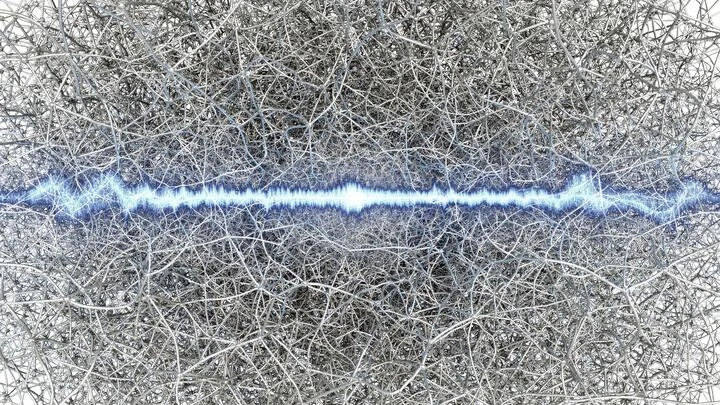
The proton is not a solid ball but a seething cloud of quarks and gluons. Each particle carries its own bit of rotation, but if you add up all the bits, you don't get the full proton spin. Part of the rotation seems to hide in the cloud's slowest inhabitants: those carrying only a tiny share of the total motion.
The atomic nucleus is not just a ball of protons and neutrons. Inside it, like a tiny magnet, there is its own distribution of magnetization. Until now, it has been difficult to see: nuclei live for tiny fractions of a second, and their magnetic field is weak. Now physicists at CERN have found a way to look inside.
The proton is not a solid ball. Its charge, mass, and other properties are distributed differently in space, and each property has its own radius. Physicists have long been able to measure where the proton's charge is concentrated and where its mass lies.
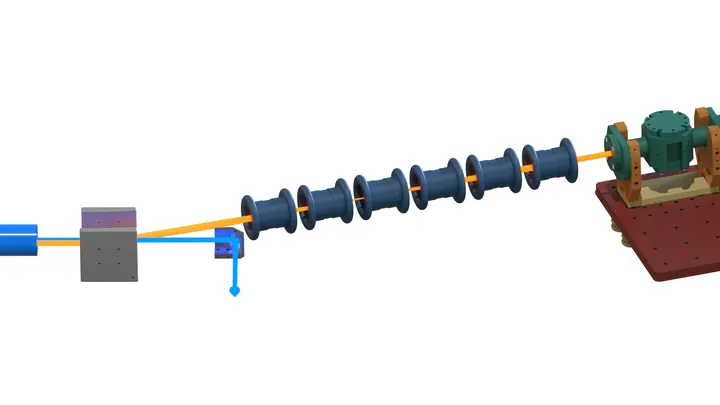
Every time deuterium and tritium fuse in a fusion reactor, a fast neutron flies out. It can turn one substance into another — for example, create valuable isotopes for medicine.
Today such neutrons cost a fortune, because there are few experimental facilities and they rarely operate.
The Large Hadron Collider doesn't just smash protons: it also collides entire atomic nuclei. When two nuclei smash together at tremendous speed, they create a tiny blob of matter so hot that protons and neutrons melt into a 'soup' of quarks and gluons.
Long before that, Fritz Zwicky predicted that a supernova explosion gives birth to a tiny neutron star. Years later, Jocelyn Bell Burnell caught its pulses, discovering pulsars.
At the heart of a neutron star, matter is squeezed so tightly that protons and neutrons transform into heavier particles — hyperons. These particles resemble neutrons but contain a strange quark. For a long time, physicists couldn't understand how a star with hyperons inside could be as heavy as observations show.
Ten microseconds after the Big Bang, the Universe resembled a pot of boiling broth. Floating in it were quarks and gluons — the particles that would later assemble into protons and neutrons. As the broth cooled, at some point the quarks clumped together into lumps — the very protons and neutrons that make up all visible matter.