Fusion Cauldron with Hot Plasma express
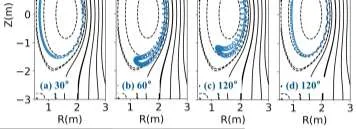
A doughnut-shaped magnetic trap holds plasma made of boron and hydrogen. Inside, the temperature rises above one hundred million degrees — hotter than the center of the Sun. At such heat, nuclei collide and fuse, releasing energy.
The plasma in the device rotates like a carousel: heavy boron ions lag behind light protons. The magnetic field and electric forces hold each group in its own way. Thanks to this, the hot zone doesn't fall apart, and the reaction lasts longer.
Such a scheme suits a compact reactor with a radius of 1.4 meters and a current of 13 million amperes. If it can be realized, energy would be produced without neutron radiation — cleaner and safer.
Original abstract
as written by the authors arXiv:2604.04002
A spherical torus (ST) p B11 plasma model that satisfies multi-magnetofluid force balance is developed, which includes small fractions of suprathermal ions with temperatures around 0.5 MeV and suprathermal electrons in the MeV range. Alongside the primary thermal plasma with ion temperatures exceeding 100 keV and densities above 10E20 m-3, these components enhance fusion reaction rates by leveraging the p B11 double-peak fusion cross section. Suprathermal ions and strong toroidal rotation driven by neutral beam injection have been observed in devices such as START, MAST, NSTX, Globus-M2, and ST40. Central-solenoid-free plasma initiation, ramp-up, and sustainment were tested on EXL-50 and replicated on EXL-50U with partial central induction, demonstrating efficient current drive and consistent with the multi-magnetofluid equilibrium model. Motivated by ENN's aneutronic commercial fusion roadmap, this paper presents a rotating, thermally un-equilibrated ST p B11 plasma with unique properties: fluid components experience separate balance under centripetal, electrostatic, and Lorentz forces with common electric and magnetic fields, leading to large rotation speed differences between thermal boron ions and suprathermal protons; a large outboard region with magnetic well and omnigeneity is created, affecting neoclassical transport and gradient-driven turbulence; suprathermal charged particles can extend beyond the last closed flux surface and be limited by plasma-facing components, influencing recycling and pedestal conditions; and the superposition of these plasma components modifies sources and sinks of free energy, prompting renewed evaluation of stability, turbulence, transport, heating, current drive, and flux diffusion. Challenges and opportunities for sustained burn are discussed for a compact p B11 ST with 1.4-meter major radius, 13-MA current, and 3-T toroidal field.
In this plasma, heavy boron ions rotate noticeably slower than light protons, like figure skaters on an ice rink: massive partners stay closer to the center, while lighter ones overtake them on the outer circle.
The idea of neutron-free fusion echoes reactors from "Star Trek," where fuel is deuterium, but here it's boron with hydrogen.