Ytterbium ions are single atoms of the rare-earth element ytterbium that have been stripped of one or more electrons, turning them into electrically charged particles. In quantum computing, they serve as one of the most promising platforms for building qubits—the quantum equivalent of classical bits. Their appeal lies in their internal energy levels: ytterbium ions have a particularly stable 'clock' transition that can be used to encode quantum information, and they interact well with laser light, making them easy to manipulate and read out.
History
The use of ytterbium ions for quantum computing was pioneered in the early 2000s, with groups at NIST and the University of Oxford demonstrating key trapping and manipulation techniques. The element itself was discovered in 1878 by Jean-Charles Galissard de Marignac.
How it works
Ytterbium ions are typically trapped using electromagnetic fields in devices called Paul traps, which hold them in place in a vacuum. Laser beams are used to cool the ions to near absolute zero, slowing their motion so quantum states can be controlled. The qubit is encoded in two hyperfine energy levels of the ion's ground state, which are extremely stable against external disturbances. Quantum operations are performed by applying precisely tuned laser pulses that drive transitions between these levels, while the ions' mutual Coulomb repulsion allows them to become entangled, enabling multi-qubit computations.
In practice
Ytterbium ion qubits are used in experimental quantum computers, including those developed by companies like IonQ, and are also central to quantum network research, where they act as nodes for entanglement distribution.
Fun fact
Ytterbium ions are so stable that their optical clock transition is used as a candidate for redefining the SI second.
On the table lies a layered cake of hexagonal boron nitride flakes, a material similar to graphite but made of boron and nitrogen atoms. One flake is carefully transferred onto another, and at the spot where they overlap, after heating in oxygen, bright single light sources are born.
The pendulum in these clocks doesn't swing from a spring or a weight, but from a tiny kick inside the atomic nucleus. Ordinary atomic clocks keep time by the oscillations of electrons, but here the pendulum is the nucleus itself — a dense ball of protons and neutrons.
The quantum networks of the future resemble the Tower of Babel: each node speaks its own dialect. Some store information in the polarization of a photon — the direction of oscillation of the light wave. Others use time bins: that is, when exactly the pulse arrives.
In 1905, Einstein showed that the chaotic motion of pollen in water results from the jostling of invisible molecules. A century later, physicists have learned not only to observe but also to control motion at the quantum level.
Strike a tuning fork with a mallet — it vibrates, and the sound gradually fades. A black hole behaves much the same way when disturbed: it emits gravitational waves — ripples in spacetime itself — and then settles down.
A pendulum that swings almost half a quadrillion times per second. This isn't mechanics: it's the pulse of light trapped by ytterbium atoms. Instead of gears, there's an optical lattice — a standing wave that holds atoms at its nodes like peas in a pod.
A single camera shot stores both a normal picture and a hidden map of how light rippled through the scene. Quantum entanglement makes this possible. Pairs of linked photons are generated: one visits the object, its twin takes a detour. Later, measuring the twin one way pulls out the brightness information.
The atomic nucleus is a natural spring of colossal power. When the protons and neutrons inside it rearrange, it enters a special long-lived state — a nuclear isomer. It stores energy like a spring compressed to its limit.
In the orchestra of atoms, each instrument has its own score. But sometimes two musicians start playing in unison, and the sound amplifies many times over. In the quantum world, this 'harmony' is called a Feshbach resonance. It allows you to control atomic interactions with jeweler-like precision.
Quantum networks need a mediator between storage — spin — and carrier — light. No single molecule had ever pulled off such a feat. But now physicists have found a solution. They placed a carbene molecule into a crystal and cooled it to -269°C.
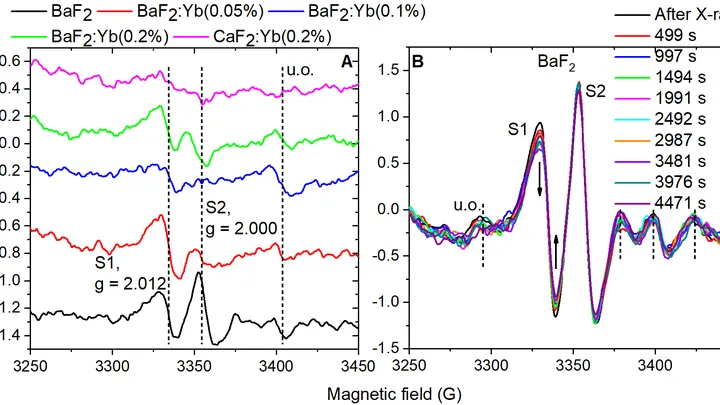
Light passing through a transparent crystal can subtly change color. That's how many lasers work: a tiny addition of a rare-earth metal makes the crystal glow. But the same metal behaves differently in different crystals, and physicists have studied this quirk using ytterbium.
A doughnut-shaped magnetic trap holds plasma made of boron and hydrogen. Inside, the temperature rises above one hundred million degrees — hotter than the center of the Sun. At such heat, nuclei collide and fuse, releasing energy.
The tip of a scanning tunneling microscope approaches a crystal surface so closely that an electric current jumps between them. Electrons from the needle are injected into a layered semiconductor and land in an atomic vacancy — a spot where one atom is missing from the lattice. This void acts as a tiny trap for charge.
A tiny cloud of 300,000 ytterbium atoms, cooled to near absolute zero, was shuttled along a light track 34 centimeters long, like transporting a fragile cargo over a bumpy road without shaking it apart.
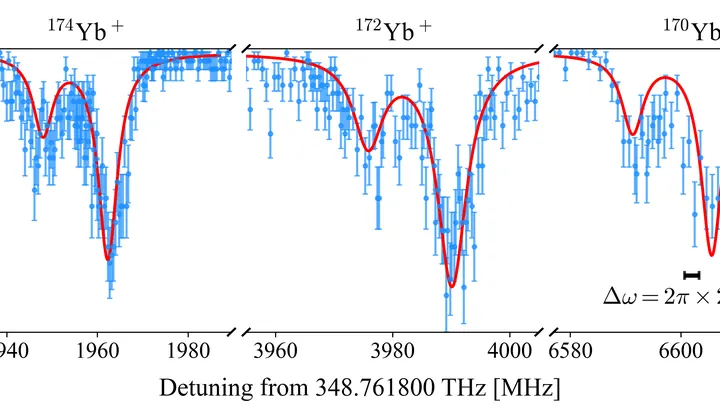
The light an atom emits or absorbs is like a fingerprint: each element has its own pattern of lines. In an ytterbium ion (an atom that has lost one electron), researchers have found three new lines that were previously unused. These lines are very narrow, like thin slits in a fence that let you see far and clearly.
A magnetic material can be compared to a crowd of tiny compasses. In an ordinary magnet, all the needles point in the same direction, and turning them all at once is no easy feat. Physicists have found a way to do this with an electric current.
Inside every cell, chemical reactions are constantly underway, like a tiny kitchen where protein chefs whip up essential compounds. But seeing exactly how a chef prepares a dish is tricky when you're surrounded by a crowd of other molecules.
Quantum devices usually live inside cryostats — giant thermoses where temperatures are colder than deep space. An erbium ion trapped in a tiny well on a silicon chip breaks that mold.
A quantum computer isn't a monolith: it's more like an orchestra, where each qubit must play its part without drowning out the neighbors. In ion-based machines, two types of qubits are used: some store information, others process it. Previously, each type required its own laser, like separate batons for violins and trumpets.
In a dark laboratory where superconducting chips are cooled to thousandths of a kelvin, a qubit spins under the influence of a magnetic field. A regular qubit rotates in one direction. An antiqubit, its mirror twin, rotates in the opposite direction. Together they form a pair that senses the field twice as sharply as any ordinary pair.