Fusion Cauldron with Hot Plasma express
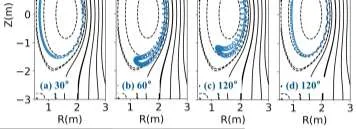
A doughnut-shaped magnetic trap holds plasma made of boron and hydrogen. Inside, the temperature rises above one hundred million degrees — hotter than the center of the Sun. At such heat, nuclei collide and fuse, releasing energy.
The plasma in the device rotates like a carousel: heavy boron ions lag behind light protons. The magnetic field and electric forces hold each group in its own way. Thanks to this, the hot zone doesn't fall apart, and the reaction lasts longer.
Such a scheme suits a compact reactor with a radius of 1.4 meters and a current of 13 million amperes. If it can be realized, energy would be produced without neutron radiation — cleaner and safer.
In this plasma, heavy boron ions rotate noticeably slower than light protons, like figure skaters on an ice rink: massive partners stay closer to the center, while lighter ones overtake them on the outer circle.
The idea of neutron-free fusion echoes reactors from "Star Trek," where fuel is deuterium, but here it's boron with hydrogen.