The Stefan–Boltzmann constant (σ) is the proportionality factor in the Stefan–Boltzmann law, which states that the total power radiated per unit area from a blackbody is proportional to the fourth power of its absolute temperature: P/A = σT⁴. Its value is approximately 5.670374419 × 10⁻⁸ W·m⁻²·K⁻⁴. This constant bridges macroscopic thermal radiation with fundamental physics, as it can be expressed in terms of the Boltzmann constant, Planck's constant, and the speed of light.
History
The law was empirically formulated by Josef Stefan in 1879 and theoretically derived by Ludwig Boltzmann in 1884 using thermodynamics. The precise value of the constant was later refined through quantum theory by Max Planck in 1900.
How it works
The constant emerges from integrating Planck's law of blackbody radiation over all frequencies and solid angles. The derivation involves quantum statistics: photons are bosons, and their energy distribution follows the Bose–Einstein distribution. The integral yields a universal number that depends only on fundamental constants, making σ a fixed property of nature rather than a material-dependent parameter.
In practice
It is used in astrophysics to estimate stellar luminosities and temperatures, in engineering for heat transfer calculations, and in climate science to model Earth's energy balance.
Fun fact
The Stefan–Boltzmann constant is exactly related to the radiation constant 'a' by a = 4σ/c, where c is the speed of light, and its value is known to better than one part per million.
Effective temperature of the surface — temperaturekelvin
\sigma
constant
Proportionality constant relating blackbody radiated power to temperature — stefan boltzmann constant= 5.670374419e-8watt per metre squared per kelvin to the fourth
Constant of universal gravitation. — gravitational constant= 6.67430e-11cubic metre per kilogram per second squared
\sigma
constant
Constant relating blackbody radiated power to temperature. — stefan boltzmann constant= 5.670374419e-8watt per square metre per kelvin to the fourth
$$F_{\text{total}} = \sigma T^4$$
Total flux equals Stefan-Boltzmann radiation.
What is in the formula
F_{\text{total}}
variable
total radiative flux emitted per unit area — radiative flux watt per square metre
T
variable
absolute temperature of the radiating body — temperaturekelvin
\sigma
constant
Stefan-Boltzmann constant relating temperature to radiated power — stefan boltzmann constant= 5.670374419e-8watt per square metre per kelvin to the fourth
When a ψ(2S) particle decays into a proton and an antiproton, two different mechanisms act simultaneously: the strong interaction, like glue holding quarks together, and the electromagnetic one, like light pushing charges apart. Their contributions add up with a certain phase shift.
The solar wind is a continuous stream of charged particles flowing from the Sun. It has two main components: protons (hydrogen nuclei) and alpha particles (helium nuclei, four times heavier).
A black hole is not an absolutely black bag. In 1974, Stephen Hawking showed that it glows — faintly, but continuously. This radiation is born not inside, but outside, right at the boundary from which even light cannot escape.
A new study sharpens the picture.
A black hole is a place where gravity is so strong that even light cannot escape. But around it there is a glowing ring of gas, and in the center a dark void known as the shadow. The size of this shadow depends on how spacetime is curved.
A drop of water stretches in a strong electric field. The deuterium nucleus, a bound pair of a proton and a neutron, behaves the same way, except here the field comes from a passing gamma ray, and instead of just stretching, the nucleus can simply fall apart.
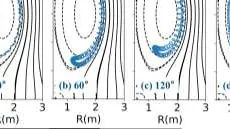
A doughnut-shaped magnetic trap holds plasma made of boron and hydrogen. Inside, the temperature rises above one hundred million degrees — hotter than the center of the Sun. At such heat, nuclei collide and fuse, releasing energy.
A liquid that flows without friction is superfluid helium-4, a strange state of matter at temperatures below two kelvins. In a large volume, the transition to superfluidity occurs at the lambda-point temperature, but in narrow channels everything changes.
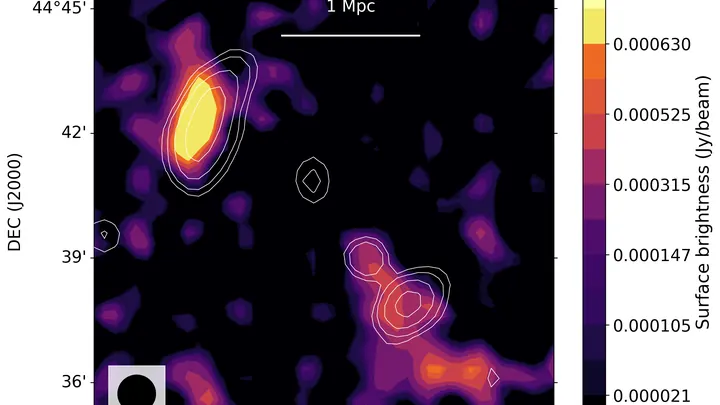
The cosmic microwave background is faint light left over from the Big Bang. It fills the sky uniformly, but it encounters obstacles along the way. One such obstacle is galaxy clusters, which contain very hot gas. When CMB photons pass through this gas, some of them get an extra kick and change energy.
When a bright spot flares up on a star, astronomers want to know how much energy was released into space. They used to picture a flare as a growing campfire: the area of the fire increases, but the heat remains the same. That made calculations simpler, but reality turned out to be different.
At the South Pole, where the air is dry and transparent to millimeter waves, stands a telescope that looks not at stars but at the oldest light in the universe. This light is the cosmic microwave background — the radiation left over from the Big Bang, filling the entire sky.