Plasma heating refers to the various processes that increase the thermal energy of a plasma — a hot, ionized gas of charged particles. In astrophysical contexts, it explains why the solar corona is millions of degrees hotter than the Sun's surface, and why solar flares release enormous amounts of energy. In laboratory fusion devices, plasma heating is essential to reach the temperatures needed for nuclear fusion, but it also poses challenges because turbulent losses can cool the plasma faster than it is heated.
History
The puzzle of coronal heating was recognized in the 1930s, and magnetic reconnection was proposed as a mechanism by Ronald Giovanelli in 1946 and later developed by Peter Sweet and Eugene Parker in the 1950s.
How it works
One major mechanism is magnetic reconnection, where magnetic field lines break and reconnect, converting magnetic energy into kinetic and thermal energy of the plasma. Another is wave heating: electromagnetic waves (like Alfvén waves) propagate through the plasma and are absorbed, transferring their energy to particles. Turbulence also plays a role — chaotic fluid motions can cascade energy from large scales to small scales, where it is dissipated as heat. In fusion devices, neutral beam injection and radio-frequency waves are used to heat the plasma externally.
In practice
Plasma heating is critical for magnetic confinement fusion experiments like ITER, where it is used to bring deuterium-tritium fuel to temperatures above 150 million degrees Celsius, and for understanding space weather that affects satellites and power grids.
Fun fact
In the solar corona, the heating is so efficient that the temperature reaches about 1-3 million degrees Celsius, yet the density is so low that a spacecraft passing through it would not melt — it would just feel a gentle warmth.
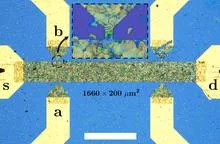
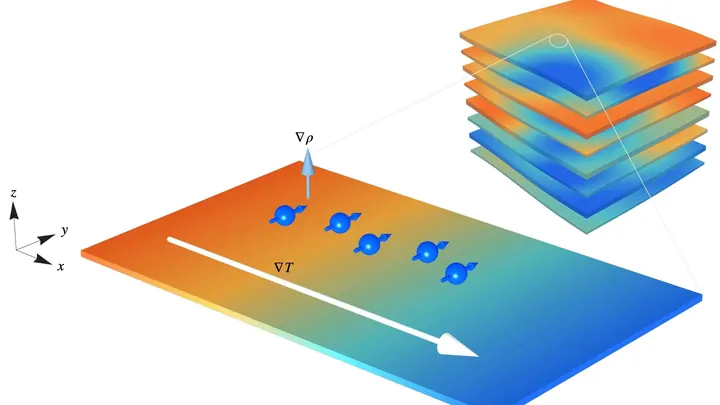
On the lab bench lies a piece of graphite grown from gas, like a deposit on the wall of a reactor. Usually, such material is not suitable for converting heat into electricity: inside it, electrons and holes run in opposite directions and cancel each other out.
At the center of nearly every large galaxy sits a supermassive black hole. It doesn't just devour infalling gas; it also blasts some of it back out in powerful jets. These jets act like giant pistons, shoving the surrounding gas and heating it. Astronomers have long suspected that this is how black holes keep galaxies from cooling into cold star factories.
In a pot on the stove, water starts to churn from the bottom long before the whole thing boils. Bubbles of steam rise from the base even though the burner itself hasn't heated up yet.
A laser beam strikes a thin target hidden inside layers of another material. Within billionths of a second, the material is compressed to a density of 25 grams per cubic centimeter, as if a piece of lead became more than twice as heavy without moving an inch.
A fusion reactor is like a super-hot furnace where plasma reaches millions of degrees. The walls are made of tungsten, the most refractory metal there is. But even tungsten needs protection: fast particles from the plasma bombard the surface and knock atoms loose. These ejected atoms enter the plasma and cool it down, like a spoonful of cold milk in hot tea.
In a pot of boiling soup, light fat droplets rise to the top, while heavy vegetable chunks sink to the bottom. Particles in the tenuous hot gas around the Sun and other stars behave much the same way — except instead of broth, there's a mixture of charged particles: electrons, protons, and alpha particles.
The solar wind is a stream of charged particles constantly blown off the Sun's surface, filling the entire solar system. It's not like a steady breeze: it has eddies, gusts, and calm patches. Scientists call this turbulence.
In the solar corona, it rains from time to time — only not water, but plasma. The hot gas cools, clumps into blobs, and rushes downward along magnetic loops, like drops running down invisible gutters.
A light field, like a neat waffle iron, presses a regular pattern of bright and dark regions into space. Atoms get stuck in the brightest spots as if in tiny dimples: that's an optical lattice. It's a favorite tool for physicists who want to study quantum behavior of matter in its pure form.
To probe deeper into the workings of the universe, physicists accelerate electrons and smash them together. An ordinary electron is like a spinning top that wobbles randomly. For delicate experiments, you need particles whose spins all point in the same direction: this is called polarization.
It all started with stretching. In the first fractions of a second, the universe ballooned — physicists call this inflation. Then the rapid expansion gave way to a phase where the field's energy converted into ordinary particles.
The early universe resembled an overheated cauldron, seething with quantum fluctuations (random bursts of energy). In this chaos, like steam over boiling water, a special field, the scalar field, condensed. It became the 'engine' that made space expand at an incredible rate. This process is called inflation.
The race for fusion energy is like trying to bottle a lightning bolt. For decades, physicists have struggled to recreate on Earth the processes that power the Sun. The main challenge is getting light nuclei to fuse despite their mutual repulsion, while extracting more energy than was spent heating and confining the plasma.
Hot tea cools down, and ice cream melts — heat always flows from warm to cold, and this law seemed unbreakable. But in the quantum world, even familiar rules can be rewritten. Physicists placed a tiny mechanical resonator (a vibrating bridge the size of a microbe) in an optical cavity between two mirrors.
The Sun is a giant cauldron where light struggles through a thick layer of scorching matter. On its way out, photons (light particles) constantly bump into atoms and lose energy. How strongly matter holds back light is called "opacity," and it determines how quickly heat escapes.
Iron is one of the main culprits for opacity in the Sun's interior.
The Sun continuously scribbles magnetic fields across its surface. These patterns are not mere ripples but a handwriting in which nature has encoded warnings of flares. A flare is an explosion that releases the energy of billions of nuclear bombs in minutes, ejecting streams of plasma and radiation into space.
A waterfall that doesn't heat up from the fall but freezes — that's roughly how gas behaves as it flows onto a neutron star in an X-ray pulsar when the star shines dimly. Usually, infalling matter is heated to a white-hot glow, but new work shows the opposite.
In the vast clouds of rarefied gas that fill the space between stars, something is always churning. Supernova explosions, colliding streams — all of it shakes the plasma. And in this rippling, as it turns out, hides the mechanism that gives birth to magnetic fields.
Plasma is a gas in which electrons are stripped from atoms.
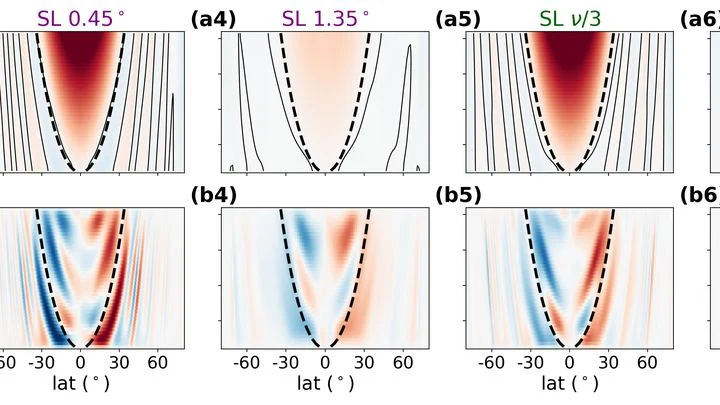
In the deep oceans of icy moons, water is not still. Warm plumes rise from the rocky seafloor, but the planet's rotation twists them into long, slanted rolls stretched along the rotation axis. Previously, this process could not be included in global models: it was too complex.
In a hot mug, water sometimes freezes faster than in a warm one. This paradox is over half a century old and is called the Mpemba effect. It is usually attributed to fluid motion or evaporation. Now physicists have shown that a similar trick is possible without water, just through radiation of heat.
The Sun is a boiling cauldron of hydrogen and helium, where scorching gas is caught in magnetic snares. When invisible ropes reconnect, energy comparable to billions of thermonuclear explosions is released. Where does it go?
Space is full of invisible sprinters — particles racing nearly at the speed of light. They are caught in the solar wind, near neutron stars, and even in the intergalactic void between galaxies. But what accelerates them where there are no shock waves or magnetic reconnections?
Imagine a powerful hair dryer that blows not warm air but white-hot plasma, such devices are called plasma wind tunnels. They are used to test on Earth how a spacecraft will enter the atmosphere.
Inside a neutron star, matter is compressed so intensely that atomic nuclei fuse into long strands and flat sheets. Astrophysicists call these structures nuclear pasta. At their surface, the density of matter plummets to nearly zero, like diving out of thick jelly into thin air.
It's this sharp transition that creates the unusual effect.
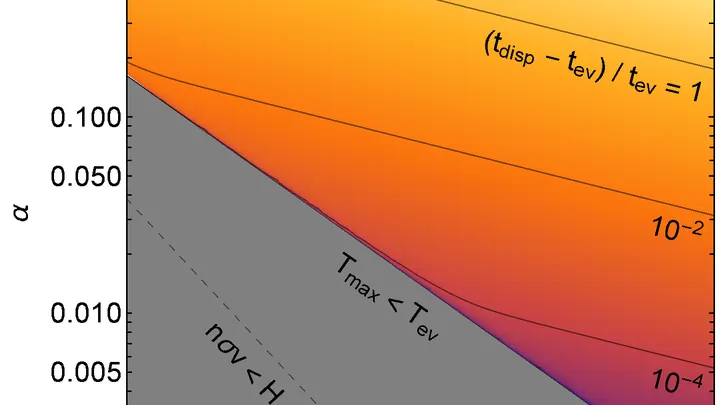
A tiny black hole zips through a gas cloud. Instead of swallowing the gas, it heats it up, like an iron left on a damp cloth. Radiation streams from the black hole, creating a hot spot — a region where the temperature is hundreds of times higher than in the surrounding space.
A thin layer of oil on the surface of water breaks into separate droplets at the slightest disturbance. Something similar happens in the pulsar wind — a stream of particles ejected by a rapidly rotating neutron star. This stream also contains plasma layers, which can break apart into clumps — magnetic islands.
In the scorching solar corona, where temperatures soar past a million degrees, float cold, dense clouds — solar prominences. They hang for weeks, neither falling nor dissolving, like icebergs in a boiling ocean. How they got there is a question that has puzzled astronomers for decades.
Plutonium is a metal with attitude. One form shrinks when cooled, another swells. But at room temperature, the alloy behaves strangely: the ruler says one thing, X-rays say another. The ruler shows the sample barely grows, while X-rays see atoms in the crystal lattice moving further apart.
Immediately after the Big Bang, the Universe underwent ultra-fast expansion, an idea proposed by Alan Guth and developed by Andrei Linde. When the expansion stopped, the field-energy began to oscillate like a giant swing.
A giant cauldron of simmering soup stretches across millions of light-years. This is the atmosphere of the Perseus galaxy cluster — a cloud of scorching gas held together by gravity. Until recently, astronomers thought that in the center of this cauldron, the gas was calmly cooling, ready to condense into new stars.
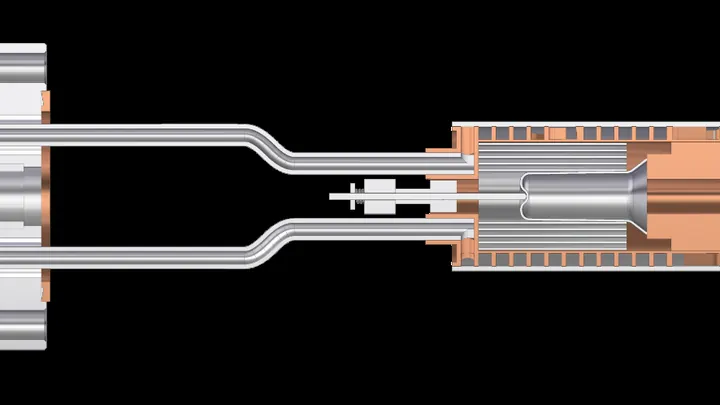
An ordinary aluminum pot on a stove doesn't emit molecules you can catch with light. But if you take aluminum and an aluminum salt, heat them together in a small oven, you get a stream of aluminum fluoride molecules, like steam from a kettle's spout, except instead of water droplets, tiny particles fly out.
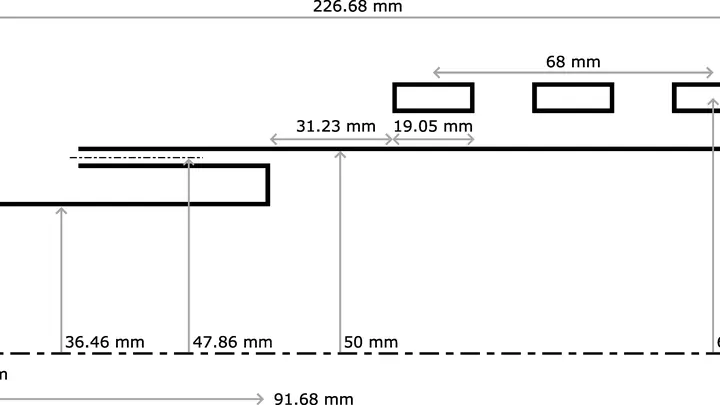
A doughnut-shaped magnetic trap holds plasma made of boron and hydrogen. Inside, the temperature rises above one hundred million degrees — hotter than the center of the Sun. At such heat, nuclei collide and fuse, releasing energy.
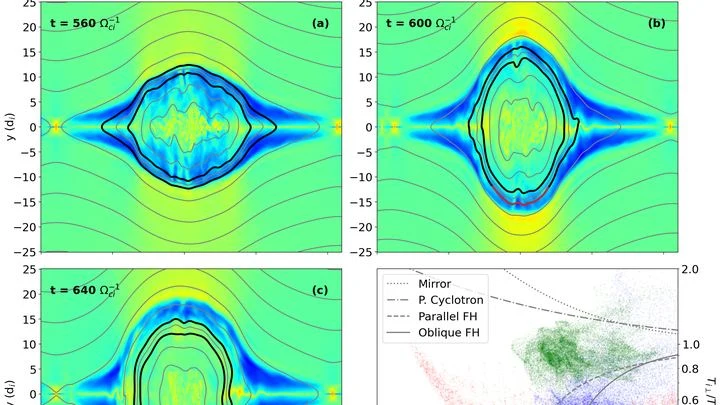
Space plasma is not a calm gas but a boiling soup of charged particles threaded with magnetic fields. These fields behave like stretched rubber bands: sometimes they snap and immediately reconnect, but in a different configuration. This process, called magnetic reconnection, releases enormous energy.
A neutron star is the remnant of an exploded star, compressed to the size of a city. In its core, matter is packed so densely that a teaspoon of such material would weigh as much as a mountain. At such densities, as predicted by the theory of strong interactions, particles acquire 'twins'—parity partners.
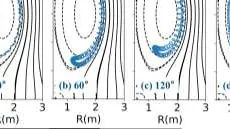
Hot plasma in a tokamak is like a temperamental beast: you need to hold it in, but not let it overheat. In the ASDEX Upgrade reactor, researchers found a regime where plasma eddies solve this problem on their own. Stochastic modeling showed that oscillations at the plasma edge fling out blobs, like bubbles from a boiling pot.
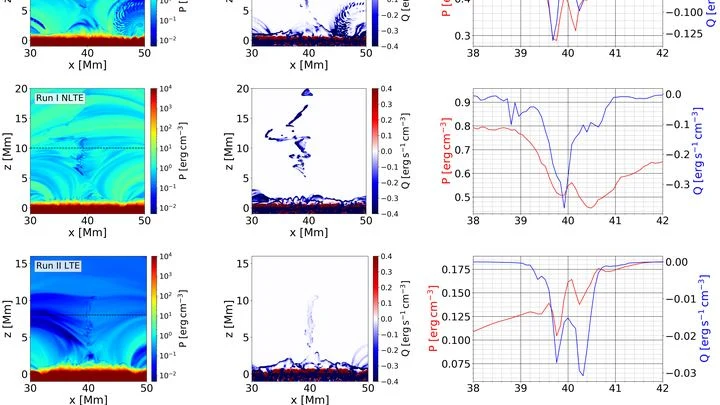
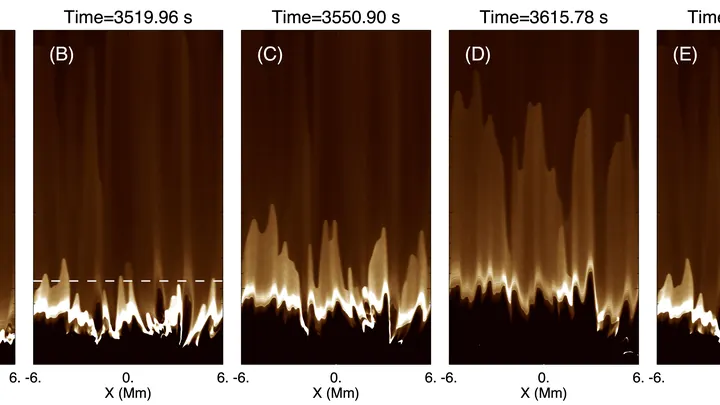
The Sun's surface boils like water in a pot. Hot gas rises, cools, and sinks: that's convection. Magnetic fields churn around, tearing and reconnecting. In this frenzy, spicules are born: narrow plasma jets that shoot thousands of kilometers upward.
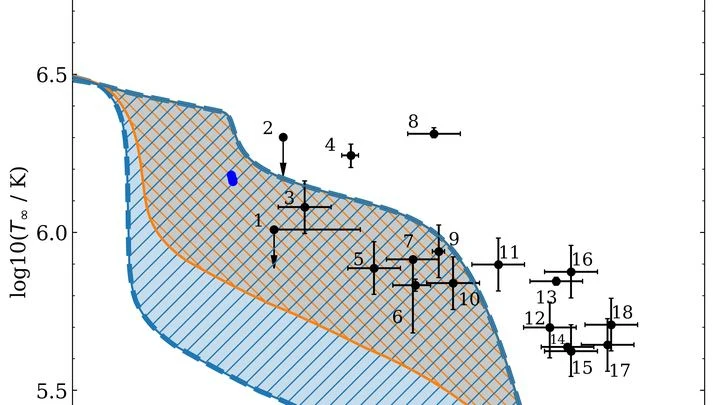
In April 2023, Japanese satellites detected a super-intense X-ray burst on the neutron star MAXI J1752–457. The star cooled down in 4 days — five times faster than usual. Like someone cracked open a cosmic window.
A solar flare is like a giant spring that gets twisted and twisted, and then suddenly snaps. The energy stored in the magnetic field is unleashed into space within minutes, heating plasma to millions of degrees.
The solar flare of June 3, 2012 behaved like an orchestra where, after the main performance, a second soloist unexpectedly steps in. First, instruments recorded a sharp burst of gamma-ray emission with energies above 100 megaelectronvolts — as if billions of tiny bullets struck the detectors at once. Then, after a brief pause, the emission intensified again and persisted for more than eight minutes.
When a bright spot flares up on a star, astronomers want to know how much energy was released into space. They used to picture a flare as a growing campfire: the area of the fire increases, but the heat remains the same. That made calculations simpler, but reality turned out to be different.