Hidden states on the surface of a uranium superconductor express
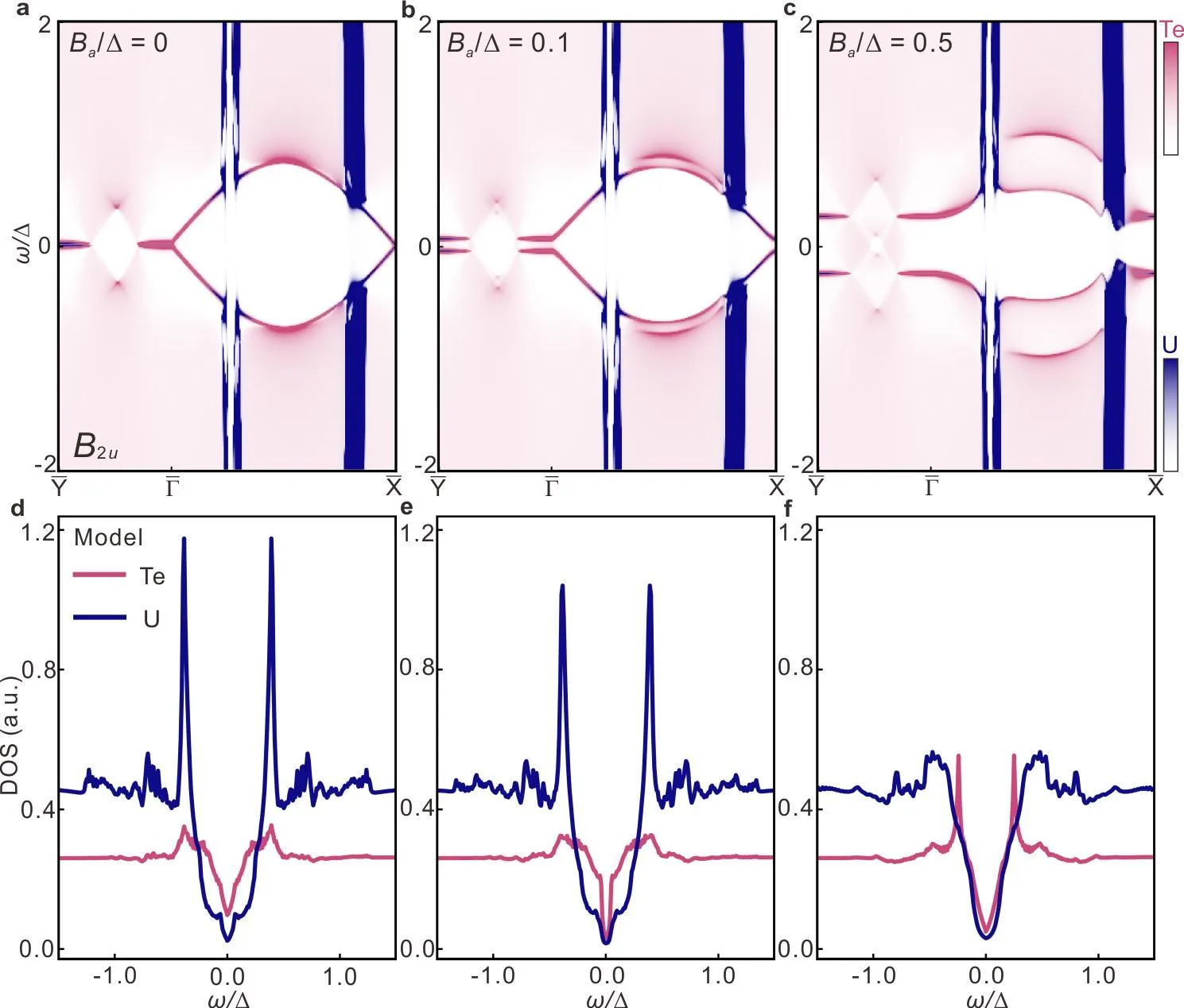
A superconductor is like a city where electric current flows without traffic lights or jams. But the crystal UTe2 has a quirk: its surface follows different rules than its interior. On the tellurium atoms sitting at the surface, electrons found a 'loophole'—states with energies that are forbidden inside the crystal. These states almost completely fill the energy gap — the void that remains empty in a conventional superconductor.
Physicists used a scanning tunneling microscope — a device that probes the surface with a needle, mapping electronic states with atomic resolution. It turned out that on tellurium atoms the density of states inside the gap is high, while on neighboring uranium atoms the gap remains untouched.
When a magnetic field was switched on, the loophole on tellurium closed: the states inside the gap disappeared, and superconductivity became uniform across the surface. Theoretical calculations accounting for the electron spin's interaction with the magnetic field reproduced this picture exactly. This means the found states are not a random impurity but a predicted topological signature.
Now UTe2 becomes a testing ground for studying topological superconductivity. Such materials could be useful for quantum computing: their surface states behave like particles that remember their history of exchanging places.
A scanning tunneling microscope 'sees' individual atoms by measuring the current that flows between a sharp tip and the surface at a distance of less than a nanometer.
Topological superconductors with their protected surface states resemble 'adamantium' from the Marvel universe — a material whose properties are determined by its very structure, not its composition.