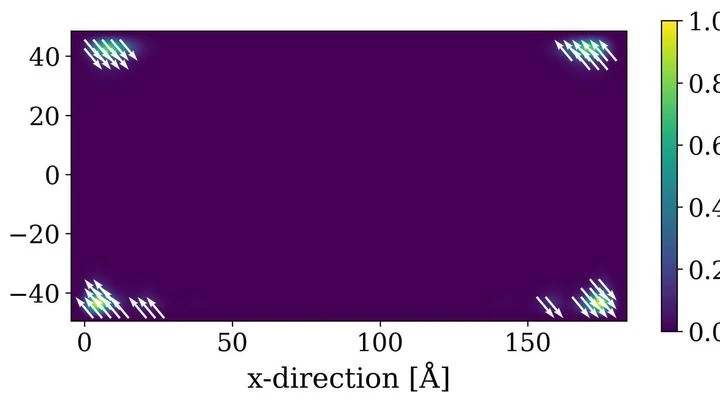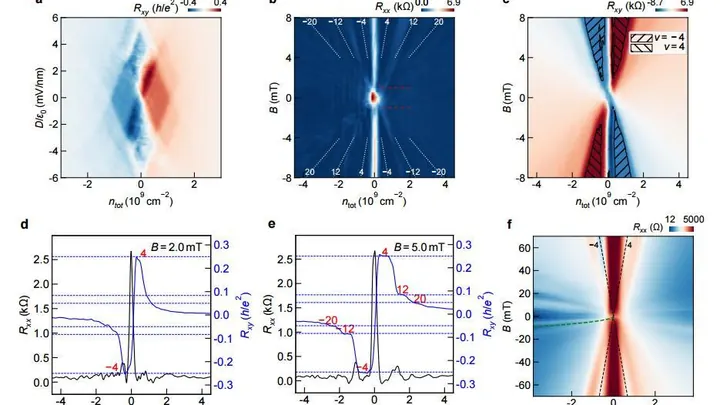
Conducting paths that exist only along the edges or surfaces of certain materials.Edge states are conducting channels that exist only at the boundaries of certain materials, while the interior remains insulating. These states arise from the material's topological properties—global characteristics of its electronic band structure that are robust against local perturbations. The most famous example is the quantum Hall effect, where electrons at the edge of a 2D electron gas in a strong magnetic field form perfectly conducting channels.
The theoretical foundation was laid by the discovery of the quantum Hall effect in 1980 by Klaus von Klitzing. The concept of topological insulators with protected edge states was developed in the mid-2000s by Charles Kane, Eugene Mele, and Shoucheng Zhang, among others.
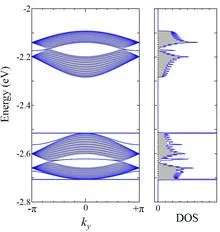
In a topological insulator, the bulk of the material has an energy gap that prevents electron conduction, but at the edges or surfaces, the band structure closes the gap, creating states that are protected by time-reversal symmetry. These edge states are chiral or helical: electrons travel in one direction along one edge and the opposite direction on the other edge, with no backscattering. This protection makes them immune to disorder and defects, as there are no available states for scattering into the opposite direction.
Edge states are promising for low-power electronics and quantum computing, as they could carry current without dissipation. They are also being explored for spintronics, where the spin of the electron carries information.
The edge states in a quantum Hall system are so precise that they are used to define the international standard for electrical resistance, the von Klitzing constant.