Thin film superconductivity refers to the phenomenon where superconductivity—the ability to conduct electricity with zero resistance—emerges in ultrathin metal films, such as those made of gold or copper, which are typically not superconducting in bulk form. This is a striking example of how reduced dimensionality and surface effects can dramatically alter electronic behavior. In these films, quantum confinement and the increased influence of interfaces can induce or enhance superconducting properties, sometimes even in materials that are normally poor superconductors or not superconducting at all.
History
The study of superconductivity in thin films dates back to the mid-20th century, with early experiments on evaporated metal films. However, the specific observation of superconductivity in ultrathin films of normally non-superconducting metals like gold and copper emerged from more recent research in the 2000s and 2010s, often using advanced fabrication and measurement techniques.
How it works
In a thin film, electrons are confined in one dimension, which changes their energy levels and interactions. This confinement can strengthen the electron-phonon coupling or other pairing mechanisms that give rise to Cooper pairs, the fundamental building blocks of superconductivity. Additionally, the proximity of the film to a substrate or another material can induce superconductivity through the proximity effect, where Cooper pairs leak from a superconducting layer into the film. The film's thickness, typically on the nanometer scale, plays a crucial role: too thin and disorder suppresses superconductivity, but at optimal thickness, the enhanced interactions can stabilize it.
In practice
Thin film superconductors are used in superconducting quantum interference devices (SQUIDs), single-photon detectors, and as components in quantum computing architectures, where their small size and tunable properties are essential.
Fun fact
Ultrathin films of gold, which is famously a good conductor but not a superconductor in bulk, can become superconducting when cooled to extremely low temperatures and made just a few atoms thick.
A transparent film of bismuth tungstate sits on a substrate and does not conduct electricity. Three minutes in a cloud of nitrogen plasma, and it turns black, with resistance dropping by a factor of a billion.
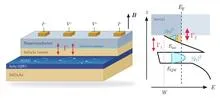
A thin layer of indium arsenide lies hidden under a superconducting film, like a voice beneath the noise of a crowd. In such a hybrid, current takes the path of least resistance and flows almost entirely through the metal, leaving the semiconductor inaudible to standard probes.
A microwave oven heats food, but in the lab, microwaves have done something different: they turned a superconductor into a permanent magnet. A 300-nanometer-thick film of yttrium barium copper oxide, cooled to 80 kelvin, responded to 5-gigahertz radiation.
A thin film of zirconium nitride lies on a magnesium oxide substrate. Its thickness is two-tenths of a micron, like a spider's web, but inside it quantum life is boiling. When cooled to half a kelvin, superconductivity does not disappear all at once: it breaks up into rare islands that still hold on amid the disorder.
Current in an ordinary metal flows like a crowd of people down a straight street: each electron is on its own, and if you turn on a magnetic field, the whole crowd shifts slightly sideways. This shift is called the Hall effect.
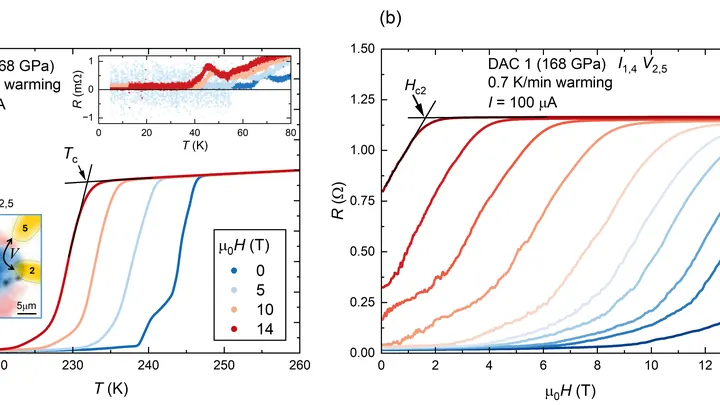
Inside a diamond anvil cell, squeezing a sample with a force millions of times greater than atmospheric pressure, a thin film of lanthanum meets hydrogen. The hydrogen comes from ammonia borane — a powder that, when heated, releases its hydrogen like a sponge releasing water.
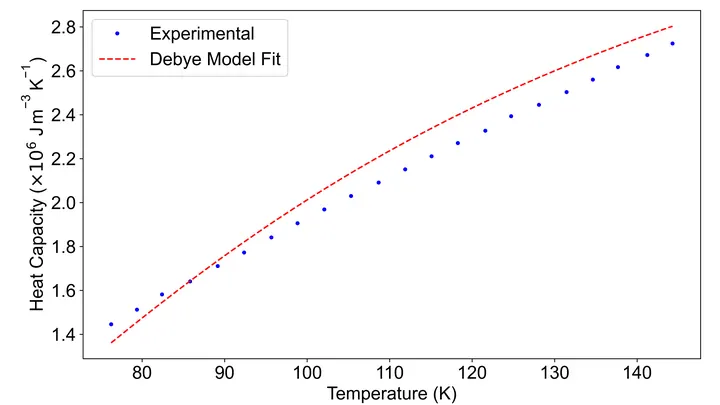
A microchip the size of a fingernail gives off as much heat as a small light bulb. Getting rid of that heat is like trying to cool a cup of hot tea with a teaspoon: the insulating material around transistors is usually a poor heat conductor.
A quantum spin liquid is a state of matter in which the magnetic moments of atoms behave like a fluid: they constantly fluctuate and never settle into a rigid order, even at extremely low temperatures. One of the most famous theoretical models of such a liquid was proposed by Alexei Kitaev.
The uranium-arsenic crystal UAs2 under pressure behaves like a house with two rooms. In one room, electrons sit still; in the other, they roam freely. Under normal conditions, it's a classic "lattice Kondo" system: heavy, almost immobile electrons on 5f5/2 orbitals are surrounded by a sea of fast conduction electrons.
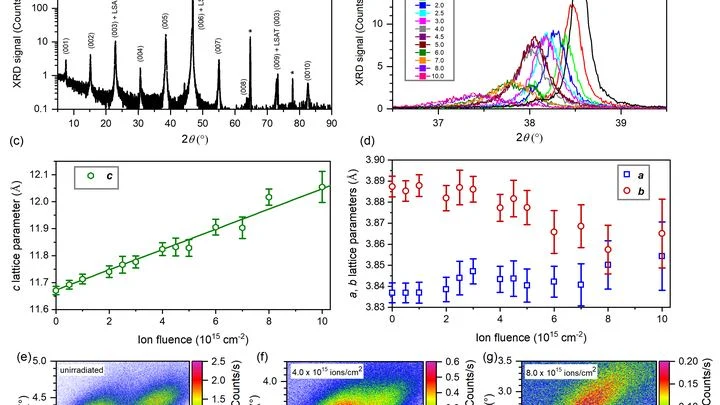
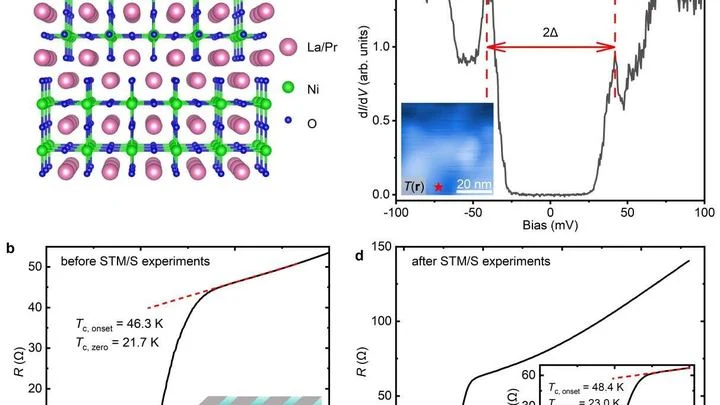
A ceramic plate as thin as a soap film, and through it flows current with zero resistance. That's the superconductivity achieved in nickelates, relatives of the famous cuprate superconductors. Previously, this required enormous pressure, comparable to that at the ocean floor.
A thin film of yttrium barium copper oxide warms under a stream of infrared light, and suddenly stops dissipating energy. That's superconductivity: electrons pair up and move as a single quantum swarm. But in underdoped samples, the harmony breaks long before the pairs fall apart. The pairs are there, but the collective rhythm isn't.
A potter uses a sharp stylus to trace a pattern on a still-damp clay tile. One wrong move, and the line blurs, the tile cracks. Physicists work with films of the high-temperature superconductor YBCO (a compound of yttrium, barium, copper, and oxygen) in much the same way.
Electrons in a conductor are like a chaotic crowd: colliding, they lose energy, and resistance arises. In a superconductor, however, they move in unison, like partners in a well-coordinated dance, without touching each other. This state has reduced энтропией — meaning disorder.
Such behavior is rare for gold and copper.
A packed stadium: fans mill about chaotically, creating jostling and resistance. That's how electrons behave in an ordinary conductor. In superconductivity, they pair up and move in sync, like spectators holding hands and calmly leaving the stands, without losing energy.
A crystal that looks like a stack of pancakes was placed on a smooth substrate of magnesium oxide. The result was a film only a few hundred atoms thick. When they ran a current through it and switched on a magnet, the resistance jumped by nearly a quarter—22.5% in a 9-tesla field.
Inside the film, electricity is carried by two streams of particles.
A mosaic floor made of many small tiles, each turned in a different direction. It seems that any pattern trying to cross such a floor would get scrambled and vanish. That's how people usually think about disorder in crystals: if atoms aren't arranged in a perfect lattice, delicate quantum effects should fall apart.
When you flip a switch, the light doesn't come on immediately — electrons in the wires need time to 'get going' and move together. In ordinary metals and semiconductors, current builds up gradually, like water in a hose when you first open the tap.
A superconductor is a material through which current flows without loss, like water through a perfectly smooth pipe. But to make the pipe perfect, you have to cool it to very low temperatures. Physicists have long been looking for ways to make such a pipe at warmer temperatures, and one clue is the quantum critical point.
An ordinary transistor in a phone is made in a vacuum chamber, where atoms are deposited layer by layer. Expensive and slow. But indium oxide can be printed like ink — from a drop of liquid metal that, in air, coats itself with a thin oxide film.
The authors took indium, melted it, and rolled it over a substrate at 250 degrees.
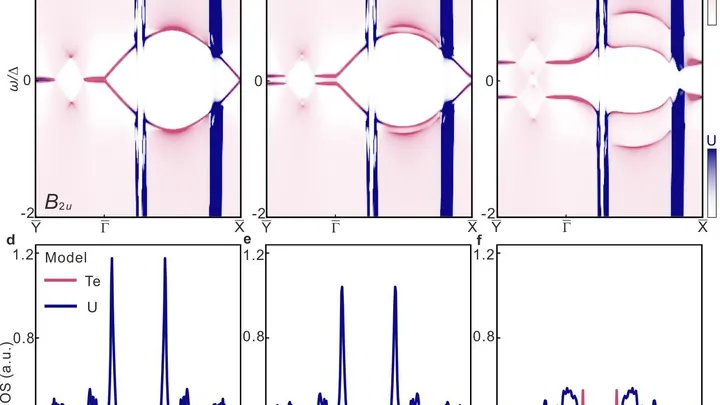
A superconductor is like a city where electric current flows without traffic lights or jams. But the crystal UTe2 has a quirk: its surface follows different rules than its interior. On the tellurium atoms sitting at the surface, electrons found a 'loophole'—states with energies that are forbidden inside the crystal.
An alloy of palladium and tellurium with a small amount of gold added behaves like a wire that loses its resistance when cooled. At ambient pressure, the three samples with different gold contents had superconducting transition temperatures of 2.7, 4.1, and 4.6 kelvin — colder than a freezer, roughly like deep space.
A rug lies flat, but if you push it from the edge, wrinkles run across it. In a thin film of tantalum sulfide (1T-TaS2), wrinkles made of electrons, charge waves, freeze as if the rug were stuck to the floor. To move them, you need to apply force. Scientists have found a way to control this force using an electric field and a magnet.
A sheet of graphene one atom thick is twisted at a small angle, and it starts behaving like a layered pie with layers slightly rotated relative to each other. At a certain twist angle, this material becomes a superconductor: electrons begin to move in pairs, like dancers in a waltz, without losing energy. But what exactly happens inside has remained a mystery.
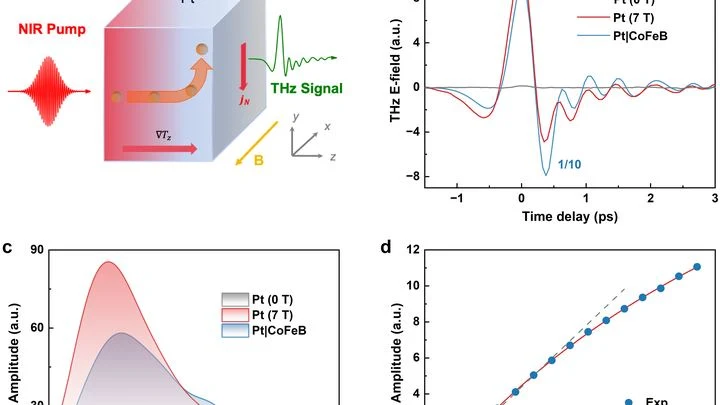
Usually, to generate terahertz waves (light between microwaves and infrared), researchers build a sandwich of different metals. One layer acts as the source, another as the receiver of charges. In such designs, platinum was assigned the role of a simple conductor. But it turns out it can work alone.
A thin film of nickel oxide, tens of nanometers thick, is like a sheet of paper folded hundreds of times thinner. At room temperature, it conducts electricity, but cool it slightly and it becomes an insulator.
A sheet of graphene one atom thick is like a perfectly smooth tablecloth on which electron marbles roll. Place an electric barrier in their path, and usually they'll bounce back. But in graphene, it's different: under certain conditions, electrons pass through the barrier without even noticing it, as if the wall were made of mist.
A metal is a sea of electrons that move almost freely, colliding only occasionally. But in some materials, this sea suddenly becomes viscous and unpredictable: electrons stop behaving like independent particles. Physicists call this state 'non-Fermi liquid,' and it remains a puzzle.
Magnetic atoms in a solid are like compass needles: usually, when cooled, they align in one direction: that's how magnetism arises. But in TbInO3, the terbium needles sit on a triangular lattice where it's impossible to please all neighbors at once. One needle wants to point north, another south, and in the end none can settle into a stable position.
A superconductor is a material that, when cooled sufficiently, conducts electricity without losses, like water flowing through a perfectly smooth pipe. But if you hit it with a brief flash of light, it quickly loses this property.
Ordinary soldering doesn't work for quantum circuits: when cooled to liquid helium temperatures, metal cracks, and the contacts themselves introduce noise. Engineers from the research group tried something different — a drop of gallium alloy that stays liquid at room temperature, like mercury in an old thermometer.
A sheet of paper hundreds of times thinner than a human hair: that's roughly the thickness of the vanadium oxide film scientists grew. Inside this film, electrons, the tiny carriers of electric current, move almost without collisions. Like cars on an empty night highway, they accelerate and don't lose speed.
Sound on a crystal surface is like ripples on water, but traveling through a solid. This ripple is called a surface acoustic wave: it moves a hundred thousand times slower than light, so it can be compressed into very short segments and fit on a tiny chip. Usually, such waves are launched by metallic combs made of aluminum or gold.
A thin film of niobium and tin conducts electricity without resistance — until you make it really thin. Then it suddenly becomes an insulator. A team of physicists tested what happens when you add a bit more tin to the film than the formula calls for.
A quantum computer is like a musical instrument: even a tiny scratch on a string ruins the sound. Instead of strings, we have superconducting resonators — thin traces of titanium nitride on a silicon wafer.
The layered material (SnS)1.15(TaS2) resembles a stack of paper, where the sheets conduct electricity and the interlayers prevent them from sticking together. At ambient pressure, this material conducts current without resistance, making it a superconductor.
A crystal is like a perfectly laid mosaic of atoms. But growing such a mosaic is a tricky task: if the order slips even slightly, 'seams' appear — boundaries where rows of atoms don't align. For ordinary electronics, that's a minor issue, but for a quantum computer, it's a disaster.
An ordinary wire heats up when current flows through it. A superconductor doesn't. But almost all known superconductors require either very low temperatures or enormous pressures, like those deep inside planets. Scientists have long searched for a material that avoids these extremes.
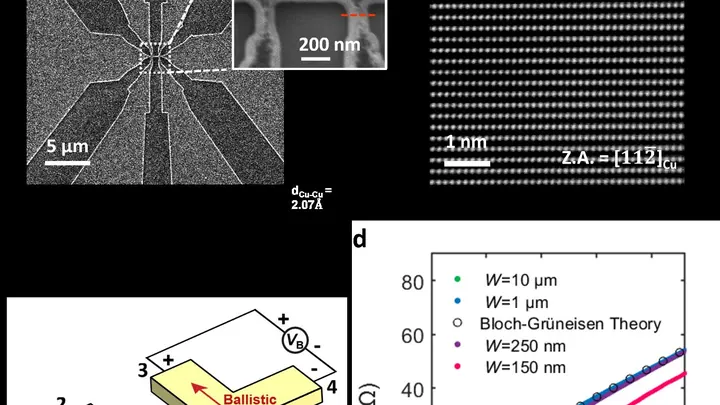
An electron in a metal is usually like a person in rush hour: it constantly bumps into others and loses its way. But if you remove the obstacles, it can fly in a straight line, like a car on an empty night highway. This kind of motion is called ballistic — from the word "ballista," an ancient catapult that hurled a stone without interference.
Sunlight hits a rooftop, and electrons are born in a thin film. They must reach the wires before they cool down and lose their energy. In tin sulfide, a cheap and accessible material for batteries, this sprint and cooldown has now been captured with unprecedented sharpness: frames follow every billionth of a billionth of a second.