concept

edge state

A conducting state localized at the boundary of a material, often topologically protected.
41 related articles

Description

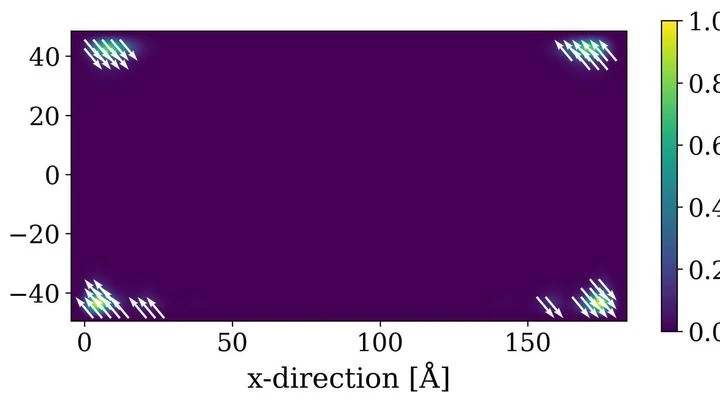
An edge state is a conducting channel that forms at the boundary of a material, often as a consequence of its topological properties. In certain materials, the interior may be insulating, but the edge can conduct electricity without resistance, and this conduction is protected against disorder and defects. This phenomenon is a hallmark of topological insulators and quantum Hall systems, where the edge state's existence is guaranteed by the material's bulk band structure.

History

The concept of edge states emerged from the study of the quantum Hall effect in the 1980s, where they were identified as the conducting channels along the sample boundary. The generalization to topological insulators was developed in the mid-2000s, with theoretical predictions by Charles Kane, Eugene Mele, and others, followed by experimental confirmations.

How it works

In a topological material, the electronic band structure has a nontrivial 'twist' that forces the existence of states at the boundary. These edge states are chiral or helical, meaning electrons travel in a specific direction along the edge, and they cannot scatter backward because that would require a transition to a state that doesn't exist. The protection arises from the fact that the edge state's properties are determined by the topology of the bulk, not by the details of the edge itself. This makes the conduction robust against impurities and imperfections.

In practice

Edge states are explored for use in low-power electronics, quantum computing, and spintronics, where their dissipationless conduction could reduce energy loss and provide stable qubit platforms.

Fun fact

In a quantum Hall system, the edge state's direction of travel is determined by the magnetic field, and it is so robust that it can flow around obstacles without scattering, a property that has been demonstrated in experiments with engineered barriers.

Concept graph →

Related articles · 41

Mesoscale2026-09-023 minarXiv:2609.02567
Zigzag at the Edge: How a Molecular Lattice Mimics Graphene's Electronic States
The triptycene molecule resembles a three-pointed star with rigid arms. When such stars are scattered on a lead surface, they spontaneously assemble into a pattern like a woven basket: triangles and hexagons alternate, and at each node sits not one star but a pair.
Materials2026-08-212 minarXiv:2608.20978express
Quantum Relief of a Monolayer
An ultrathin film of tellurium, tantalum, and iridium atoms behaves as an insulator in its interior but conducts current along its edges. This property, the quantum spin Hall effect, promises lossless electronics. However, calculations of the electronic structure did not predict such a phase for the 1T-TaIrTe₄ monolayer.
Mesoscale2026-08-091 minarXiv:2608.08697express
Magnetic Patterns in Graphene
Graphene, a sheet of carbon just one atom thick, can change its magnetic properties the way water changes shape: sometimes flowing, sometimes freezing into ice. In a new study, physicists peered inside this process for the first time using a sensor the size of a needle tip.
Mesoscale2026-08-071 minarXiv:2608.07374express
Mirror Crystal Splits Electron Highways
A highway where opposing flows are separated not just onto different sides, but onto two independent roads: each with its own entrance and exit. Something similar happens to electrons in a new type of topological insulator described by the authors of the study.
Strongly Correlated2026-08-062 minarXiv:2608.05887express
How an insulator grows a metallic skin
A house with cork walls suddenly gets covered in copper sheets, but only when frost sets in. That's roughly how FeSb₂ behaves when made into a film just a few atomic layers thick. Under normal conditions, it's a narrow-gap insulator: electrons sit tightly in place like spectators in an overcrowded hall.
Strongly Correlated2026-08-032 minarXiv:2608.02753express
Superconductivity on the Edge of Two Worlds
At low temperatures, many materials become superconductors — current flows without resistance. But how exactly does this happen if electrons were initially trapped in an insulator? Half a century ago, Philip Anderson suggested that the answer lies in a special quantum dance of particles.
Strongly Correlated2026-07-231 minarXiv:2607.21705express
Cutting a Quantum Chain to Count Its Edge Modes
Cut a spin chain, and particles without an energy gap appear at the edges. They are called zero modes, and they live only at the boundary. Previously, they were counted using complex topological invariants, but now there is a simpler way.
When a Material Bends Only One Way
Bending a sheet of paper is easy. But compressing it by pushing from the edge is a different story: the paper will crumple but barely transmit the force further. That's how ordinary elasticity works — deformation depends on where and how you press. The new three-dimensional lattice pushes this contrast to the limit.
Materials2026-07-111 minarXiv:2607.10049express
Topology at the Interface of Layers
The book is open to the middle. Current runs along the spine, while the pages remain cool. That's roughly how a two-dimensional topological insulator works — a material where electricity flows only along the edges, while the interior stays still.
Switching Spinners: A Recipe for Eternal Edge Currents
In the new model, each active particle has an internal rhythm: it spins either left or right. Chirality is key: some twirl clockwise, others counterclockwise. But when such a particle bumps into an obstacle or a neighbor, it flips its spin, like a figure skater who, after touching the board, explodes into a reverse pirouette.
How Squeezing Rubber Gives Rise to Elusive Angles
A sheet of rubber is squeezed from two sides. At first glance, it's just deformation. But inside, deep within the material, a hidden order awakens. This is not just wrinkles on the surface. It's the birth of special zones where vibrations become trapped, as if in a cage. Previously, it was thought that such effects require intricate lattices and periodic structures.
Superconductivity2026-06-192 minarXiv:2606.21166express
How the Geometry of Electron Orbits Gives Rise to Superconductivity
In a long corridor, a crowd of people tries to keep as far apart as possible. In a spacious hall, they would simply spread out, but here the walls squeeze them so tightly that they have to move single file, coordinating every step. Electrons in graphene layers twisted by a tiny angle behave in a similar way.
Strongly Correlated2026-06-172 minarXiv:2606.19437express
Quantum Shock: Why Edge Memory Doesn't Fade
Strike a tuning fork: it rings and gradually fades. Roughly the same happens to the edges of special quantum chains when they are suddenly "shaken": oscillations decay, and memory of the initial state disappears. But physicists have discovered that in some cases this ringing lasts surprisingly long.
The Ocean Conveyor on the Brink
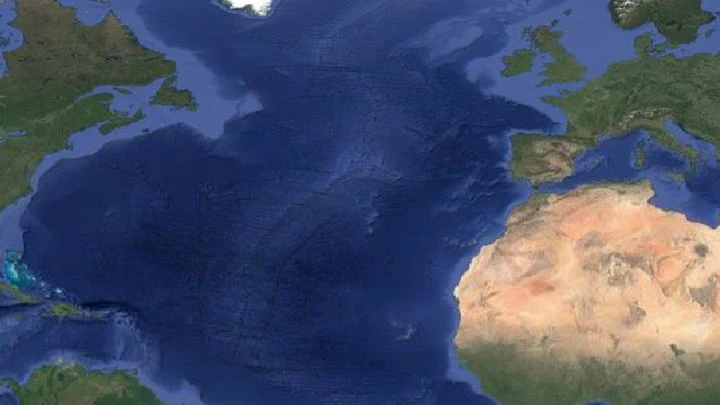
In the Atlantic, a giant invisible conveyor operates: warm surface waters flow north, cool, sink, and return south. This circulation, AMOC, carries heat, making Europe noticeably milder than Canada at the same latitudes. But the conveyor isn't eternal: if diluted by fresh water from melting Greenland ice, the engine stalls.
Quantum Physics2026-06-062 minarXiv:2606.08189express
When Quantum Entanglement Takes the Wheel
Two dice lie in different rooms. If they are 'entangled,' a roll of one instantly determines the outcome of the other — even at a distance. In the quantum world, such a link is called steering: one party, by performing measurements on their side, seems to dictate the state of the partner.
Mesoscale2026-05-172 minarXiv:2605.17335express
The Edge of an Insulator Conducts Electricity Like a Metal
Two thin layers of a semiconductor were twisted relative to each other by 2.29 degrees, like two sheets of transparent paper with printed grids. Where the lines nearly align, a large pattern of dark and bright spots emerges. Electrons in this pattern behave very differently from those in a regular crystal.
Geometry's Verdict: Why Wormholes Are Doomed to Exoticity
Since time immemorial, physicists have dreamed of tunnels piercing the cosmos — wormholes, capable of connecting far-flung corners of the Universe in an instant.
Strongly Correlated2026-05-033 minarXiv:2605.01686express
Superconductivity Without Heavy Atoms
Imagine a line of people holding hands but facing in opposite directions: some look north, others south. That's how a p-wave magnet is arranged. Electrons in it align their magnetic moments (spins) not randomly but in a strict wave-like pattern.
Optics2026-04-251 minarXiv:2604.23209express
Light in a Trap: A New Effect in Special Crystals
Light, discovered by Maxwell, behaves differently in different media. In a new study, researchers simulated a two-dimensional crystal that absorbs light and has magnetic properties. In it, light waves behave like passengers on a one-way escalator: they relentlessly move toward edges and corners, where they accumulate.
Mesoscale2026-04-241 minarXiv:2604.22553express
Quantum Bricks at the Crystal's Edge
A fabric that stretches lengthwise but not crosswise. That's roughly how a semi-Dirac material works: electrons can move freely in one direction but barely budge in the other. Because of this unusual anisotropy, special tracks, one-dimensional channels, emerge at the edges of the two-dimensional crystal. Electrons race along them only along the perimeter, like water in a trough.
Superconductivity2026-04-191 minarXiv:2604.17333express
How to Hear the Shiver of Superconducting Boundaries
Ordinary magnetic measurements only see the surface of a superconductor, where barriers and viscous flows of magnetic field get in the way. Inside, in the so-called intermediate state, superconducting and normal domains coexist, separated by thin walls. These walls can oscillate, but hearing them directly has been difficult.
Mesoscale2026-04-182 minarXiv:2604.16860express
Layers Change the Material's Character
A single-atom-thick sheet of tungsten telluride is like thin foil: electrons can't pass through because there's a band gap between their possible states, like a moat you can't jump across. Add two more layers, and the moat disappears; the material becomes a metal, and current flows. Add more layers, and the properties change again, as if someone is flipping modes with a single button.
Strongly Correlated2026-04-172 minarXiv:2604.16293express
Lone Electrons and Pairs with a Twist: A New Look at Superconductors
Picture a packed bus where every passenger is an electron. In a superconductor, passengers pair up and move in sync, losing no energy. But in high-temperature superconductors like cuprates, this idyll only works when extra passengers are added. If you drop some off, the pairs start acting strangely.
Optics2026-04-112 minarXiv:2604.10111express
Captured Waves: Light Trapped in Time
A struck tuning fork fades: its vibrations leak into the air. But there are systems where the oscillation does not decay, even though there are plenty of free waves around, ready to carry energy away. Physicists call such 'captured' states bound states in the continuum (BIC).
Superconductivity2026-04-061 minarXiv:2604.04883express
Hidden states on the surface of a uranium superconductor
A superconductor is like a city where electric current flows without traffic lights or jams. But the crystal UTe2 has a quirk: its surface follows different rules than its interior. On the tellurium atoms sitting at the surface, electrons found a 'loophole'—states with energies that are forbidden inside the crystal.
Optics2026-03-281 minarXiv:2603.27219express
A Light Vortex That Keeps Its Shape
A laser beam twisted into a spiral looks like a drain vortex in a sink: light moves not only forward but also in circles. Such vortex beams already help move tiny particles and transmit more data. But once they pass through an inhomogeneous medium, the vortex falls apart, like water from a leaky bucket.
Quantum Gases2026-03-211 minarXiv:2603.20763express
Atoms Only Live on the Edge
Atoms settled along a chain of traps, like a line of coastal forts. Nearby, a quantum sea: a Bose-Einstein condensate (a substance with zero resistance, where particles move as a single wave).
Superconductivity2026-03-111 minarXiv:2603.11278express
Heat Unlocks the Secret of a Superconductor
A uranium crystal the size of a grain of rice was cooled to one-fiftieth of a degree above absolute zero. At such temperatures, heat is not transported chaotically but strictly according to the rules of the quantum world.
Mesoscale2026-03-041 minarXiv:2603.03927express
Indestructible current: how quantum edges bypass obstacles
Certain materials, when placed in a strong magnetic field at low temperatures, exhibit a surprising property: their interior stops conducting, becoming an insulator, while along the very edge of the sample electricity runs like a river along a channel, always in one direction.
Mesoscale2026-03-021 minarXiv:2603.02397express
Graphene wraps bismuth in a protective film
Two-dimensional bismuth on a silicon substrate is a promising material for future electronics. Its edges conduct current without loss, like a highway with no traffic lights. But bismuth itself is delicate: air and moisture quickly degrade its properties.
Materials2026-02-221 minarXiv:2602.19347express
How Phosphorus Hides Its Edges
A chain of red phosphorus atoms is like a train where the cars are atoms and the couplers are chemical bonds. Sometimes the couplers are stronger, sometimes weaker, and that affects how electrons run through the train.
Materials2026-02-212 minarXiv:2602.18855express
Layers as a Switch: Topology from Ordinary Components
A stack of identical pancakes on a plate is just a stack. But if you arrange them with a certain order, something new suddenly appears: for example, a pattern that was not visible in each pancake individually. Physicists have performed a similar trick with thin layers of materials.
Strongly Correlated2026-02-201 minarXiv:2602.17906express
The Edge of Graphene: How the Rim of Two-Dimensional Carbon Behaves
A sheet of carbon just one atom thick is placed in a strong magnetic field and cooled to thousandths of a degree above absolute zero. A microwave microscope slides along the sheet's edge, measuring how well that edge conducts electricity.
Superconductivity2026-02-081 minarXiv:2602.08038express
Two Superconductors in One Crystal
The crystal CeRh₂As₂ behaves like a switch: cool it down and it becomes a superconductor, then bring a magnet close and it abruptly jumps to another superconducting state. Such behavior is rare: most superconductors have only one state, but here there are two, separated by a sharp boundary.
Materials2026-02-041 minarXiv:2602.04591express
Lone Waves That Won't Stop
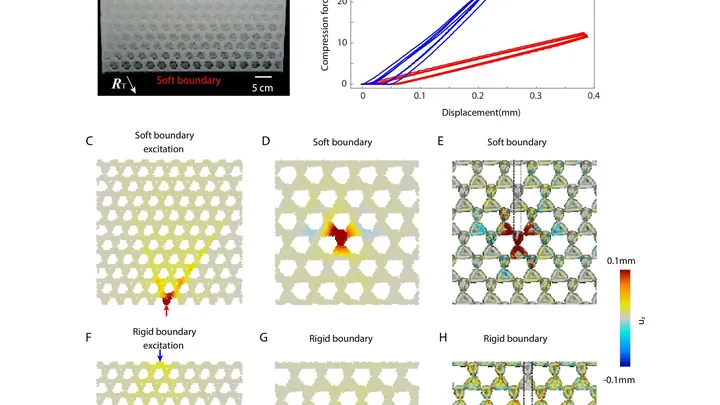
The popping lid of a jam jar is the hero of this story. Press it, and with a loud click it flips from a convex to a concave shape. Exactly the same happens with a hinged beam inside each cell of a new mechanical lattice. Scientists assembled these snapping beams into a hexagonal grid, like honeycomb, but made of elastic plates. When one beam is sharply compressed, it snaps and pushes its neighbor.
Quantum Physics2026-02-042 minarXiv:2602.04627express
Light in Unison: How a Metasurface Makes Atoms Blink Together
Light from many tiny emitters — atoms or artificial "quantum dots"—usually scatters in all directions, like a crowd where everyone shouts on their own. But if you make them "sing in chorus," the flash becomes many times brighter.
Classical Physics2026-01-111 minarXiv:2601.06855express
Sound Passes Through a Wall
Sound in a thin plate behaves like ripples on water: it travels, reflects off edges, and changes shape. But sound has a peculiar trait: it can pass through places where waves are forbidden to exist. It's as if ripples on a pond suddenly vanished before a stone barrier and reappeared on the other side, without going around it.
Mesoscale2026-01-112 minarXiv:2601.06927express
Traps at the Interface: How Defects Mess with Quantum Chips
A quantum chip is like a musical instrument that goes out of tune at the slightest touch. In devices made from strained germanium, a material where atoms are slightly stretched for better conductivity, the main source of off-key notes is defects at the interface between the semiconductor and the insulating layer.
Mesoscale2025-06-023 minarXiv:2506.01401
A Möbius Strip Shaken in Time: Quantum Edges with No Static Counterpart
An ordinary insulator conducts no current, neither in its interior nor along its edges. A topological insulator is a different story: it remains insulating inside but conducts electricity without loss along its edges.
Materials2024-12-032 minarXiv:2412.02813
Where the Electron Lives: Topology of the Band Structure in Real Space
Electronic charge is a tumbleweed that moves camp depending on energy. In tungsten selenide (WSe₂) crystals, this is seen with utmost clarity: at a bias of −1.4 V, near the K point of the Brillouin zone, the maxima of tunneling current sit in the centers of hexagons, where there are no atoms.