Discovered in 1933 by Walther Meissner and Robert Ochsenfeld. Before this, it was thought that a superconductor is simply an ideal conductor with zero resistance, but the experiment revealed a deeper property: regardless of whether the magnetic field was applied before or after cooling, the magnetic induction inside the superconductor is always zero. This is like an elastic ball in carbon dioxide: the gas is displaced, and the ball maintains the field shape around it.
History
The effect was discovered in 1933 by German physicists Walther Meissner and Robert Ochsenfeld. They cooled tin and lead in a magnetic field and measured the field distribution, finding that the field is completely expelled upon transition to the superconducting state. This demonstrated that superconductivity is not merely the disappearance of resistance but a thermodynamic phase. Later, the London brothers (Fritz and Heinz) developed a phenomenological theory, and the microscopic explanation was provided by the BCS theory (Bardeen, Cooper, Schrieffer) in 1957.
How it works
The effect is used to create powerful magnets for MRI, particle accelerators, and levitating transport systems. Limits of applicability: the superconducting state is typically destroyed upon exceeding critical temperature, current density, or magnetic field. In type-II superconductors, the field partially penetrates in the form of vortices (mixed state), limiting ideal screening.
Based on the Meissner effect, ultra-sensitive magnetometers (SQUIDs) have been created, capable of detecting the magnetic field of a human heart from several centimeters away.
The magnetic framework of the EuMnSb2 crystal resembles scaffolding: manganese atoms form rigid vertical pillars, while europium atoms act as movable crossbars. Until now, there was no consensus on the angle at which these crossbars rest and how they rotate when a magnetic field presses on the scaffold.
Inside an MRI magnet, current flows through a closed superconducting loop, like water circling in a bucket after you give it a spin, it just keeps going on its own. To change that current, you heat the loop with a small heater: it stops being superconducting, becomes an ordinary resistor, and then an external source can 'top up' or 'draw off' current.
An ordinary wire heats up when current flows through it — some energy is wasted. A superconductor lacks this flaw: electricity flows through it without loss, like water through a perfectly smooth pipe. The trouble is that most superconductors require either very low temperatures or colossal pressures, like those found in the depths of planets.
A superconductor pushes out a magnetic field like a sponge squeezing out water. This Meissner effect has been known for nearly a century, but it's usually calculated in a flat world — without gravity. In the strong field of a black hole or at enormous speeds, the picture changes.
A superconductor pushes out a magnetic field like a sponge squeezing out water. This Meissner effect has been known for nearly a century, but it's usually calculated in a flat world — without gravity. In the strong field of a black hole or at enormous speeds, the picture changes.
Many materials behave like finicky ice: at one pressure they melt, at another they turn harder. Superconductors in the cuprate family are no exception. Their ability to carry current without loss depends on how tightly the crystal lattice is squeezed. In a new study, physicists traced this dependence for the compound Bi-2223.
A ceramic plate as thin as a soap film, and through it flows current with zero resistance. That's the superconductivity achieved in nickelates, relatives of the famous cuprate superconductors. Previously, this required enormous pressure, comparable to that at the ocean floor.
Many materials behave like finicky ice: at one pressure they melt, at another they turn harder. Superconductors in the cuprate family are no exception. Their ability to carry current without loss depends on how tightly the crystal lattice is squeezed. In a new study, physicists traced this dependence for the compound Bi-2223.
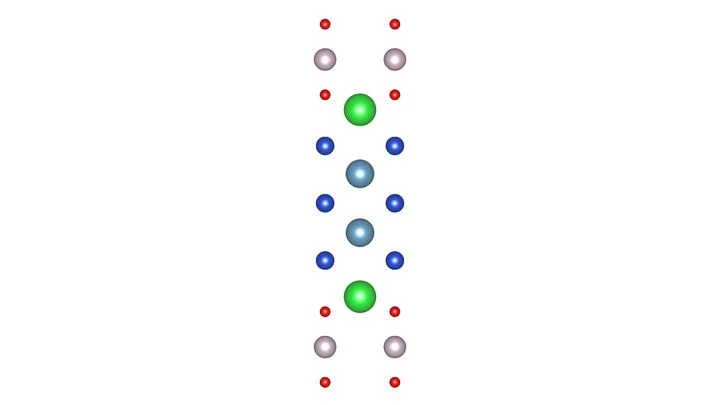
A layered cake where each tier conducts electricity differently: that's the structure of the crystal La3Ni2O7, a compound of nickel, lanthanum, and oxygen. Current flows differently along the layers than across them.
A pale green crystal was placed in a magnetic field and cooled below one kelvin — almost to absolute zero. Inside it hide chains of copper atoms that behave like tiny magnetic needles. Usually their orientation is chaotic, but the strong field and cold make the needles align in a unified impulse, like soldiers on a parade ground.
In superconductors, electrons pair up and flow without resistance. Usually, these pairs are distributed uniformly, like water in a calm lake. But sometimes ripples appear in the material — pairs bunch up and thin out with a certain period. This state is called superconductivity with pair-density waves.
An old factory where instead of machines there are atomic nuclei, and neutrino radiation seethes all around. When a massive star exhausts its fuel, its core compresses a hundredfold, and the temperature skyrockets to billions of degrees.
The interiors of neutron stars are a realm of degenerate matter. Here, protons condense into a superconducting condensate, threaded by quantum vortices. Imagine tiny magnetic tops: each carries a quantum of magnetic flux and glides through the electron fluid.
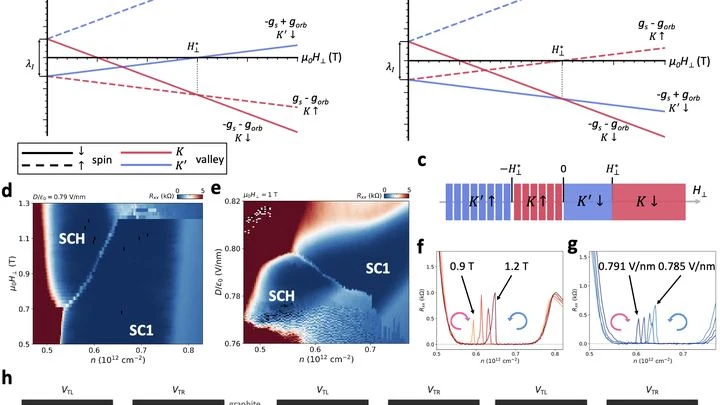
Superconductors usually don't get along with magnets: a strong field destroys the state in which current flows without resistance. But in thin layers of carbon, things are different.
Superconductivity and magnetic field are age-old foes: the field barges in like a whirlwind, tearing apart the delicate pairing of Cooper pairs, destroying order.
Usually, superconductivity is a story about cold. The lower the temperature, the easier it is for electrons to pair up and flow without resistance. But in a new study, physicists grew thin films of nickelates doped with europium and saw the opposite picture.
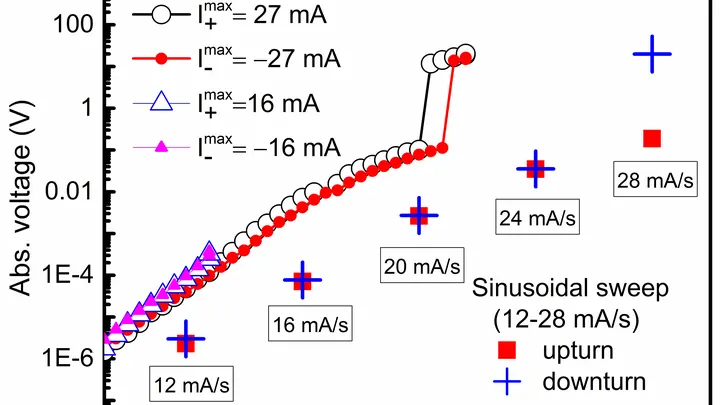
A superconductor is like an ideal highway with no traffic lights: electrons race along without hindrance. But apply a voltage, and the picture changes. In a new experiment, physicists found that an electric field penetrates the superconductor and creates a mixed regime inside.
Superconductors conduct current without loss, but usually require extreme cold. Hg1223 — a mixture of mercury, barium, calcium, copper and oxygen — breaks the rule: it stops resisting current already at –139°C. The secret is that the strong electrical repulsion between electrons forces them to pair up.
A long, narrow pan, and a thin pancake sets in uneven stripes. For decades, scientists saw a similar picture when modeling the behavior of electrons in superconductors — materials that conduct electricity without loss. They used elongated "cylinders," and the result was always the same: rigid magnetic "stripes" that were thought to hinder superconductivity.
Drop an ice cube into boiling water, and it will melt away until nothing is left. A black hole in space behaves much the same way — except the 'boiling water' is space itself, which continuously siphons energy out of the hole.
A superconductor is like a perfect electron dance: electrons move in pairs without losing energy, like dancers who never miss a beat. But add a few magnetic impurities, and strangers crash into the dance, disrupting the synchronized motion. The temperature at which this dance begins drops.
If you squeeze an ordinary piece of metal, it heats up — even those who have pumped a bicycle tire know that. But what happens if you squeeze a magnet in which atomic arrows refuse to freeze even at absolute zero?
A tuning fork grows quieter not because someone stops holding it, but because the very hand that strikes it creates an invisible haze around it that damps the vibrations. A superconducting resonator behaves much the same way — a tiny track along which a microwave signal runs with almost no loss.
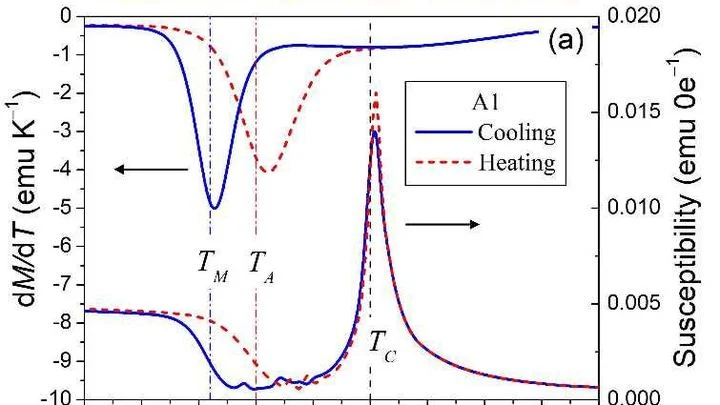
A metal bar suddenly becomes stiff when heated, and at the same time loses or gains magnetic properties. In alloys based on nickel and manganese, such transformations occur not smoothly but abruptly — atoms rearrange into a new order, and the material changes its behavior.
Two paper-thin sheets of a semiconductor are stacked and slightly rotated — by about three to four degrees. The atomic lattices don't match, creating a large-scale pattern — a moiré, like the ripples from two washboards shifted by a small angle. In this pattern, electrons move quite differently than in a regular crystal.
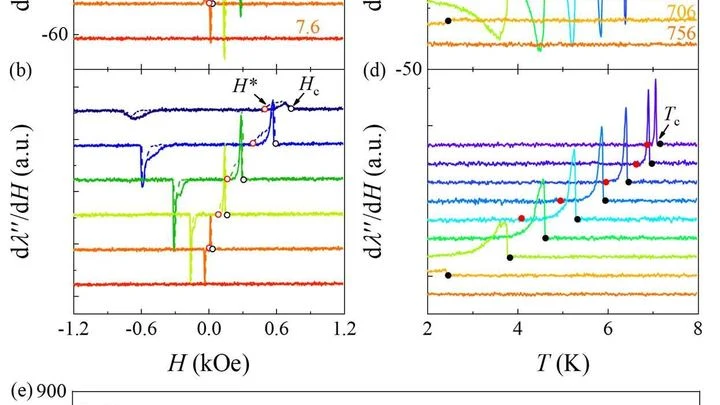
Ordinary magnetic measurements only see the surface of a superconductor, where barriers and viscous flows of magnetic field get in the way. Inside, in the so-called intermediate state, superconducting and normal domains coexist, separated by thin walls. These walls can oscillate, but hearing them directly has been difficult.
Gas falls onto a neutron star — the ultra-dense remnant of an exploded star. This gas accumulates at the magnetic poles and forms a mountain. But a mountain on a neutron star is not like one on Earth: it is held not by rock but by magnetic field lines, like iron filings on a magnet.
When there is too much gas, the mountain begins to break apart.
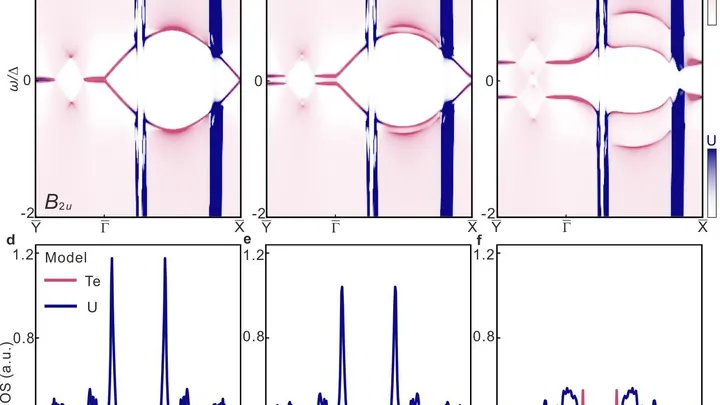
A superconductor is like a city where electric current flows without traffic lights or jams. But the crystal UTe2 has a quirk: its surface follows different rules than its interior. On the tellurium atoms sitting at the surface, electrons found a 'loophole'—states with energies that are forbidden inside the crystal.
A thin sheet of graphene, just a few micrometers thick, was placed in a weak magnetic field, and it began to push the field out of itself, like a sponge squeezing out water. This effect, known as the Meissner effect, is the hallmark of a superconductor: a material that conducts electricity without loss.
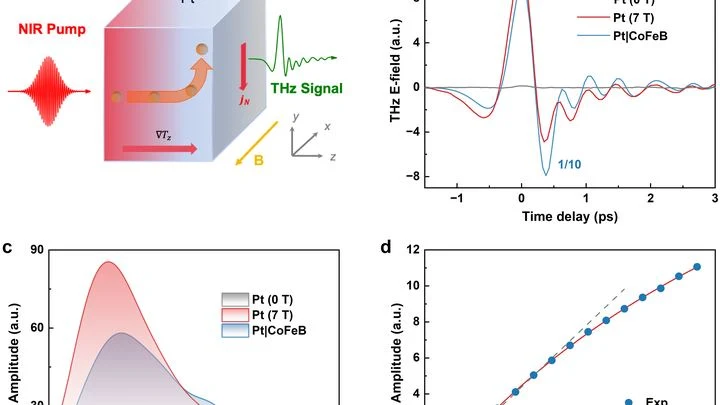
Usually, to generate terahertz waves (light between microwaves and infrared), researchers build a sandwich of different metals. One layer acts as the source, another as the receiver of charges. In such designs, platinum was assigned the role of a simple conductor. But it turns out it can work alone.
In a crystal made of europium, zinc, and phosphorus, electric current behaves like a car on a bumpy road. Electrons don't run freely but drag magnetic clouds, polarons, behind them.
Superconductivity is the ability of a material to conduct electricity without losses. Ordinary wires heat up, and some energy is lost as heat, but a superconductor carries current with zero resistance.
A superconductor is a material that, when cooled sufficiently, conducts electricity without losses, like water flowing through a perfectly smooth pipe. But if you hit it with a brief flash of light, it quickly loses this property.
An ordinary superconductor expels magnetic fields, but this ring does the opposite: it creates a magnetic field inside itself. The ring is made of Fe(Te,Se) — a compound of iron, tellurium, and selenium that loses its electrical resistance at very low temperatures.
Certain materials, near absolute zero, superconduct: electricity flows without loss. The critical temperature starts this. John Bardeen and colleagues explained that atomic vibrations glue electrons into Cooper pairs.
The layered material (SnS)1.15(TaS2) resembles a stack of paper, where the sheets conduct electricity and the interlayers prevent them from sticking together. At ambient pressure, this material conducts current without resistance, making it a superconductor.
An ordinary superconductor loses resistance when cooled, and current flows through it without loss. But in ultrathin films, things are different: the material fluctuates between normal and superconducting states, and in this transition zone, strange resistance waves emerge. Resistance rises and falls as if someone were turning a volume knob.
An ordinary conductor carries current equally in both directions, like a door that swings both inward and outward. A diode, by contrast, is a door with a self-closing hinge: it opens easily one way but pushes back the other.
In an ordinary wire, heat drives electrons: that's the Seebeck effect, familiar from thermocouples. But in magnets, things are trickier: charge carriers also carry spin, their own little 'top.' In some materials, called altermagnets, electrons with different spins interact differently with the crystal lattice, so a…
A superconductor is a material that, at very low temperatures, conducts electricity without losses: electrons move without bumping into each other, like a crowd walking down a perfectly smooth corridor. But turn on a strong magnetic field, and vortices appear inside the superconductor — tiny regions where superconductivity vanishes.