How to Catch Chaos in the Quantum World express
A spoon drops into a cup of hot coffee, and ripples spread across the surface. They show how quickly the disturbance moves away from the point of impact. In the quantum world, physicists look for similar 'ripples on water'—how information spreads along a chain of atoms. But there's a catch: to measure this motion, you usually need to run time backward, which is nearly impossible.
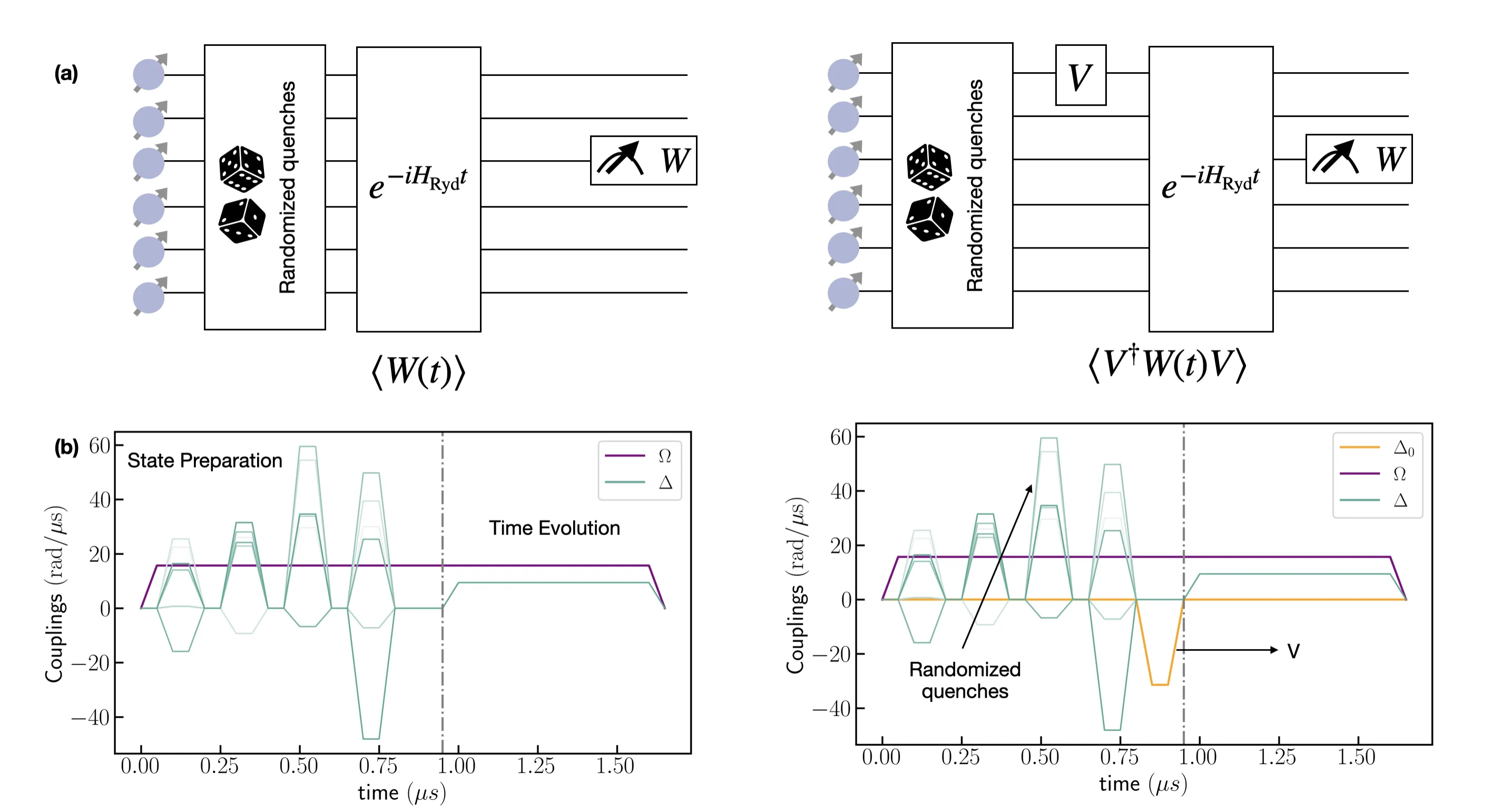
Researchers at QuEra Computing came up with a workaround. Instead of reversing time, they randomly shake the entire system many times, like shaking a box of marbles to figure out how they roll around. From the statistics of these shakes, you can reconstruct the picture of information spreading. The method was tested on the Aquila quantum computer with a chain of hydrogen atoms cooled to near absolute zero. And for the first time, they saw a 'light cone'—the boundary beyond which information cannot travel faster than light.
Previously, such measurements required a complex procedure with time reversal, which doesn't work well on analog quantum computers. The new protocol uses only random shakes and statistics, and it works. The authors compared their results with exact calculations on a classical computer, and everything matched. Now scientists have a simple tool to study quantum chaos in large systems — which is important for building more powerful quantum computers.
The ripples from the spoon in the coffee are exactly that 'light cone' of information. Only now physicists can see it in the world of atoms, without rewinding time.
Original abstract
as written by the authors arXiv:2604.05038
Out-of-time-order correlators (OTOCs) are the main tool for probing quantum chaos and scrambling, and have become crucial probes in many areas of quantum computing. However, the measurement of OTOCs is difficult to implement on analog quantum computers due to the requirement of backward time evolution. In this paper, we develop and implement a randomized measurement protocol to compute OTOCs on Aquila by QuEra Computing. Unlike traditional methods that require backward time evolution, our approach utilizes a sequence of global randomized quenches that approximates the unitary 2-design properties necessary for extracting infinite-temperature OTOCs from statistical correlations. We demonstrate the protocol's success by explicitly observing the lightcone of information propagation in 1D Rydberg chains, and compare hardware results to both state-vector simulations and matrix product state (MPS) tensor network calculations. This work establishes the first demonstration of fully analog randomized OTOC measurements in neutral-atom simulators, providing a scalable pathway to probe quantum chaos in complex many-body systems.
In the quantum world, information cannot travel faster than light: this limit is called the 'light cone.' In the experiment with atoms, it was observed directly, like ripples on water.