Time reversal is a wave-focusing technique that exploits the reversibility of wave equations to concentrate energy at a specific point in space and time. By recording a wave signal, reversing it in time, and re-emitting it, the wave retraces its path and focuses on the original source, even in complex, scattering media. This principle applies to sound, light, microwaves, and even seismic waves, enabling precise targeting in applications from medical therapy to communication.
History
The concept was developed in the 1990s by Mathias Fink and colleagues at the University of Paris, who demonstrated time-reversal mirrors for ultrasound. It builds on earlier work in phase conjugation in optics.
How it works
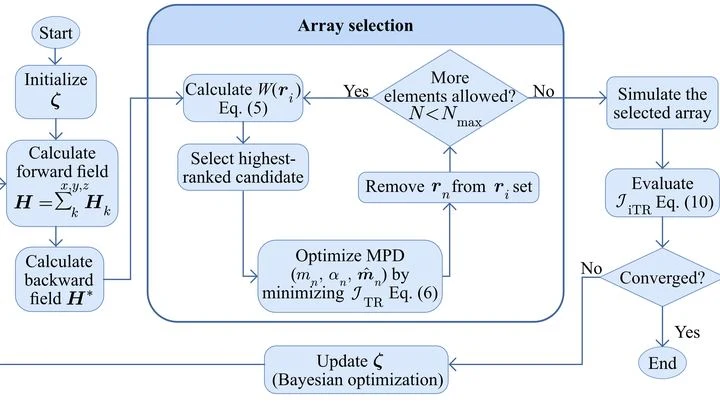
The method relies on the time-reversal symmetry of wave propagation in lossless media. A wave emitted from a source is recorded by an array of transducers. The recorded signals are time-reversed (played backward) and re-emitted. Because the wave equation is symmetric under time reversal, the reversed waves interfere constructively at the original source location, effectively 'refocusing' the energy there. In practice, this works even in heterogeneous media because the scattering that scrambled the wave is undone by the time-reversal process.
In practice
Time reversal is used in non-invasive medical treatments (e.g., focusing ultrasound to destroy tumors), underwater acoustic communication, and nondestructive testing of materials.
Fun fact
Time-reversal focusing can be so precise that it can target a single grain of sand in a water tank, a feat demonstrated in early experiments.
The universe sometimes resembles a pot of boiling water. With enough heat, liquid turns to vapor: that's a phase transition. Something similar could have happened in the early universe: a field filling space suddenly changed its state, like water becoming gas.
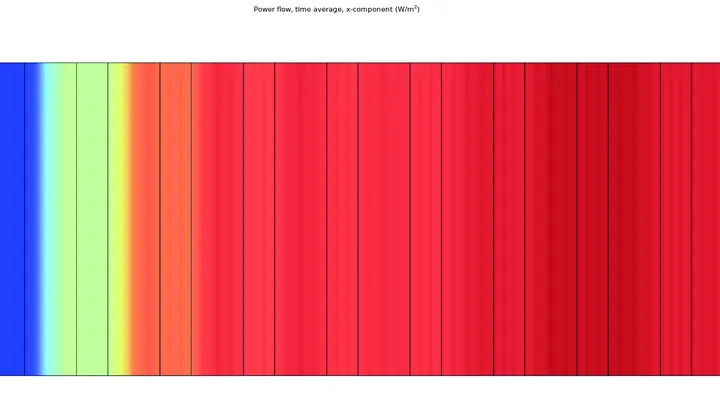
A pebble tossed into a pond sends ripples spreading in all directions. Now imagine the pond itself suddenly turning into jelly — instantly, faster than the wave can complete a single crest. Some ripples would keep spreading but change their spacing, while others would unexpectedly turn around and run back toward the point of impact, as if time were flowing backward for them.
A beam of light passing through a transparent plate usually keeps its color. But if you stack the plate from thin alternating layers, it becomes a grating that reflects and transmits waves selectively. This has long been used in lasers and optical filters. Now such gratings have been made to vibrate, and light started changing color.
A pendulum swings both left and right at the same time. In the atomic world, such a 'double' state is called a Schrödinger's cat: a particle exists in two states simultaneously, like the cat in the thought experiment — both alive and dead.
Scientists have found a way to assemble such states from many atoms using short light pulses.
An ordinary laser amplifies light into a bright beam. Run the process in reverse, and you get an anti-laser — a device that sucks in light without a trace. But such a machine is finicky: even a slight disorder can ruin the absorption.
Physicists have found a way to make the anti-laser invulnerable.
Sound waves on a chip usually spread in all directions, like whispers echoing around a dome. In a gyroscope, this creates noise that obscures rotation. But a new design forces sound into a one-way flow. By tapping the sound path at several points with precise timing, backward-traveling waves cancel out, while forward waves reinforce.
An orchestra plays a complex piece, and each group of instruments enters on its own schedule. The violins might slow down while the woodwinds keep the same tempo, and the percussion might suddenly burst into a roll. The conductor hears everything at once, but pinpointing the exact moment when the flutes, not the cellos, changed rhythm is nearly impossible.