Quantum algorithms exploit three key resources: quantum parallelism (superposition), quantum entanglement, and amplitude interference. Instead of enumerating possibilities, they transform the superposition of all input data so that in the end, constructive interference amplifies the amplitude of the correct answer, while incorrect information cancels out. Efficiency is often measured by the number of queries to an oracle — a 'black box' that checks the solution.
History
The theoretical foundations were laid by Richard Feynman in 1982, who pointed out that quantum systems are hard to simulate classically. David Deutsch in 1985 formulated the concept of a quantum Turing machine and gave the first example of a quantum algorithm that requires fewer oracle queries. In 1992, Deutsch and Richard Jozsa generalized it, demonstrating exponential advantage. In 1994, Peter Shor developed the factorization algorithm, and in 1996, Lov Grover proposed the algorithm for quadratic speedup in search.
How it works
A typical quantum algorithm consists of four stages: initialization of the register in a superposition of all input states (e.g., Hadamard transform), application of an oracle (quantum function evaluation), amplification of the correct solution (e.g., Grover iteration or quantum Fourier transform), and measurement. The speedup arises because quantum operations act on amplitudes rather than probabilities, and the number of possible states grows exponentially with the number of qubits.
In practice
Shor's algorithm cracks modern encryption systems; Grover's algorithm speeds up search in unordered databases; quantum computing promises breakthroughs in modeling materials and drugs.
Fun fact
Simon's problem (finding a hidden pattern in a black box), which is solved exponentially faster by a quantum computer, directly inspired Peter Shor to create the factorization algorithm — breaking down a number into prime factors.
A courtroom interpreter catches every word, every breath, every whisper in the corner. They have no right to miss a detail, because the meaning of the whole conversation depends on it. Quantum state tomography works in much the same way: it reconstructs the full quantum state of a system from a set of measurements, leaving no detail out.
Water in a river, flowing around a stone, changes its course: some streams press against the surface, others detach and swirl downstream. A classical computer calculates such flows by dividing the fluid into millions of tiny parcels and tracking each one.
At the center of a neutron star, matter is compressed so tightly that a teaspoon weighs a billion tons. You'd think there's no better place to look for signs of quantum gravity. But between the laboratory and the fundamental scale lies a chasm of 10⁸⁰ in density.
Three doors lead into this room.
A quantum computer is like an orchestra where each instrument is a qubit and the conductor is the control processor. The conductor must not only set the tempo but also change the score on the fly if a soloist plays something unexpected.
A quantum computer is like an orchestra where each musician, a qubit, plays their part but keeps hitting wrong notes. To keep the music from turning into cacophony, you need a conductor who instantly hears the off-key notes and corrects them.
A quantum computer is like an orchestra where each musician, a qubit, plays their part but keeps hitting wrong notes. To keep the music from turning into cacophony, you need a conductor who instantly hears the off-key notes and corrects them.
A cookbook without a shopping list: that's what a scientist faces when looking at a scheme of chemical reactions. The arrows and formulas on paper look neat, but once you start hunting in the lab for molecules that will actually behave that way, a real quest begins.
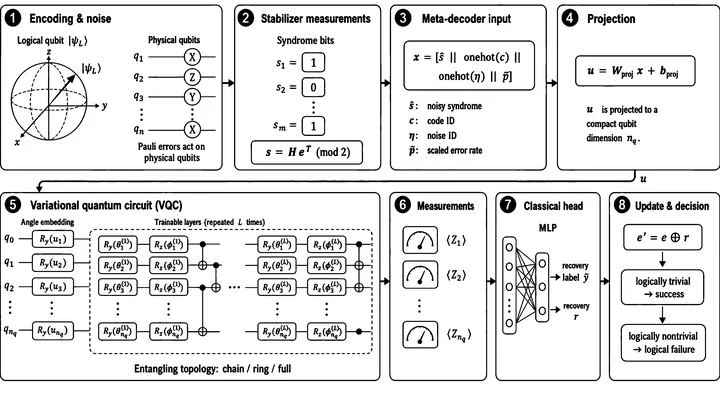
A quantum computer is like an orchestra where each musician-qubit easily loses the rhythm. The slightest noise, and the melody of computation turns into cacophony. To keep the orchestra playing in harmony, you need a conductor who instantly spots wrong notes and corrects them without stopping the performance.
In a noisy hall, an interpreter tries to catch every word, but rustles and echoes muddle the meaning. That's roughly how conventional computer methods handle complex quantum systems: the more particles and the stronger their correlations, the faster calculations drown in interference.
An electrical grid stuffed with power electronics resembles a huge orchestra without a conductor. Each converter, each line adds its own note, and sometimes the instruments start playing out of tune.
An electrical grid stuffed with power electronics resembles a huge orchestra without a conductor. Each converter, each line adds its own note, and sometimes the instruments start playing out of tune.
The quantum world is full of strange connections. Two particles can become “entangled”: the state of one instantly affects the other, even if they are kilometers apart. But how do you know if they are truly entangled? It's like a ball of yarn: at first glance, you can't tell whether it's a single tangled ball or just a mess of loose threads.
Two dancers on stage must move in perfect sync, but if one hesitates, the whole routine is ruined. That's roughly how quantum computers with neutral atoms work: two atoms are entangled by putting them into a Rydberg state (as huge as a balloon compared to an ordinary atom), and then you wait for them to 'dance' their part.
Quantum calculations often resemble assembling a complex mechanism: a physicist knows a part will fit, but can't always explain why. One favorite trick is to insert a 'unity' into the middle of a formula — not an ordinary one, but one built from an infinite set of all possible states of the system. This turns a cumbersome expression into a chain of simple integrals.
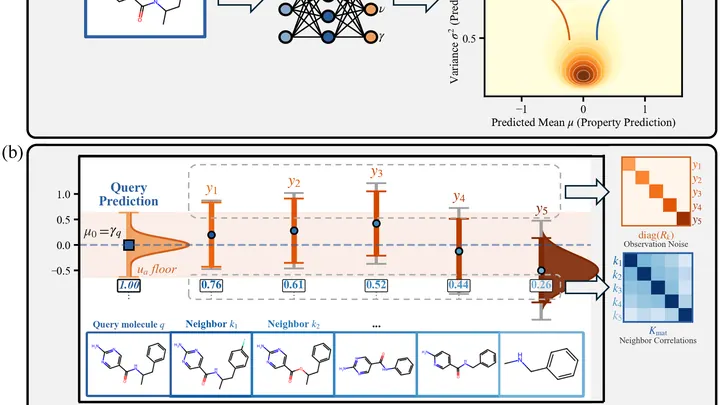
Predicting the properties of a new molecule is like guessing the flavor of an unfamiliar dish. The program works like an experienced chef: it “tastes” similar molecules whose properties are already known, and based on their “flavor,” it refines its guess.
A quantum computer is like an orchestra where each musician is a fragile qubit. The slightest noise, and the melody falls out of tune. To keep the harmony, you need a conductor who instantly hears the false notes and brings the instruments back into line.
Quantum devices are no longer lab curiosities. They are assembled, tuned, and repaired like ordinary hardware — except inside them, it's not just current but intricate tangles of particles that can exist in multiple states at once. Engineers draw schematics, programmers write code, physicists calculate effects.
DFTB is a high-speed train in the world of quantum chemistry: hundreds of times faster than classical DFT, yet still on electronic rails. But its engine — iterative self-consistency of charges — sometimes resembles an orchestra where each instrument starts from an arbitrary note.
Searching for the global minimum in the Sherrington–Kirkpatrick spin glass model resembles climbing a glacier, where every crevasse is a treacherous local optimum, and the true bottom lies buried beneath a chaos of ice blocks. A classical climber, trudging along the gradient, would almost certainly freeze in the nearest crevice.
A quantum computer is like an orchestra without a conductor: each qubit is a musician, and the slightest slip throws off the entire symphony. To keep the music from turning into cacophony, quantum error-correcting codes were invented.
A quantum computer is like an orchestra where every musician must hit their note exactly. If one plays off-key, the melody falls apart. The musicians here are qubits, storing information.
The classical neuron is a chamber musician, drawing only one note from each string: it takes a weighted sum of inputs, adds a bias, and passes it through a nonlinearity.
A quantum computer is like a finicky musical instrument: the slightest change in temperature, humidity, or string tuning, and the melody sounds different.
Recommendation systems that decide which post you’ll see next run on deep neural networks made up of thousands of operations — intricate computation Graphs (blueprints of operations on data). These systems are living, ever-evolving Dynamical Systems: the slightest architecture change cascades through the entire graph.
A metallurgical workshop piled high with aluminum scrap looks like an orchestra out of tune before a concert: each instrument is off-key in its own way. Offcuts of airplane wings, crushed cans, shavings from milling machines: each 'instrument' has its own metallicity, nonlinearly influencing the final 'melody' of strength and thermal conductivity.
Imagine an audition for a symphony orchestra, where out of hundreds of hopefuls, only those whose instruments sound pure and withstand the furious crescendo remain. In the world of materials, computers have learned to generate 'atomic scores'—thousands of virtual crystals that promise to become the foundation for quantum chips or superconductors.
In the courtroom, a string is presented as input. Twelve jurors (computation paths) examine it symbol by symbol. Each can render a 'guilty' (accept) or 'not guilty' verdict. For a conventional nondeterministic automaton (NFA), one 'yes' vote suffices.
Quantum computing suffers from 'false notes' — errors that arise from the slightest inaccuracy. Now they are eliminated with the precision of tuning a concert grand piano. The idea traces back to the dreams of pioneers — David Deutsch and Peter Shor — of flawless operations.
Gold doesn't lie on the surface: it's hidden in tons of barren rock. To extract a gram of precious metal, prospectors sift through cubic meters of dirt.
A complex financial contract is like a wager: the payout depends on exchange rates and accrued interest. Physicists would call this uncertainty entropy — a measure of the spread of possible outcomes. To assess the risk, you need to run through all scenarios, like finding every trap-filled dead end in a vast maze.
A network of tiny magnets seeks the state with the lowest total energy: that's roughly what the quantum Max Cut problem looks like, one of the toughest in physics. Scientists have been hunting for its solution since the days of Werner Heisenberg.
Creating a material with desired properties is an art that long relied on intuition and luck. Nature gives no hints: dozens of elements in the periodic table, and the number of their combinations tends to infinity. Previously, materials scientists resembled alchemists, trying everything in a row, or relied on statistical models that lost power beyond the known.
Today's Freon-based refrigerators and air conditioners silently poison the atmosphere. An alternative is solid-state caloric materials that cool under rapid pressure changes via the barocaloric effect.
In 1953, mathematician Alexander Grothendieck proved a theorem that became a cornerstone in the theory of tensor products. It states that for ordinary function spaces, two natural norms, the projective and the injective, are equivalent up to a universal constant. In other words, two ways of measuring the 'size' of combinations of vectors give similar results.
Strike a tuning fork with a mallet — it vibrates, and the sound gradually fades. A black hole behaves much the same way when disturbed: it emits gravitational waves — ripples in spacetime itself — and then settles down.
Training a large neural network across hundreds of compute nodes is like making soup as a team: each 'chef' tastes the dish and tells the others what to adjust.
In the quantum world, particles can merge into a single liquid that flows without friction. One of its most mysterious forms is the fractional quantum Hall liquid. In it, electrons or atoms move as a single vortex, and their charge splits into fractions, like a pie cut into perfectly equal slices.
A lithium battery is like a tiny city: lithium ions are the residents who move between electrode neighborhoods, generating current. But to understand how much energy the city can deliver, you need to know not only the street layout (the material's structure) but also how residents interact with neighbors, transportation, and even the weather.
In the world of atoms and particles, everything tends toward rest: particles lose energy, just as a swing slows down due to energy loss (friction). But many devices — from hydrogen masers to atomic clocks — live by repetitive cycles.
Many cutting-edge physics calculations hit a brick wall — not for lack of ideas, but because of arithmetic. We're talking about integrals that express particle collision probabilities or the shape of gravitational wave bursts.