An Event Takes Shape
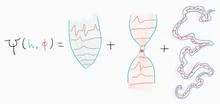
In the familiar picture of the world, an event is a point on the map of spacetime: 'here and now,' with no size or internal structure.
The boundary in spacetime beyond which information cannot travel faster than the speed of light.A light cone is a geometric construct in spacetime that defines the set of all events that can be causally connected to a given event. It consists of two cones meeting at the event: the future light cone contains all points that can be reached by light or slower signals from the event, and the past light cone contains all points from which light or slower signals could have reached it. The surface of the cone itself represents paths of light rays.
The concept was introduced by Hermann Minkowski in 1908 as part of his geometric reformulation of Einstein's special relativity, where he unified space and time into a four-dimensional manifold.
In spacetime, light travels at the maximum speed, so its worldlines form the boundary between regions that are causally connected and those that are not. Any event inside the future light cone can be influenced by the event at the apex; anything outside is unreachable, even in principle. This structure is fundamental to special and general relativity, ensuring that cause precedes effect in all reference frames. In quantum gravity, the sharpness of the light cone may blur, as suggested by some approaches.
Light cones are used in cosmology to model the observable universe, in GPS satellite corrections to account for relativistic effects, and in particle physics to determine which events can be causally related in collider experiments.
The edge of the observable universe is defined by our past light cone: we can only see objects whose light has had time to reach us since the Big Bang.