The toy Monte Carlo is a computational technique used in physics to understand the statistical behavior of an analysis without needing real data. The idea is simple: you simulate many fake datasets—'pseudo-experiments'—that are generated according to your best-guess model of the underlying physics and detector response. You then run your entire analysis pipeline on each simulated dataset, just as you would on real data, and record the result each time. By collecting the outcomes from thousands or millions of these pseudo-experiments, you build a distribution that tells you how much your analysis's answer would fluctuate due to random chance alone.
History
The technique emerged in the mid-20th century with the advent of electronic computers, and it became a standard tool in particle physics during the 1960s and 1970s, particularly at CERN and other accelerator laboratories. The name 'toy' distinguishes these simplified simulations from full detector simulations, which are much more detailed and computationally expensive.
How it works
The method relies on random number generation to create each pseudo-experiment. You start with a probability model that describes the expected signal and background, then sample from that model to produce a dataset that looks statistically like what the real experiment might produce. After running the analysis on each simulated dataset, you histogram the resulting quantities—such as a fitted parameter or a test statistic. This histogram approximates the probability distribution of the analysis output under the null hypothesis or under a given signal hypothesis, which lets you quantify uncertainties, set limits, or compute p-values.
In practice
It is used in high-energy physics to estimate the significance of a new particle discovery, to set upper limits on rare processes, and to validate that an analysis has no systematic biases.
Fun fact
The same principle underlies the 'bootstrap' method in statistics, but the toy Monte Carlo is tailored to the specific detector and analysis of a physics experiment.
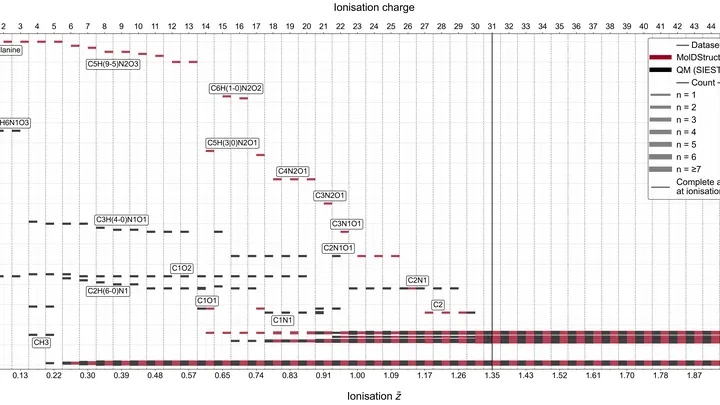
A tennis ball hits a sandcastle. The castle crumbles, but by where and how far the grains of sand fly, you can guess the castle's shape. That's roughly how the method of exploding proteins with X-rays works. The laser beam is so powerful that the protein molecule loses electrons and flies apart into charged fragments, like the castle under the ball's impact.
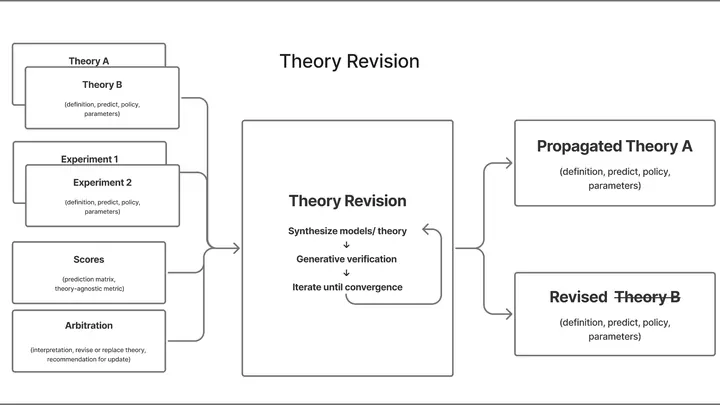
A closed loop: the machine proposes an idea, tests it on people, sees the failures, and spawns a new, more accurate guess. That's how AutoCog works — an automatic cognitive scientist. Previously, in the science of thinking (cognitive science), the hardest part, coming up with a theory, was done only by humans.
A plumber clears a clog in a narrow, winding pipe — by feel, without seeing inside. That's roughly how a surgeon feels during mechanical thrombectomy, the operation to remove a blood clot from a brain vessel. Time is short, and every move can either save a life or damage the vessel wall.
When matter is compressed to pressures of millions of atmospheres and heated to thousands of degrees, it is neither solid nor gas. This warm dense state is like the interiors of giant planets or the moment of a meteorite impact. You can't look inside directly, but you can shine X-rays and see how they scatter off electrons.
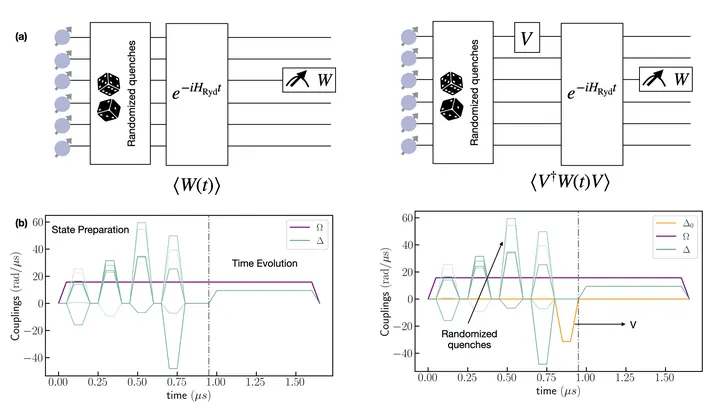
A spoon drops into a cup of hot coffee, and ripples spread across the surface. They show how quickly the disturbance moves away from the point of impact. In the quantum world, physicists look for similar 'ripples on water'—how information spreads along a chain of atoms.