The Crystal That Sings in the Cold express
A guitar string rings longer if you don't touch it too much. A resonator, a device that vibrates at a single frequency like a tuning fork, behaves in much the same way. A team of engineers made such a "tuning fork" from aluminum nitride, smaller than a grain of sand, and made it oscillate 16 billion times per second. That's the frequency at which sixth-generation mobile networks will operate.
The main enemy of oscillation is friction: it turns vibrational energy into heat. The less friction, the higher the quality factor — a measure of how many oscillations a resonator completes before it dies down. The scientists cooled the device from room temperature down to −266 °C, measuring the quality factor at each step. It turned out that in the cold, it increased more than fourfold: from 363 to 1589. For comparison, a typical tuning fork has a quality factor of about a thousand, but it oscillates thousands of times slower.
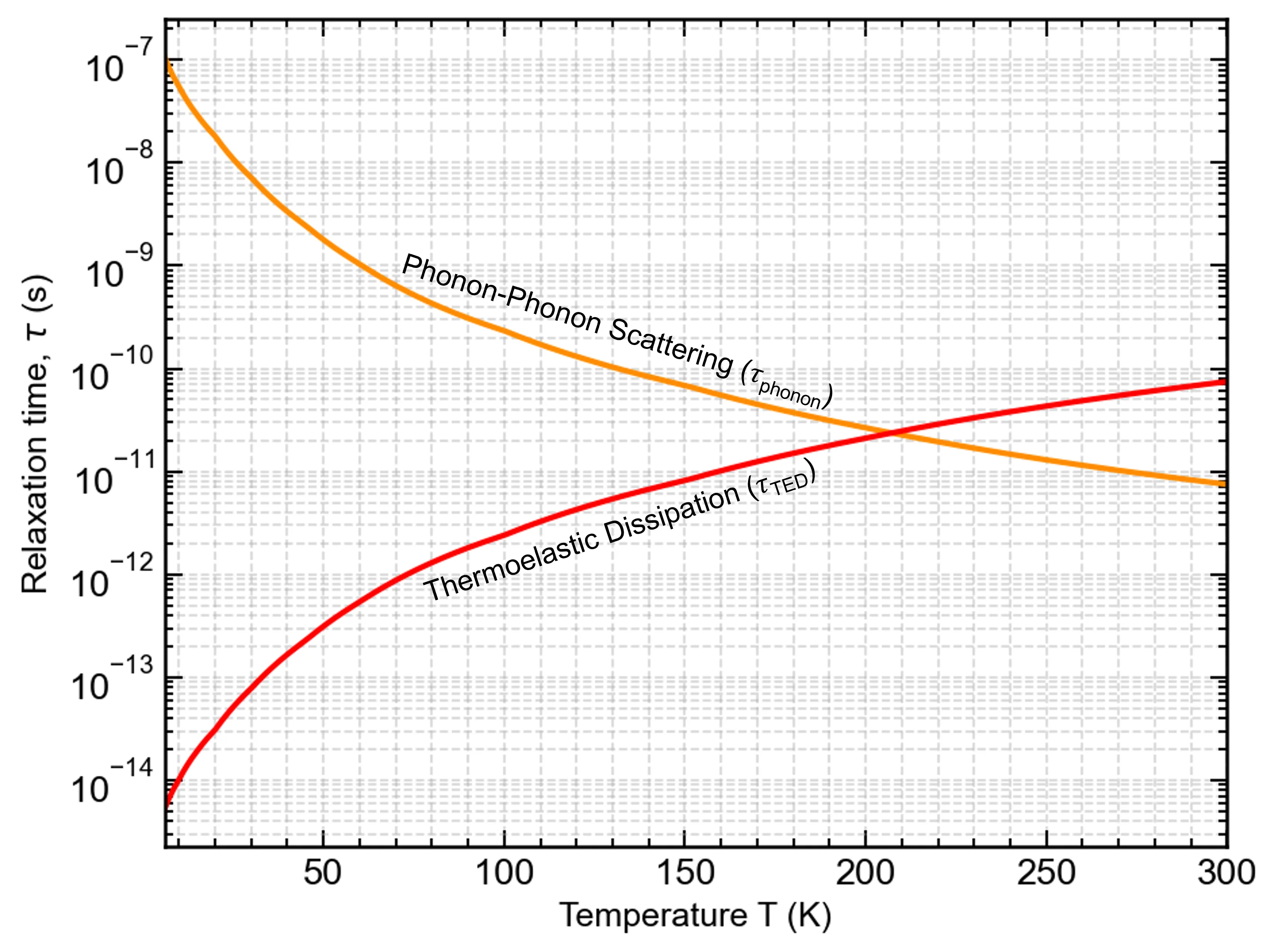
To understand where the losses come from, the engineers built a model that accounts for both internal friction in the material and energy leakage through the supports, as if a string were losing vibration not only to the air but also to the guitar body. The model predicted how the quality factor would change with temperature, and it matched the measurements. Then they tested it on another resonator that oscillates 23 billion times per second, and it matched again.
Such a tool would allow engineers to design filters for quantum computers in advance. In those devices, signals are so weak that any extra noise ruins everything. An aluminum nitride resonator in extreme cold could become that tuning fork that never goes out of tune.
Original abstract
as written by the authors arXiv:2604.13364
Aluminum nitride (AlN)-based thin-film bulk acoustic wave resonators (FBARs) are promising compact platforms for 6G communications and quantum memory hardware, enabled by their integrable acoustic modes with high quality factors. However, temperature-dependent acoustic dissipation ultimately limits device performance. In this work, we fabricated a 16 GHz epitaxial AlN FBAR as a test platform, performed small-signal RF measurements from 6.5 K to 300 K, and developed a physics-based model to estimate the fundamental quality-factor limits of FBARs to cryogenic temperatures. The proposed model incorporates both intrinsic and extrinsic loss mechanisms, including an analytical anchor-radiation loss model for bulk acoustic wave resonators, rather than relying solely on finite-element simulations. Measured loaded quality factor (Q) decreases monotonically with temperature, from Qmax of approximately 1589 (Qf=24.79 THz) at 6.5 K to 363 at 294K (Qf=5.66 THz). This trend is consistent with the theoretical limit based on the resonator geometry and the chosen Metal-Insulator-Metal (MIM) stack. To demonstrate the generality of the physics-based framework, we further validate it by benchmarking against a 23 GHz high-overtone bulk acoustic resonator (HBAR) using previously reported data. The validated model provides a practical, transferable framework to interpret Q(T) limits in low-loss resonators by quantifying the temperature-dependent mechanisms that constrain Q, enabling the design of cryogenic microwave filter elements for superconducting quantum hardware.
A quality factor of 1589 means the resonator completes fifteen hundred oscillations before its amplitude drops by a factor of one hundred. The human ear perceives the decay of sound as a long ring, but here the "ring" lasts less than a millionth of a second, yet for microchips, that's a very long time.
In Arthur C. Clarke's novel The City and the Stars, computers store memory in crystal lattices that don't lose information even over millions of years. Aluminum nitride resonators are a step toward such reliable quantum memory.