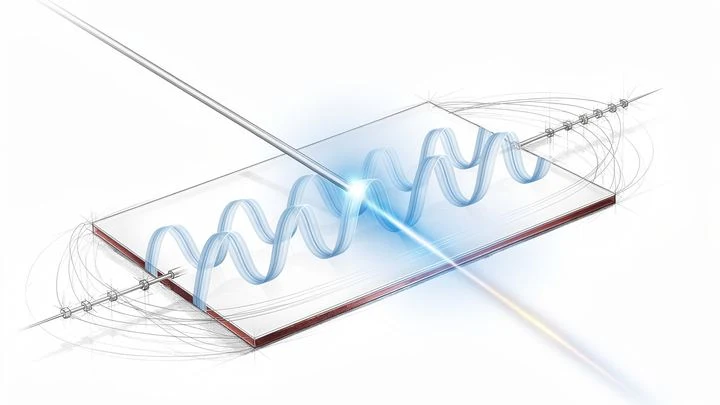
Cryogenic microwave measurement is the experimental backbone of superconducting quantum computing. It involves sending carefully shaped microwave pulses down coaxial lines into a dilution refrigerator, where qubits—tiny superconducting circuits—are cooled to about 10 millikelvin. At these temperatures, the circuits become quantum mechanical, and the microwave pulses manipulate their quantum states. The same setup reads out the qubit state by measuring the transmitted or reflected microwave signal, which carries information about the qubit's energy level.
History
The technique emerged in the late 1990s and early 2000s with the development of superconducting qubits, notably by groups at Yale and NEC. It built on earlier work in cavity quantum electrodynamics and microwave engineering.
How it works
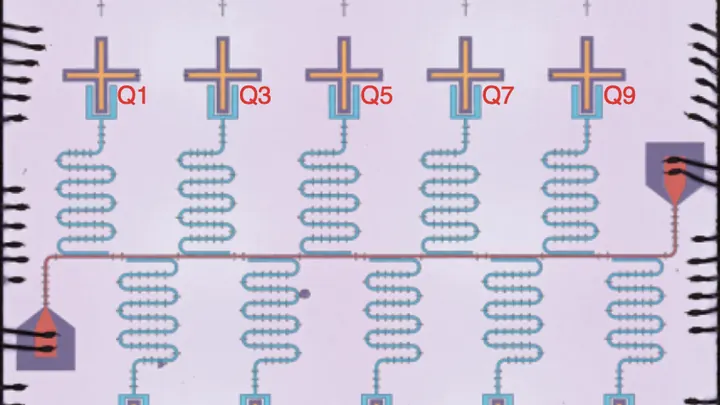
The measurement chain is carefully engineered: room-temperature electronics generate pulses, which are attenuated and filtered as they travel down the fridge to reduce thermal noise. At the bottom, the pulses interact with the qubit, which is typically coupled to a microwave resonator. The resonator shifts its resonance frequency depending on the qubit state, so measuring the phase or amplitude of a probe pulse reveals the qubit's state. The entire path is shielded and thermalized to prevent stray photons from disturbing the quantum system.
In practice
It is the standard method for controlling and reading out superconducting qubits in quantum computers, and it is also used for studying other low-temperature quantum devices like quantum dots and Josephson junctions.
Fun fact
The dilution refrigerator used in these measurements can reach temperatures colder than the cosmic microwave background radiation left over from the Big Bang.
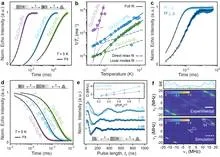
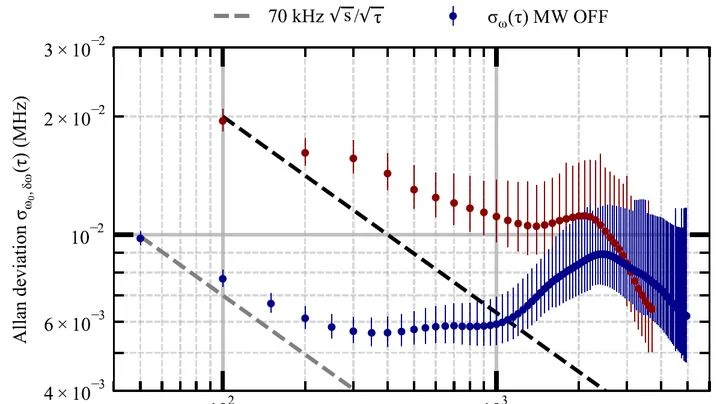
A tiny diamond, invisible to the naked eye, sits on a chip and senses heat like no ordinary thermometer can. Hidden inside it are two defects: places where a carbon atom is replaced by a nitrogen atom, with a vacancy nearby.
Instead of an ice bath, a warm gas blanket. That is how the cryogenic current comparator at Japan's National Metrology Institute is now cooled. Previously, this instrument, which compares electric currents to within billionths of a percent, required immersion in liquid helium.
A ship in a bottle is assembled from the inside, not the outside: masts and sails are pulled through the narrow neck, and once inside the glass they settle into the right pose on their own. Chemists have done something similar with a single cobaltocene molecule, which they pulled into the gap between layers of a two-dimensional crystal.
A microwave oven heats food, but in the lab, microwaves have done something different: they turned a superconductor into a permanent magnet. A 300-nanometer-thick film of yttrium barium copper oxide, cooled to 80 kelvin, responded to 5-gigahertz radiation.
A superconducting detector usually works like an honest ruler: absorb a photon, get a pulse whose amplitude is strictly proportional to the energy. This mode is convenient, but it has a ceiling: a weak signal easily gets lost in the amplifier noise.
Now imagine a swing.
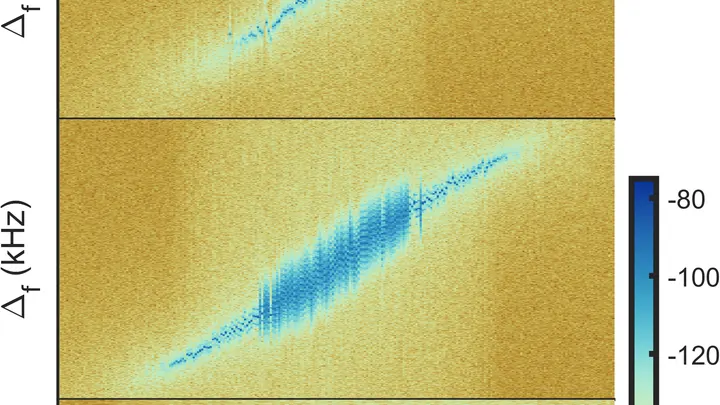
An ordinary lamp shines steadily, while a lighthouse flashes. Scientists in London have made a tiny diamond work like a lighthouse, but not for light — for radio waves. To do this, they added a bit of nitrogen to the crystal and then shone a green laser on it.
A quantum lab is like a kitchen where the chef waits a day for the stove to cool down. Superconducting qubits only work at temperatures of a few hundredths of a kelvin, and each 'cool, measure, warm up' cycle eats a whole day. A team of engineers built a fridge the size of a melon, weighing 3 kg, that does the job in just two hours.
A black hole is a maze with no way out. But what happens to the information inside? To test this, physicists didn't fly to the nearest hole; instead, they built a tiny replica on a quantum processor. The maze was played by a chain of 32 superconducting qubits, where each step leads only forward, like a one-way corridor.
A superconducting quantum interferometer is a device that senses magnetic fields billions of times weaker than the needle of an ordinary compass. Inside it, there is a narrow bridge where superconductivity briefly breaks.
Microwave plasma in a vortex is like a kitchen mixer that simultaneously heats and stirs the gas. In the reactor, the gas is swirled, and microwaves heat it to thousands of degrees, tearing carbon dioxide molecules apart. Scientists created a computer model of such a reactor to understand how pressure affects the process.
Quantum computers make mistakes. Each qubit is like a ball balanced on the tip of a pencil: a slight tremor in the hand and it rolls off. To keep the balls from falling, you need someone to notice the wobble and correct it in time.
A short flash of light is like a musical phrase: you can distinguish individual notes if you listen very carefully. But in the quantum world, these 'notes'—temporal modes — are squeezed down to picoseconds, and ordinary optics can barely tell them apart.
A radio receiver the size of a palm can measure signal power more accurately than expensive lab benches. Inside, there are no coils or antennas, just a glass head and a cloud of rubidium atoms cooled to near absolute zero.
A polar molecule is like a tiny dumbbell with opposite charges at its ends. Normally, such particles quickly stick together or fly apart when they meet — electric forces are too strong. But the authors of the work found a way to turn this aggressiveness into a controlled game.
Two tiny weights, each about the mass of a grain of sand, hang in the dark at a temperature colder than deep space. They don't touch, but an invisible thread connects them — gravity. The experiment physicists are now building aims to catch the moment when that thread tugs one weight due to the motion of the other.
A living cell constantly emits faint magnetic signals, as if whispering. Scientists eavesdrop on this whisper with two microscopic 'microphones'—magnetic field sensors.
Quantum technology urgently needs a universal 'translator' between the languages of microwaves and light. Superconducting qubits communicate on centimeter wavelengths, while photons in optical fiber talk at optical frequencies.
A well-coordinated orchestra of electrons in a superconductor is easily thrown off rhythm. Thermal jolts destroy the fragile order, and resistance returns. For decades, scientists have sought ways to strengthen this ensemble — mostly by changing the material's composition or compressing it to unimaginable pressures.
A magnet the size of a grain of rice floats in a vacuum without touching the walls. It is held by the magnetic field of a superconducting trap — a ring cooled to a state where current flows without resistance.
Quantum laws reign supreme in the microworld, but macroscopic objects usually behave classically: the thermal motion of atoms drowns out quantum effects.
A tiny ball weighing a fraction of a milligram, suspended in a magnetic field and cooled to near absolute zero, oscillates for 110 hours without stopping: this is record isolation. The energy loss is so small that the system's entropy barely increases, making any external influence noticeable.
A tuning fork grows quieter not because someone stops holding it, but because the very hand that strikes it creates an invisible haze around it that damps the vibrations. A superconducting resonator behaves much the same way — a tiny track along which a microwave signal runs with almost no loss.
The rows of wires stretching from the warm room into the fridge holding the quantum chip look like a tangled telephone exchange from the last century. Each qubit needed its own analog channel for precise tuning, and the cables carried extra heat and got underfoot.
Now researchers have placed a digital-to-analog converter right in the cold zone, next to the qubits.
An ordinary flash drive in your pocket gets warm even when it's just sitting there. Now imagine memory that, in the cold, uses almost nothing, like a thermos that never cools down. A superconductor carries current without loss at liquid-helium temperatures, but it couldn't store data. The new cell changes that.
A surgeon removes a breast tumor, but how do you know no cancer cells are left at the edge? Right now, the tissue goes to a lab, and the answer comes back days later. If the margin is not clean, a second surgery is needed. The new method promises to give the answer right in the operating room, while the patient is still on the table.
Hundreds of people on a dance floor stand at equal distances from each other — strict order, like in a crystal lattice. Slow music is thermal vibrations, making dancers sway slightly. If the music gets louder and faster, order collapses: everyone mixes. That's how thermal motion destroys ordered states of electrons in solids.
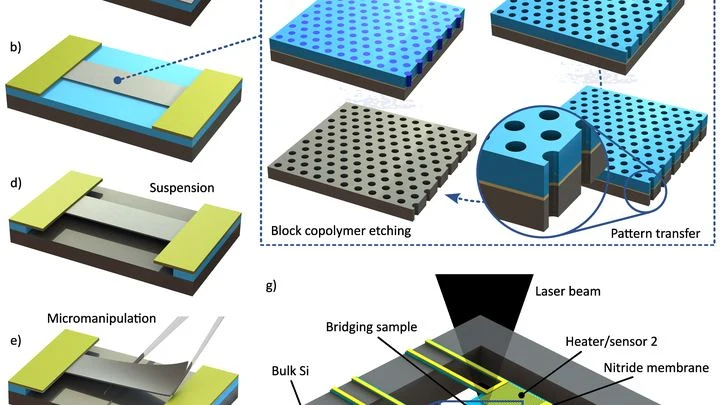
A crowd on a narrow street moves slowly because people bump into each other. In silicon, heat is carried by similar 'shoves'—atomic vibrations called phonons. If you cut tiny holes in a silicon film, phonons will bump into them like pedestrians into lampposts, and heat will flow worse.
Earth's magnetic field, the one that swings a compass needle, is strong. The new sensor picks up fields a hundred thousand times weaker, and it needs neither liquid helium nor bulky setups. Everything fits on a circuit board, just like the one inside your smartphone.
A guitar string rings longer if you don't touch it too much. A resonator, a device that vibrates at a single frequency like a tuning fork, behaves in much the same way. A team of engineers made such a "tuning fork" from aluminum nitride, smaller than a grain of sand, and made it oscillate 16 billion times per second.
Qubits in a superconducting quantum computer are like tightly stretched strings. When a particle from space or from a radioactive decay flies by, it strikes these strings and they start to vibrate. This vibration disrupts the fragile quantum states, and computations go awry.
At Fermilab's accelerator, a particle beam strikes a target of frozen ammonia. The hydrogen nuclei inside are like tiny tops, and physicists need them all spinning the same way. Then the collisions reveal how the proton's spin is put together.
A regular laser is a light amplifier in which atoms, after receiving energy, collectively emit waves of a single frequency. A maser does the same thing, but for microwaves — the invisible radiation that heats food in a microwave oven and carries signals in phones.
Any cook knows: whether dough sticks to a pan depends on what happens at the interface between two media. For molten metals, that interface long remained invisible — temperatures above 200 °C made it impossible to resolve individual atoms.
Fireflies flash in a dark forest: you see each flash, but not the flight. A quantum gas microscope can show individual cold atoms, like those fireflies. But until now, it couldn't tell you how fast they're moving.
Now scientists have found a way to fix that.
After the Big Bang, the Universe simmered as a fiery 'soup' of fundamental particles. Expanding and cooling, the soup gradually 'solidified' into protons and neutrons — much like crystallization. Had the solidifying been instantaneous, like a lake cracking in a deep freeze, the fabric of spacetime would have convulsed.
A quantum computer is like an orchestra where each musician plays their part, but if the conductor waves the baton a bit too hard, the delicate instruments go out of tune from excess heat. Controlling qubits at 10 mK (300 times colder than your freezer) is like conducting an orchestra in an ice-cold hall where even a breath can ruin everything.
A single electron in a magnetic field is like a tiny top that spins and weakly "squeaks" at its own frequency. Hearing that squeak directly is nearly impossible: it gets lost in the noise. Scientists have devised a resonator: a superconducting microwave strip that works like a tuning fork tuned to the same note.
Electric current in a superconductor is like a crowd running down a frictionless corridor. But in type-II superconductors there are obstacles, tiny vortices of magnetic field, that the current shoves out of place. Once a vortex moves, resistance appears and the current drops.
A quantum magnetometer based on hydrogen nuclei works like noise-canceling headphones. It alternately "listens" to the field in two different ways: the noise is the same for both, but the desired signal is different. By subtracting one from the other, the device extracts the signal, reducing interference by more than 1000 times.
Ordinary soldering doesn't work for quantum circuits: when cooled to liquid helium temperatures, metal cracks, and the contacts themselves introduce noise. Engineers from the research group tried something different — a drop of gallium alloy that stays liquid at room temperature, like mercury in an old thermometer.