Celsius is a unit of temperature on a scale where the freezing point of water at standard atmospheric pressure is 0 degrees and the boiling point is 100 degrees. It is the most widely used temperature scale in the world for everyday and scientific purposes, forming part of the International System of Units (SI). The scale is defined by assigning 0 °C to the triple point of water (273.16 K) and using the kelvin as the base unit, with a difference of 1 °C equal to 1 K.
History
The scale was devised by Swedish astronomer Anders Celsius in 1742, originally with 0 as the boiling point and 100 as the freezing point. It was later inverted by Carl Linnaeus or others to its modern form.
How it works
The Celsius scale is a linear scale based on the thermodynamic temperature, where 0 °C corresponds to 273.15 K and 100 °C to 373.15 K. It is defined such that the temperature difference between the freezing and boiling points of water is exactly 100 degrees. In practice, temperatures are measured with thermometers calibrated to these fixed points, or with more precise instruments that use the kelvin scale directly.
In practice
Celsius is used in weather forecasting, cooking, medical thermometers, and in most scientific contexts where temperatures are reported for public understanding.
Fun fact
The Celsius scale was originally called 'centigrade' because it had 100 degrees between the freezing and boiling points of water, but was renamed in 1948 to honor Anders Celsius.
Systems:SIThe Celsius degree is defined as 1/100 of the temperature difference between the freezing and boiling points of water at standard atmospheric pressure, with 0 °C at the freezing point and 100 °C at the boiling point.
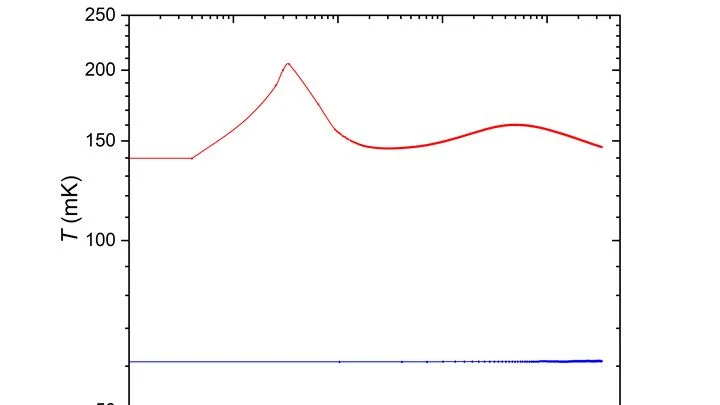
Instead of an ice bath, a warm gas blanket. That is how the cryogenic current comparator at Japan's National Metrology Institute is now cooled. Previously, this instrument, which compares electric currents to within billionths of a percent, required immersion in liquid helium.
Swimming season opens when the water feels tolerable. But everyone has their own threshold: one person shivers at twenty degrees, another swims comfortably at fifteen. Scientists decided to figure out where this difference comes from.
They compared a swimmer's body to a house trying to keep heat in while a cold wind blows outside.
Heat is all around us: from a car's exhaust pipe to the casing of a running laptop. Thermoelectric materials could turn that waste heat into electricity.
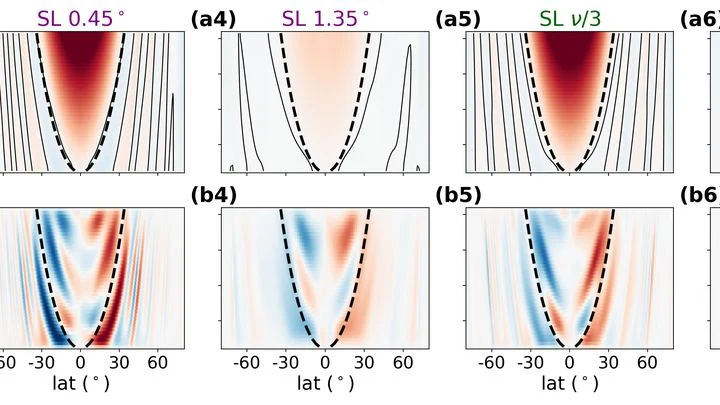
In the deep oceans of icy moons, water is not still. Warm plumes rise from the rocky seafloor, but the planet's rotation twists them into long, slanted rolls stretched along the rotation axis. Previously, this process could not be included in global models: it was too complex.
The Sun is a giant nuclear reactor that continuously sends us light and heat. But it also has another, almost silent postal service: every second, tens of billions of neutrinos, ghostly particles born in the thermonuclear furnace, fly through a square centimeter of your palm. Most of them leave no trace.
Atomic nuclei are rarely perfect spheres. More often, they resemble a slightly squashed ball — the electric charge inside is unevenly distributed, and protons may shift a bit, creating a tiny 'pear-shaped' bulge.
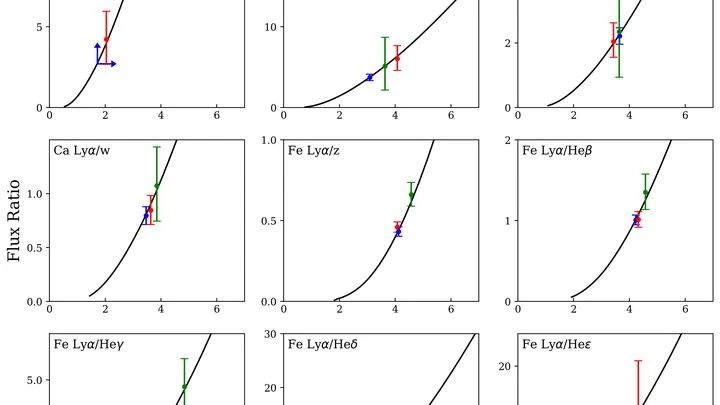
A giant cauldron of simmering soup stretches across millions of light-years. This is the atmosphere of the Perseus galaxy cluster — a cloud of scorching gas held together by gravity. Until recently, astronomers thought that in the center of this cauldron, the gas was calmly cooling, ready to condense into new stars.
An aluminum pot on the stove melts at 660 degrees Celsius — everyone knows that. But what happens if you heat aluminum a hundred times hotter? The liquid starts to boil, and here's the puzzle: at what exact temperature does that happen?
A metal needle descends onto a piece of superconductor. All of this happens inside a refrigerator that cools the sample to 30 thousandths of a degree above absolute zero — a hundred times colder than outer space. A weak current is passed through the needle, and by how electrons travel through the tiny contact point, physicists read what is happening inside the material.
Ice slips away from under a skate blade like a bar of soap in wet hands. For a hundred years, scientists argued about where this slipperiness comes from. Some said there is already a thin layer of water on top: it acts as a lubricant. Others countered that water only appears when you start moving, due to friction.
A seismometer is the planet's ear. It picks up the faintest tremors in the ground and turns them into an electrical signal. But this ear isn't perfect: its sensitivity depends on temperature. In the cold and in the heat, the instrument hears slightly differently, and that introduces error into measurements.
At 0.1 K, just three-tenths of a degree above absolute zero, matter stops following the usual rules. Helium becomes superfluid: it flows without friction, seeps through cracks, and behaves like one giant quantum liquid. Seeing what happens inside such cold is a challenge at the edge of possibility.
Deep beneath our feet, at the very center of Earth, lies a solid iron core. But it's not pure iron — there are lighter elements too, such as hydrogen. Exactly how hydrogen is distributed within the core has long been a mystery.
Salt in a glass of water is a crowd of charged particles. When there's plenty of water, each particle floats on its own, wrapped in a thick fur coat of water molecules. But as you keep adding salt, the water runs out for everyone, and the particles start seeking each other out. First, they stick together in pairs, then in larger clumps.
Rain doesn't fall just any old way. If you take records from nearly fifty thousand rain gauges scattered across the globe and compare how much water falls on a rainy day in different parts of the planet, you'll spot a surprising pattern.
A thin stream of water flows down a cold inclined board and, before your eyes, turns into an ice ridge. At first, the water paves itself a straight icy path, as if reinforcing its own banks. Then the trickle starts to meander, and the ice quickly spreads sideways. Finally, the ridge stops growing outward and begins to thicken, smoothing out irregularities.
The Universe is expanding, and every galaxy cluster takes part in a grand dance. The tempo of this dance is set by the Hubble constant, first measured by Edwin Hubble nearly a century ago. Pinpointing the number is tough because you need a ruler that spans billions of light-years.