An Amplifier That Hears Even a Quantum Whisper express
A whisper in a noisy room is nearly indistinguishable. A conventional amplifier adds its own noise and drowns out the weak sound. A quantum amplifier works differently: it amplifies the signal while adding almost no extra noise, like a perfect ear. But even such an ear has its own problems.
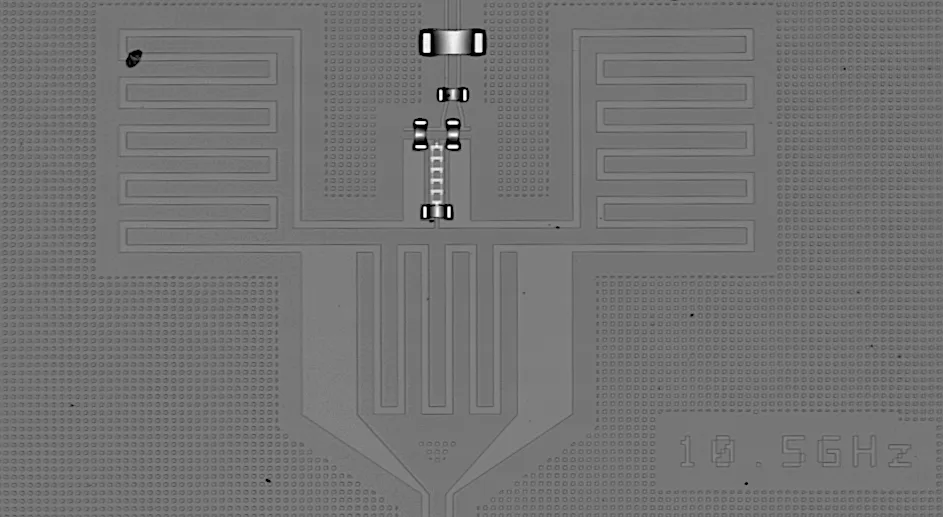
Scientists built an amplifier from a superconducting loop with an array of Josephson junctions — tiny elements that operate at ultra-low temperatures. This amplifier boosts microwave signals by a factor of 20 (up to 44) over a bandwidth of about 50 MHz. But as the signal travels along the wires, even weak reflections from imperfect connections create interference. These reflections act like echoes in the mountains: the sound returns and distorts the original signal.
The authors developed a mathematical model that precisely describes how reflections affect the gain. They showed that the complex distortions in the spectrum can be explained by interference similar to that in optical resonators. Now it is possible to separate the amplifier's intrinsic properties from environmental influences and fine-tune its operation.
This approach helps create reliable quantum amplifiers for quantum computers and detectors. In quantum technologies, every bit of extra noise means loss of information. And here, the noise is almost at the limit allowed by the laws of physics.
Original abstract
as written by the authors arXiv:2604.13881
Quantum-limited parametric amplifiers are essential components for many quantum technologies operating in the microwave domain. Achieving both high gain and broad bandwidth, however, remains challenging due to trade-offs between gain and bandwidth, pump efficiency, and dynamic range. Moreover, high-gain broadband amplifiers become increasingly sensitive to their external electromagnetic environment, which can distort their gain spectra and hinder reliable operation. Here, we present an accurate theoretical model and a systematic design methodology for a flux-driven, lumped-element Josephson parametric amplifier based on a SQUID array. Our device achieves near-quantum-limited, phase-preserving amplification with a net gain of 20 (maximally 44) dB and a 3-dB bandwidth of $$\sim$$50 ($$\lesssim$$0.2) MHz. We further show that the gain spectra exhibit pronounced sensitivity to weak reflections in the input-output waveguide caused by impedance mismatches in the microwave environment. By incorporating Fabry-P\'erot-type interference into a quantum input-output model, we analytically reproduce these complex spectral features and identify how they depend on the physical parameters of the environment. More generally, our results provide a practical framework for separating the intrinsic dynamics of parametric amplifiers from environmental effects. This approach enables reliable characterization and optimization of amplifier performance while providing a systematic strategy for diagnosing microwave reflections and engineering environmental interference to shape amplifier gain spectra, thereby offering a pathway toward robust, reproducible, and truly quantum-limited microwave amplification.
Josephson junctions are superconducting tunnel junctions that act as nonlinear inductors. They allow signal amplification without the resistive noise inherent in conventional transistors.
In the series 'The Expanse', quantum amplifiers are used for communication over ultra-long distances, where every photon counts.