A superconducting loop is a closed circuit made of a superconducting material — a substance that conducts electricity with zero resistance below a critical temperature. These loops are extraordinarily sensitive to magnetic fields and electric fields, making them ideal for detecting tiny asymmetries in atomic nuclei. The loop's behavior is governed by quantum mechanics on a macroscopic scale, where the superconducting current is a coherent quantum state that can interfere with itself, much like light in an interferometer.
History
The concept of superconducting loops with Josephson junctions was developed in the 1960s, following Brian Josephson's prediction of tunneling in superconductors in 1962. The first SQUID was built by Robert Jaklevic and colleagues in 1964.
How it works
When a superconducting loop is exposed to a magnetic field, it generates a persistent current that exactly cancels the field inside the superconductor (the Meissner effect). However, if the loop contains a small 'weak link' — a Josephson junction — the current can tunnel through it, and the loop becomes sensitive to the magnetic flux threading it. This forms the basis of a SQUID (Superconducting Quantum Interference Device), which can measure magnetic fields with exquisite precision. The loop's quantum state is also sensitive to electric fields, which can shift the energy levels of the system, allowing detection of tiny asymmetries in the charge distribution of nuclei.
In practice
Superconducting loops are used in SQUID magnetometers for medical imaging (magnetoencephalography), in quantum computing as qubits, and in precision measurements of nuclear properties.
Fun fact
A superconducting loop can maintain a persistent current for years without any power source, as long as it stays below its critical temperature.
A metal made of five different atoms is like a soup with bits of carrot, peas, potato, onion, and meat floating in it. Each bit is its own element: chromium, vanadium, titanium, niobium, and tantalum. Such an alloy is called high-entropy: there is no single order, and the atoms are mixed almost randomly.
Imagine a ladder whose rungs are tiny magnets. If neighboring magnets point in opposite directions, the ladder is "calm." But if you make them all point the same way, the whole structure becomes magnetized and "stubborn."
Scientists built such a ladder from germanium atoms — a semiconductor used to make transistors.
A quantum spin liquid is a state of matter in which the magnetic moments of atoms behave like a fluid: they constantly fluctuate and never settle into a rigid order, even at extremely low temperatures. One of the most famous theoretical models of such a liquid was proposed by Alexei Kitaev.
Hidden within thin layers of tantalum selenide (TaSe₂) is a property that defies conventional physics. When guest atoms were added between the layers of this material, the structure lost its center of symmetry, and inside, superconductivity with armor emerged.
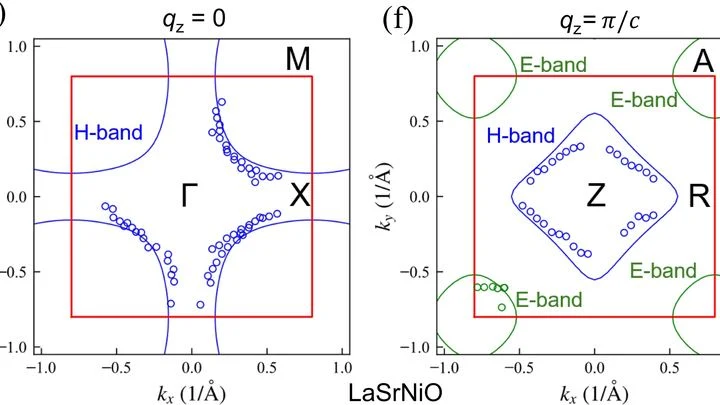
Lossless current is the dream of energy technology. Some materials become superconductors, but usually only at extreme cold. Recently, in the family of nickelates, compounds based on nickel, candidates were found that work at higher temperatures.
A piece of metal is cooled to minus two hundred degrees, and electric current begins to flow through it without the slightest friction, like water in a pipe flowing without touching the walls. This behavior is called superconductivity.
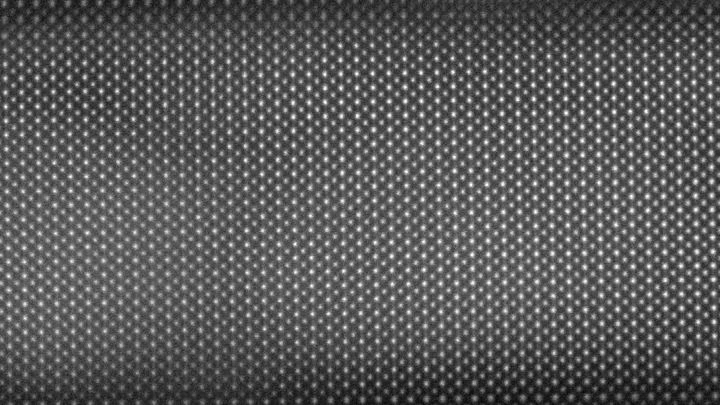
Imagine a sandwich where the bread is made of copper oxide layers and the filling is a thin layer of strontium ions. That's the infinite-layer cuprate, the simplest version of superconducting ceramics, conceived nearly 40 years ago.
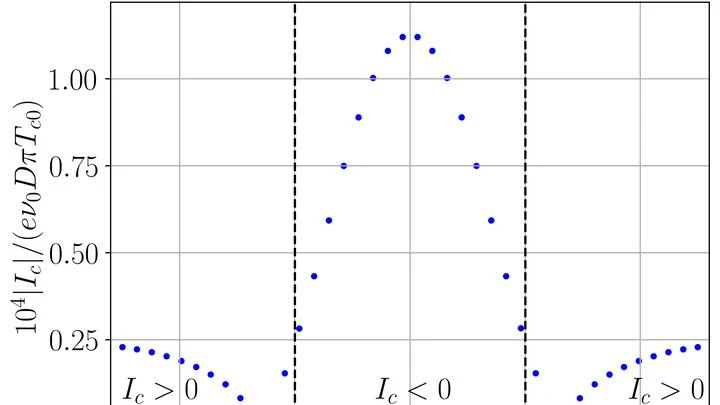
An ordinary diode in electronics works like a one-way street: current flows in only one direction. In superconductors, where electricity flows without resistance, such behavior has long been elusive — current is usually symmetric.
The authors of the new work found a way to create a perfect superconducting diode using light.
A tiny magnet levitates in a magnetic trap, like a weightless needle. Its magnetized axis is like a stubborn compass needle that is prevented from turning. An invisible wall rises before it. But in the quantum world, particles can seep through barriers — this trick is called tunneling.
A tiny ball weighing a fraction of a milligram, suspended in a magnetic field and cooled to near absolute zero, oscillates for 110 hours without stopping: this is record isolation. The energy loss is so small that the system's entropy barely increases, making any external influence noticeable.
Two superconducting banks are connected by a bridge of magnetic material. Inside the bridge lies a domain wall: a narrow boundary where the magnetization rotates, like a column of soldiers changing their marching direction.
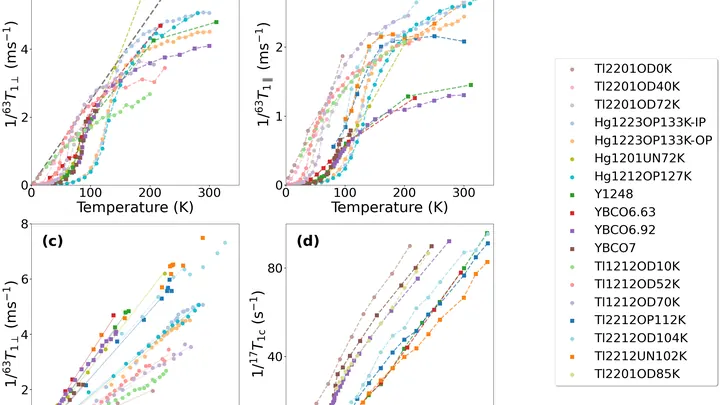
Inside copper-based superconductors, materials that carry current without loss at unexpectedly high temperatures, there is a hidden phase. It behaves like an ordinary metal, but it's invisible in standard measurements.
Superconductivity is when electric current flows without losses, like water through a perfectly smooth pipe. It usually occurs at very low temperatures, but there are materials where it appears at higher ones.
Electric current in a superconductor is like a crowd running down a frictionless corridor. But in type-II superconductors there are obstacles, tiny vortices of magnetic field, that the current shoves out of place. Once a vortex moves, resistance appears and the current drops.
A tiny superconductor, levitating above a magnet, is like a cork on the surface of an invisible ocean. The slightest breath of dark matter makes it shudder. Scientists examined two kinds of such 'wind'. The first – gravitational waves, which stretch and squeeze space itself, like ripples on the fabric of the cosmos.
A uranium crystal the size of a grain of rice was cooled to one-fiftieth of a degree above absolute zero. At such temperatures, heat is not transported chaotically but strictly according to the rules of the quantum world.
An ordinary superconductor expels magnetic fields, but this ring does the opposite: it creates a magnetic field inside itself. The ring is made of Fe(Te,Se) — a compound of iron, tellurium, and selenium that loses its electrical resistance at very low temperatures.
An ordinary superconductor loses resistance when cooled, and current flows through it without loss. But in ultrathin films, things are different: the material fluctuates between normal and superconducting states, and in this transition zone, strange resistance waves emerge. Resistance rises and falls as if someone were turning a volume knob.
Inside some materials, electric current flows with zero resistance. These are superconductors, and they only work when it's very cold. Copper oxides are special: they stay superconducting at somewhat higher temperatures, but why has been a puzzle for forty years.
An ordinary superconductor is like a squad of soldiers marching in pairs: electrons pair up, and their spins (internal 'tops') point in opposite directions. A magnetic field easily flips such pairs, destroying superconductivity.
In UTe₂, things are different.
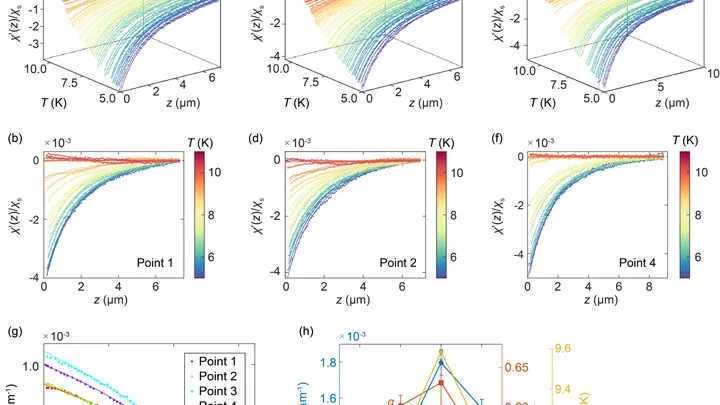
A superconductor is like a city where electrons stop jostling and start moving in pairs, like people strolling arm in arm. In neodymium-strontium nickelate (Nd₀.₈Sr₀.₂NiO₂), this 'parade' kicks in at around 10 kelvin (minus 263 degrees Celsius), but not uniformly.
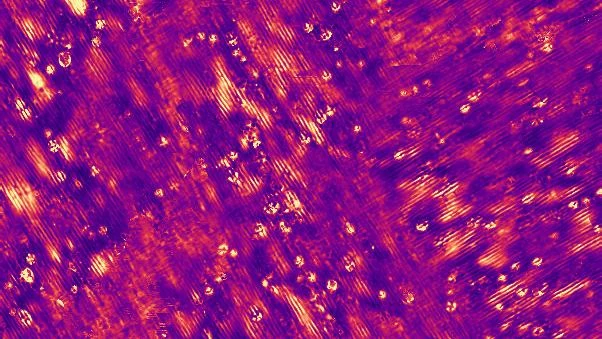
In NaAlSi, as it cools, electrons form fleeting ripples — stripes that appear and vanish, like patterns on water stirred by wind. These stripes intertwine with superconductivity, a state where current flows without resistance. Typically, for this, electrons pair up with uniform binding energy.
Run a current through a contact between a superconductor and a ferromagnet, and you will hear the whisper of the quantum world. In the lab at 0.3 K, that whisper turned into a roar: the shot noise—electrical noise due to the discreteness of charge—was a hundred times louder than theory allows for ordinary contacts.