In 1962, the British physicist Brian Josephson, then a graduate student, theoretically predicted that a current would flow through a superconductor–insulator–superconductor junction even at zero voltage. The stationary effect: current I = I_c sin φ, where I_c is the critical current, φ is the phase difference of the order parameters. The non-stationary effect: at a constant voltage V, the phase changes at a rate dφ/dt = 2eV/ħ, which gives an alternating current with a frequency of 483.6 GHz per millivolt. This is a direct manifestation of quantum coherence of a macroscopic superconducting state.
History
In 1962, Brian Josephson derived his equations, drawing on the Bardeen–Cooper–Schrieffer theory of superconductivity and the concept of Cooper pairs. Initially, the scientific community was skeptical of the prediction, but in 1963, Anderson and Rowell experimentally confirmed the existence of Josephson current. For this discovery, Josephson received the Nobel Prize in 1973, sharing it with Leo Esaki for the tunnel diode and I. Giaever for furthering the understanding of superconducting contacts. Later, Josephson electronics was developed.
How it works
The effect underlies SQUID magnetometers with record sensitivity, quantum voltage standards, single-photon detectors, and superconducting qubits for quantum computing. Limits: temperature below the superconductor's critical temperature, weak magnetic fields (above critical destroys superconductivity), currents below the critical current. Josephson generators operate in the high-frequency regime, up to the terahertz range.
In practice
Ultra-sensitive magnetometers (SQUIDs) based on the Josephson effect map magnetic fields of the brain, and the volt standard is defined via Josephson frequencies.
Fun fact
Using the Josephson effect, scientists have built volt standards accurate to 10⁻¹⁰, linking electrical voltage exclusively to the fundamental constants e and h.
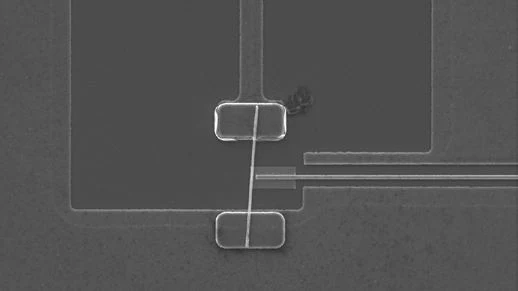
You don't build a road by demolishing neighboring houses: first you lay the asphalt, then you grind away the excess, leaving a smooth surface. That's roughly what physicists in Heidelberg did when they took on the production of Josephson junctions, tiny sandwiches of superconductor and insulator through which current flows without resistance.
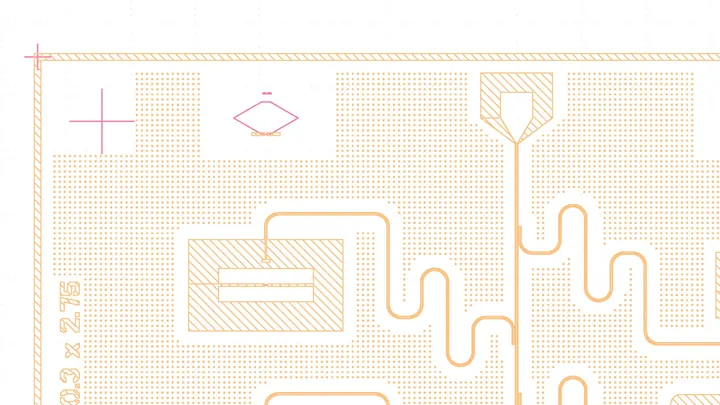
A courtroom interpreter must relay every word without being distracted by noise in the room. In the quantum world, a superconducting resonator plays that role, losing photons on schedule without straying into spurious effects.
A courtroom interpreter must relay every word without being distracted by noise in the room. In the quantum world, a superconducting resonator plays that role, losing photons on schedule without straying into spurious effects.
In a narrow corridor, people walk in rows rather than as a crowd. The number of rows depends on the width of the passage. In graphene, this corridor is a quantum point contact — a constriction where electrons move ballistically without scattering.
A superconducting quantum interferometer is a device that senses magnetic fields billions of times weaker than the needle of an ordinary compass. Inside it, there is a narrow bridge where superconductivity briefly breaks.
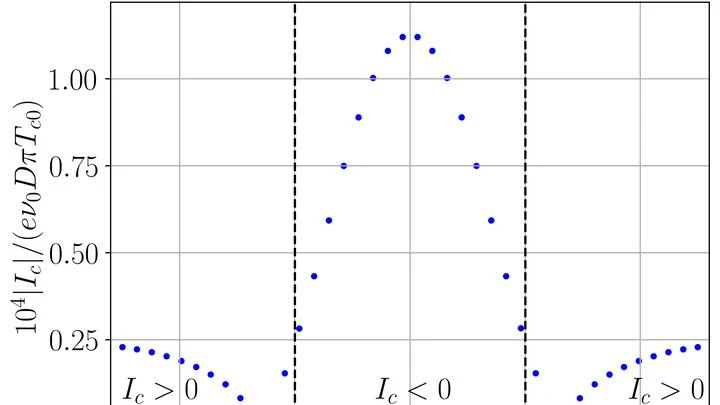
A water pipe: the wider it is, the more water flows through. In superconducting contacts — Josephson junctions (bridges through which current flows without resistance)—it's usually the same: the better the material conducts in its normal state, the larger the superconducting current that flows through it.
A water pipe: the wider it is, the more water flows through. In superconducting contacts — Josephson junctions (bridges through which current flows without resistance)—it's usually the same: the better the material conducts in its normal state, the larger the superconducting current that flows through it.
At low temperatures, many materials become superconductors — current flows without resistance. But how exactly does this happen if electrons were initially trapped in an insulator? Half a century ago, Philip Anderson suggested that the answer lies in a special quantum dance of particles.
The Josephson junction is a bridge made of superconductor, separated by an ultra-thin insulating layer. Current flows through it even without voltage. But when the current becomes too large, the bridge starts to oscillate, and even steps, Shapiro steps, appear on the voltage graph. Between these steps hide invisible gaps where the system behaves strangely.
Drop by drop from a faucet, or a steady stream without a single splash. That's roughly what the two regimes of current in a superconducting contact look like. Only here, the role of water is played by Cooper pairs — bound electrons that move without resistance.
Drop by drop from a faucet, or a steady stream without a single splash. That's roughly what the two regimes of current in a superconducting contact look like. Only here, the role of water is played by Cooper pairs — bound electrons that move without resistance.
A thin film of a special crystal (for instance, molybdenum disulfide) sits on a microscope stage. The temperature is just above the point where the material becomes a superconductor.
In a superconducting ring shaped like a washer, current sometimes flows more easily in one direction than the other. This property is called the diode effect. Usually, its direction is rigidly set by the material's structure. But in new work, physicists showed that it can be switched, and the switch is the number of magnetic vortices trapped in the ring.
An ordinary network of four optical waveguides is like an intersection without traffic lights: the signal wanders in all directions and mixes. But if you look only at some of the outputs, the picture changes. An illusion arises that the system has losses — though in reality energy doesn't disappear; it just goes into unobserved ports.
In a long corridor, a crowd of people tries to keep as far apart as possible. In a spacious hall, they would simply spread out, but here the walls squeeze them so tightly that they have to move single file, coordinating every step. Electrons in graphene layers twisted by a tiny angle behave in a similar way.
In the crystal CsV3Sb5-xSnx, which becomes a superconductor at low temperatures, current does not flow as a uniform stream but along narrow, winding paths. A scanning microscope with a sensitive magnetic field sensor helped reveal these paths: it picks up the faintest currents, much like a sonar probes the seafloor.
Usually, superconductivity is a story about cold. The lower the temperature, the easier it is for electrons to pair up and flow without resistance. But in a new study, physicists grew thin films of nickelates doped with europium and saw the opposite picture.
A superconductor is like an ideal highway with no traffic lights: electrons race along without hindrance. But apply a voltage, and the picture changes. In a new experiment, physicists found that an electric field penetrates the superconductor and creates a mixed regime inside.
A switch that knows which way to let current flow. That's how a Josephson diode works — a superconducting bridge where current goes willingly in one direction but meets resistance in the other. In the new study, such a bridge was made from graphene — a sheet of carbon just one atom thick.
A supersolid is matter that is both crystalline and fluid. It is created from atoms cooled almost to absolute zero. In new work, physicists obtained such a substance as a triangular lattice of droplets. Each droplet oscillates in its own rhythm.
A stone falls into a pond, and ripples spread across the water. Long waves and short ones travel at the same speed: that's how ordinary sound behaves in almost any medium. But in quantum liquids, things can be different.
Physicists considered a superfluid where particles move along a "flat" energy band.
In a water supply system, water sometimes flows not as a continuous stream but in separate identical portions, as if the tap opens and closes, letting through exactly one drop each time. This is roughly how electric current behaves in superconducting contacts called Josephson junctions.
A swing can rock strongly or barely move. Usually, if left alone, it stays in its chosen mode. But in the microworld, things are different: a tiny membrane, oscillating under the action of a laser beam, can spontaneously jump from one amplitude to another.
The atom is like a conductor, and the light in the resonator is the orchestra. Their energy exchange, known as the Jaynes–Cummings interaction (part of the Standard Model), lets the atom use “baton” strokes to change the rhythm and timbre of the oscillations.
Two thin layers of a semiconductor were twisted relative to each other by 2.29 degrees, like two sheets of transparent paper with printed grids. Where the lines nearly align, a large pattern of dark and bright spots emerges. Electrons in this pattern behave very differently from those in a regular crystal.
Electric current in a wire is like a crowd of people hurrying down a corridor. Usually, each person bumps into walls and loses speed almost instantly: that's electrical resistance.
The dance floor is packed: everyone moves on their own, no one holds hands. Suddenly the music gets louder and more rhythmic — neighbors start grabbing each other, forming pairs that spin in sync. That's roughly what the experiment looked like in the lab, where a cloud of lithium atoms, cooled to near absolute zero, was made to suddenly strengthen its mutual attraction.
Sunlight hits a silicon wafer, and a current flows in the circuit. That's the familiar work of a solar cell: light knocks out electrons, and a p–n junction (the boundary between two layers with different conductivities) forces them to move in one direction. But in some crystals, current arises differently — without any junctions, purely from the material's internal structure.
Imagine a line of people holding hands but facing in opposite directions: some look north, others south. That's how a p-wave magnet is arranged. Electrons in it align their magnetic moments (spins) not randomly but in a strict wave-like pattern.
A bridge of aluminum just a few atoms thick is the heart of many quantum devices. Current flows through such a bridge without resistance, and it can be controlled with a magnetic field. These bridges are called Josephson junctions, after the British physicist who described their behavior.
A superfluid gas behaves like a frictionless liquid. Two clouds of such gas are connected by a narrow bridge, and a stream of particles flows through it. This resembles the Josephson effect in superconductors, but here the particles are neutral atoms instead of electrons.
A whisper in a noisy room is nearly indistinguishable. A conventional amplifier adds its own noise and drowns out the weak sound. A quantum amplifier works differently: it amplifies the signal while adding almost no extra noise, like a perfect ear. But even such an ear has its own problems.
Two superconducting banks are connected by a bridge of magnetic material. Inside the bridge lies a domain wall: a narrow boundary where the magnetization rotates, like a column of soldiers changing their marching direction.
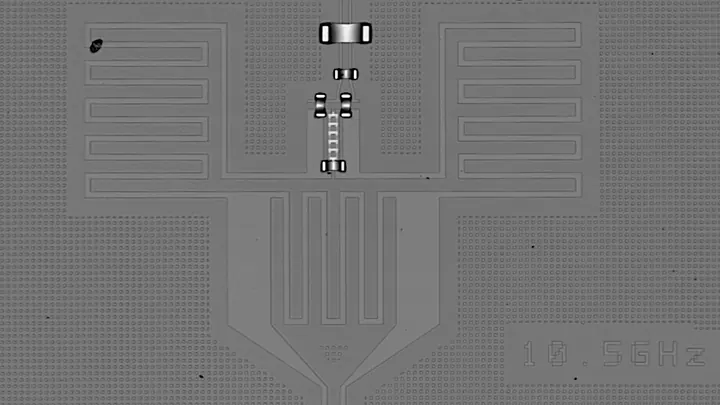
A quantum chip is like a layered cake: superconducting metal, a thin insulator layer, and more metal. Previously, layers were applied through a polymer mask, like a stencil for paint. The polymer left invisible droplets on the surface that degraded superconductivity and compromised cleanliness.
Now, the mask is gone.
On a dance floor, the lights and dancers move independently: the lights flicker on their own, and people move separately. The quantum world is similar: electrons and photons rarely synchronize — this is the no-go theorem for superradiance. But add a rhythmic beat, and the dance floor comes alive.
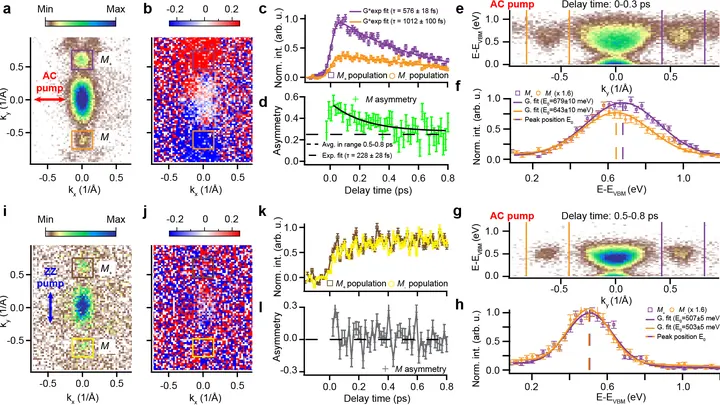
An ordinary sheet of black phosphorus looks like a layered cake of atoms. If you shine a regular lamp on it, nothing special happens: the electrons sit still, like spectators in a dark theater. But a short laser flash lasting millionths of a billionth of a second shakes up that theater.
Two identical cars roll off the same assembly line. Body, wheels, steering — everything matches. Only one has a regular gasoline engine, while the other has a hybrid engine that can be tuned to the road. And the hybrid stalls after a couple of kilometers, while the gasoline one runs for tens.