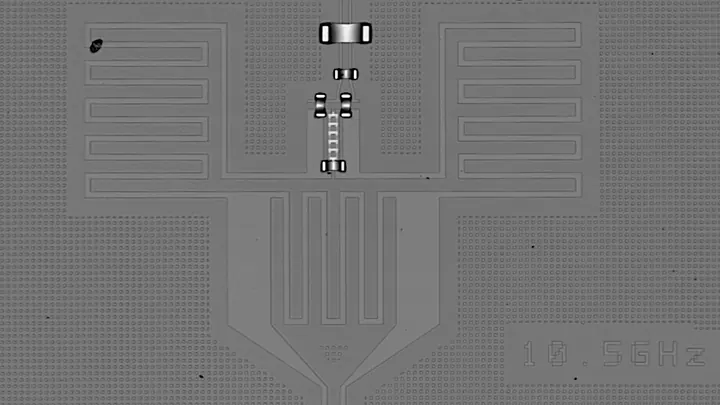
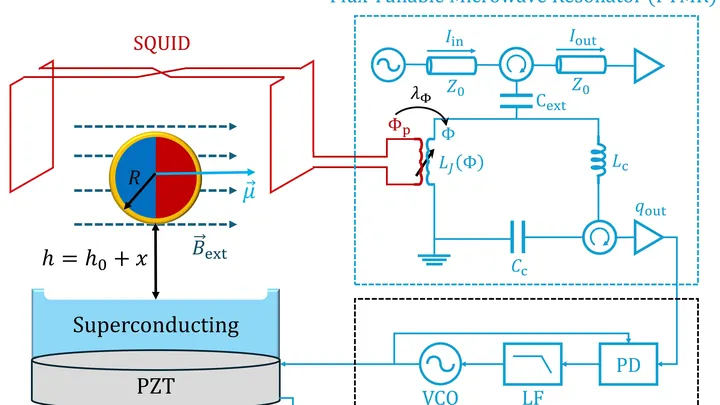
A superconducting quantum interference device, or SQUID, is an extremely sensitive magnetometer that can detect minuscule changes in magnetic fields. It operates on the principles of quantum mechanics and superconductivity, using a loop of superconducting material interrupted by one or two weak links, known as Josephson junctions. SQUIDs are the most sensitive magnetic field detectors known, capable of measuring fields billions of times weaker than the Earth's magnetic field.
History
The SQUID was invented in 1964 by Robert Jaklevic, John Lambe, Arnold Silver, and James Mercereau at Ford Research Labs, building on Brian Josephson's theoretical prediction of tunneling in superconductors. The first practical devices were developed shortly thereafter.
How it works
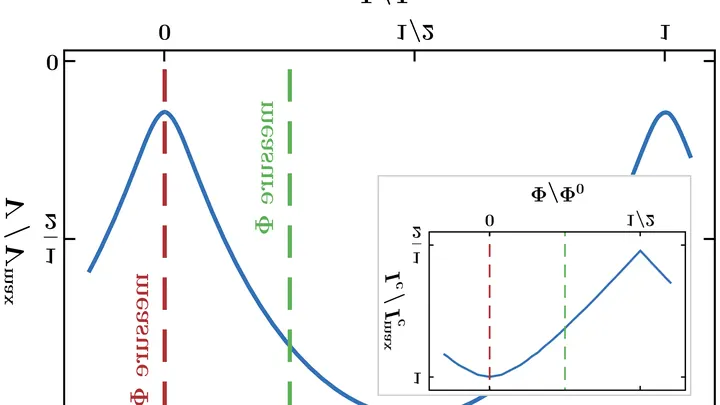
In a superconductor, electrons form Cooper pairs that flow without resistance. When a magnetic field is applied to a superconducting loop, it induces a circulating current that opposes the field, but the current is quantized — it can only take discrete values. The Josephson junctions allow the current to tunnel through the weak links, and the maximum current that can flow through the device depends on the magnetic flux threading the loop. By measuring this critical current, the SQUID acts as a flux-to-voltage converter, providing an extremely precise readout of the magnetic field. The device is typically operated in a feedback loop to maintain a constant flux, and the feedback signal is proportional to the external field.
In practice
SQUIDs are used in a wide range of applications, including magnetoencephalography (MEG) to map brain activity, non-destructive testing of materials, geophysical surveys to locate mineral deposits, and as amplifiers in quantum computing and dark matter detection experiments.
Fun fact
SQUIDs are so sensitive that they can detect the magnetic fields produced by the electrical activity of a single neuron in the brain, which is why they are used in advanced brain imaging techniques.
In a quiet room with no magnets anywhere, two electrons in a silicon trap still feel a faint trembling. It comes from the nuclei of silicon and germanium atoms, which spin randomly like the needles of broken compasses. This trembling was once considered noise, but now it has become a measuring instrument itself.
A superconducting quantum interferometer is a device that senses magnetic fields billions of times weaker than the needle of an ordinary compass. Inside it, there is a narrow bridge where superconductivity briefly breaks.
A bridge where pedestrians and cyclists flow together without getting in each other's way. That's roughly how hybrid systems of superconductors and semiconductors work: the former carry current without loss, the latter control that current.
In a dark room, a whisper is barely audible. To make out the words, you need to get close, or set up many sensitive microphones. That's roughly the reasoning behind the new work: the authors place quantum "ears" right inside a resonator, where a high-frequency gravitational wave turns into an electromagnetic echo.
A switch that knows which way to let current flow. That's how a Josephson diode works — a superconducting bridge where current goes willingly in one direction but meets resistance in the other. In the new study, such a bridge was made from graphene — a sheet of carbon just one atom thick.
Dark matter has eluded direct observation so far, even though its gravity holds galaxies together. One hypothesis: it’s made of axions — ultra-light particles predicted by theory.
A bridge of aluminum just a few atoms thick is the heart of many quantum devices. Current flows through such a bridge without resistance, and it can be controlled with a magnetic field. These bridges are called Josephson junctions, after the British physicist who described their behavior.
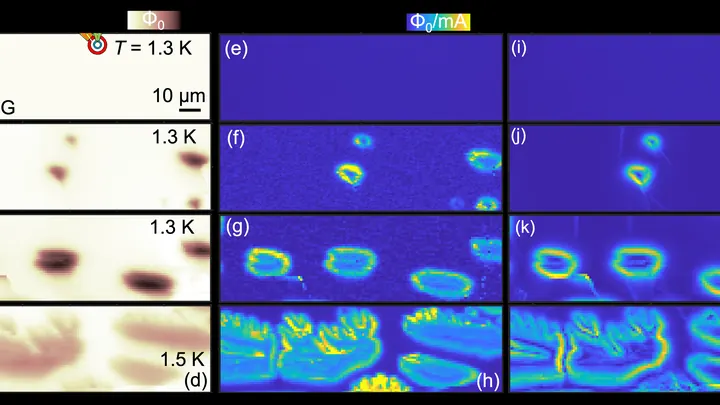
A magnetic field penetrates a superconductor not as a continuous flux but as thin filaments — vortices. Usually, they repel each other and arrange into a neat triangular lattice, like floats on water. But in CaSb₂, things went differently: vortices bunched into tight clusters, with almost empty space between them.
Physicists are trying to hear a whisper in a noisy room. They build a soundproof booth, but even inside, their own breathing and heartbeat create interference. That's roughly how the search for quantum gravity goes: they want to see gravity bind two particles into a single whole — entangle them.
A superfluid gas behaves like a frictionless liquid. Two clouds of such gas are connected by a narrow bridge, and a stream of particles flows through it. This resembles the Josephson effect in superconductors, but here the particles are neutral atoms instead of electrons.
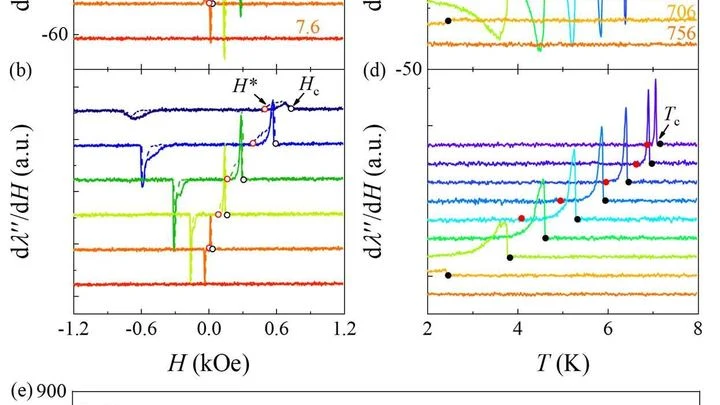
Ordinary magnetic measurements only see the surface of a superconductor, where barriers and viscous flows of magnetic field get in the way. Inside, in the so-called intermediate state, superconducting and normal domains coexist, separated by thin walls. These walls can oscillate, but hearing them directly has been difficult.
Earth's magnetic field, the one that swings a compass needle, is strong. The new sensor picks up fields a hundred thousand times weaker, and it needs neither liquid helium nor bulky setups. Everything fits on a circuit board, just like the one inside your smartphone.
A whisper in a noisy room is nearly indistinguishable. A conventional amplifier adds its own noise and drowns out the weak sound. A quantum amplifier works differently: it amplifies the signal while adding almost no extra noise, like a perfect ear. But even such an ear has its own problems.
Water boils at 100 degrees Celsius, but if you squeeze it hard enough, it behaves differently. Similarly, quarks and gluons, the building blocks of protons and neutrons, change their properties in a strong magnetic field.
A power transistor made of silicon carbide operates under voltages thousands of times higher than what comes out of a wall outlet. If the field inside it becomes uneven, the device burns out. Previously, this field was invisible: it is too strong for ordinary sensors, and the device must remain under voltage.
An ordinary ultra-sensitive magnetic field sensor is like a scale that starts lying when you put too heavy a weight on it. The signal becomes distorted, and you have to add complex electronics to straighten out the readings. That electronics adds noise and slows things down.
The new sensor, bi-SQUIPT, works differently.
A photon is like a car in a multi-story parking lot, where each floor is its frequency (color). Usually it gets stuck on one level, but scientists added an elevator — a programmable modulator that moves the photon between floors on command.
A magnetic sphere hangs in a vacuum above a cold metal plate. No strings, no stands — only the invisible field of a superconductor keeps it from falling. Give the sphere a gentle nudge, and it starts to oscillate up and down; the frequency of those oscillations depends on how strongly the plate pulls on it.
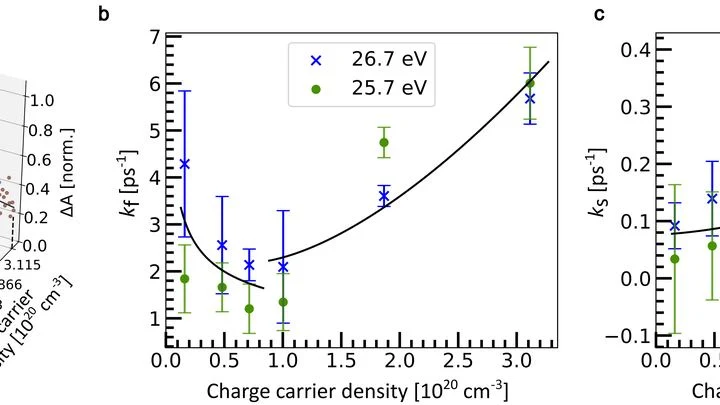
Sunlight hits a rooftop, and electrons are born in a thin film. They must reach the wires before they cool down and lose their energy. In tin sulfide, a cheap and accessible material for batteries, this sprint and cooldown has now been captured with unprecedented sharpness: frames follow every billionth of a billionth of a second.
An X-ray beam strikes a piece of superconductor, and the material warms up ever so slightly. That heating, by billionths of a degree, is the only trace the light leaves behind. The new detector catches exactly that, like a sensitive thermometer pressed against cold metal.
Quantum computers promise to describe molecules with perfect accuracy, but their main nemesis is noise. Every extra qubit and every extra operation add errors. Chemists and physicists have now devised a way to compute molecules with half the qubits: the HSQD method.
A regular switch clicks, and current either flows or it doesn't. Now imagine a material that switches itself between 'conducts without loss' and 'resists' under the influence of a magnet. That's exactly the sandwich physicists built: a thin lead film on top of a superconductor made of bismuth, strontium, calcium, copper, and oxygen.
Inside the receiver of a telescope aimed at the oldest glow in the universe sits a tiny thermometer chip. It's so sensitive that the heat from a single photon can warm it noticeably. But to hear that whisper of heat, you need a middleman — an amplifier that doesn't add its own noise.
A superconducting single-photon detector is like a string stretched in the dark. When a single photon hits it, the string momentarily loses its superconductivity, and we hear a click. But until now, the string was always out of tune: the detector performed worse than the material would allow.
The reason is the uneven distribution of current across the detector's width.
Two stars orbit so closely that their outer layers merge into a shared envelope. Matter flows from one to the other, like water spilling from an overfull cup into its neighbor. In this cosmic dance, where stars literally touch each other, astronomers have for the first time detected magnetic fields in large numbers.
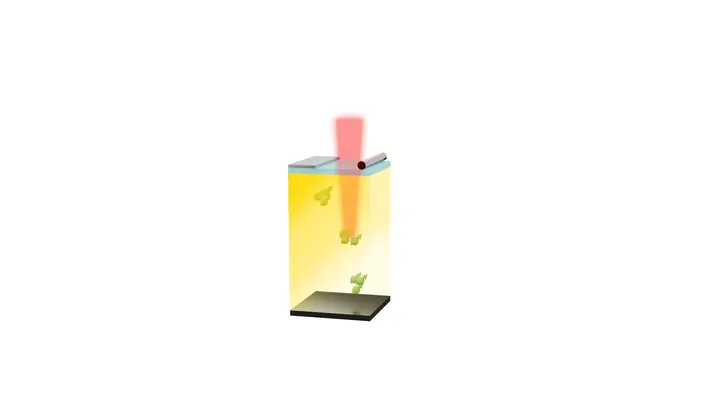
In a dark room, a tiny diamond glows red when a green laser hits it. This glow isn't just for show: it's a signal: its brightness changes when a magnetic field is nearby. Inside the diamond sit defects — nitrogen atoms with an empty neighboring site. They act like sensitive needles that rotate under the influence of a magnet.
Accurate measurements of gravity are needed by geologists and navigators alike. But conventional gravimeters are bulky instruments that take a long time to 'settle' after each measurement. What if you need to track rapid changes in gravity — say, while moving underground or in flight? That calls for a device that is small and responsive.
A superconducting circuit is like a frictionless swing, only possible at temperatures of liquid helium (–273 °C). In such cold, electric current runs in a loop without fading, keeping its rhythm.
The void is deceptive. William Unruh showed that an accelerating observer perceives the vacuum as hot. The effect resembles the particle birth near black holes, predicted by Stephen Hawking, but instead of spacetime curvature, acceleration is at work.
A chain of atoms on a light-guiding chip behaves like a row of pendulums on a shared support: swinging in opposite directions, they barely transfer energy to the air and freeze for a long time.
According to Einstein's theory, Earth's rotation drags space-time itself along — like a spoon dragging thick honey. This effect is incredibly weak: about one revolution in billions of years. But it can be caught.
Run a current through a contact between a superconductor and a ferromagnet, and you will hear the whisper of the quantum world. In the lab at 0.3 K, that whisper turned into a roar: the shot noise—electrical noise due to the discreteness of charge—was a hundred times louder than theory allows for ordinary contacts.
At Jefferson Lab, electrons are accelerated to 12 GeV and smash into protons to pry out their secrets. But existing detectors are like cameras with a narrow field of view: you either see a lot but dimly, or brightly but only a tiny patch. Electron scattering is the main tool, but statistics are insufficient for subtle effects.