A Two-Color Laser: The Infrared Orchestra express
The infrared laser at the Fritz Haber Institute now works like a conductor with two batons. Previously, it produced a single beam in the mid-infrared range, where molecules vibrate. Now, a second oscillator has been added, emitting far-infrared light, where entire molecular frameworks "breathe."
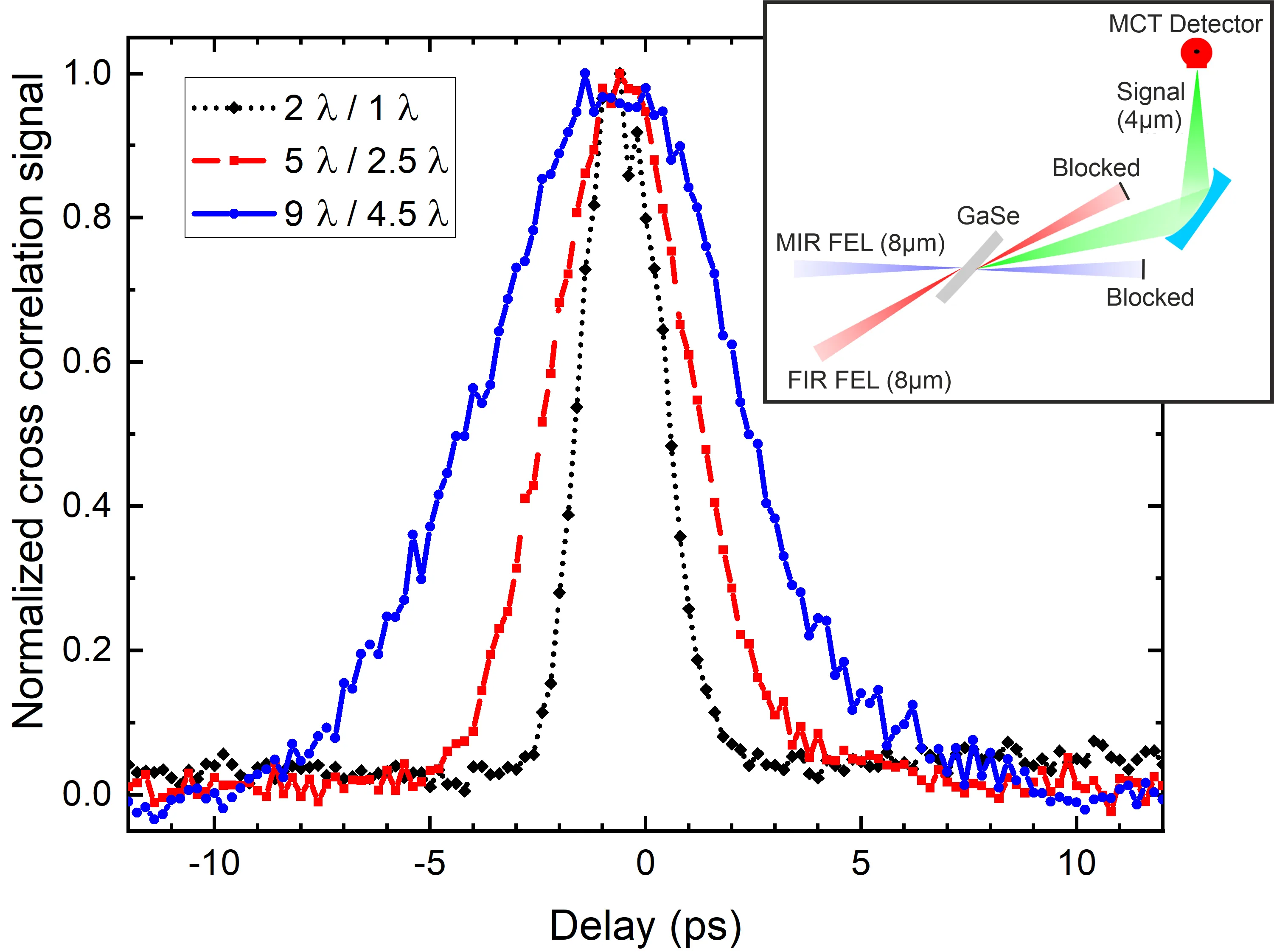
Spectroscopy loves such pairs: one beam breaks a hydrogen bond, the other watches how the molecule falls back. To achieve this, the electron beam from the accelerator is split into two streams using a rocking cavity: it pushes electrons left and right, like a switchman on a railway. Each stream enters its own laser, and both beams emerge strictly simultaneously.
Such an instrument opens the door to pump-probe experiments: the first beam triggers a process in the material, the second captures it a billionth of a second later. Previously, this required two separate lasers and complex synchronization. Now everything is in one corridor, and the time between pulses is known with exquisite precision.
Original abstract
as written by the authors arXiv:2604.16189
We report on the design and performance of a two-color dual-oscillator infrared free-electron laser (FEL). The mid-infrared (MIR) FEL at the Fritz Haber Institute (FHI FEL) has been upgraded to include a second oscillator FEL beamline that permits lasing in the far-infrared (FIR) regime from 4.5 {\mu}m to 175 {\mu}m. In addition, a 500 MHz kicker cavity has been installed downstream of the electron accelerator. It allows to deflect electron bunches of up to 50 MeV energy alternately left and right by an angle of {\pm}2{\deg}. It can, thus, split the high-repetition-rate (1 GHz) electron bunch train from the accelerator into two bunch trains of 500 MHz repetition rate each; one is steered to the MIR FEL and the other one to the new FIR FEL. In this two-color mode of simultaneous, synchronized operation the wavelengths in both FELs can be tuned independently over wide ranges of up to a factor of four each by undulator-gap variation. In addition, two-color operation is also available at reduced repetition rates (e.g. 55.6 MHz of both MIR and FIR pulses), as needed for some applications. This unique two-color mode opens up a wealth of novel user applications such as, MIR-FIR pump-probe experiments.
Far-infrared light with a wavelength of 175 micrometers is already close to radio waves. The human eye can see only up to 0.75 micrometers.