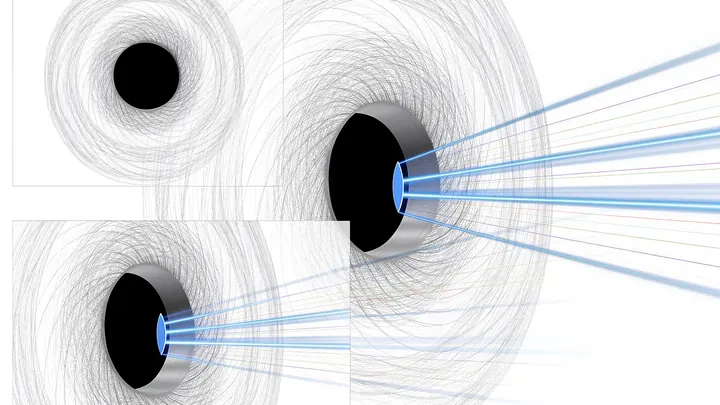
A free-electronlaser (FEL) is a type of laser that generates high-power, tunable coherent radiation by passing a relativistic electron beam through a periodic magnetic structure (an undulator). Unlike conventional lasers that rely on atomic or molecular transitions, FELs use free electrons, allowing them to produce light across a vast range of wavelengths, from terahertz to X-rays. This makes them invaluable for probing matter at atomic and molecular scales, as highlighted in the provided articles on magnetic melting, thin-film patterns, and neutron generation.
History
The concept of the free-electronlaser was first proposed by John Madey in 1971, and the first FEL was demonstrated at Stanford University in 1977. Since then, large-scale facilities like FLASH and European XFEL in Germany have pushed the technology to X-ray wavelengths.
How it works
In an FEL, electrons accelerated to near light speed travel through a periodic magnetic field, which forces them to wiggle transversely. This acceleration causes them to emit synchrotron radiation. The interaction between the electron beam and the emitted light can lead to a self-amplification process (self-amplified spontaneous emission, SASE), where the electrons bunch together and emit coherently, producing a powerful, laser-like beam. The wavelength of the light can be tuned by adjusting the electron energy or the magnetic field period.
In practice
FELs are used in materials science, chemistry, and biology to study ultrafast processes, such as melting magnets, imaging nanoscale structures, and capturing molecular dynamics in real time. They are also used in medical research for high-resolution imaging.
Fun fact
The first free-electronlaser used a superconducting electron accelerator and produced infrared light, but today's X-ray FELs can generate pulses so short they can capture the motion of atoms during chemical reactions.
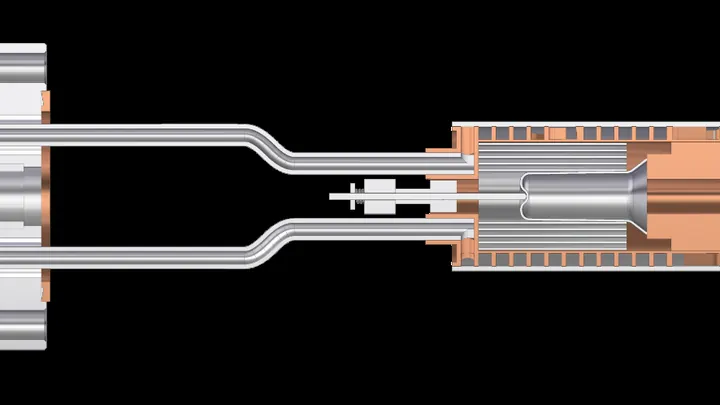
A shooter aims at a target, pulls the trigger, and hears two shots: one loud, one quiet. That's how the new setup works, except instead of bullets, there's an electron bunch, and instead of shots, there are two flashes of light. One flash is X-ray, the other is terahertz. They fly to the same point with perfect timing.
To probe deeper into the workings of the universe, physicists accelerate electrons and smash them together. An ordinary electron is like a spinning top that wobbles randomly. For delicate experiments, you need particles whose spins all point in the same direction: this is called polarization.
In a tight row of atoms, spaced closer than the wavelength of light, a remarkable state hides. The excitation is distributed among all particles so that their radiation cancels itself out. This quantum 'silence' is an ideal vault for a photon: it can be stored there hundreds of times longer than usual.
A flashlight beam cuts through fog. The denser the fog, the more the light scatters and the later it reaches your eye. A similar principle works with fast radio bursts — mysterious, super-powerful pulses from distant galaxies. As their radio waves travel through space, they interact with free electrons — particles stripped from atoms.
In the center of almost every large galaxy lurks a supermassive black hole, whose gravitational abyss was first mathematically described by Karl Schwarzschild. When it swallows gas, a dazzling active nucleus is born — a quasar.
An ordinary microscope is powerless when you need to examine a single virus in detail. It's too small. But there's a tool that fires flashes billions of times brighter than sunlight — an X-ray free-electron laser. It's designed to 'photograph' a particle before the beam vaporizes it.
A laser isn't just about light. If you make a particle oscillate like a pendulum and those oscillations sustain themselves, you get a phonon laser. Sounds complicated, but the idea is simple: instead of light waves, the device emits orderly waves of mechanical vibrations — phonons.
Usually, isotopes are separated by exploiting the difference in nuclear weight. That difference is tiny, like sorting grains of sand that differ by one hundredth of a millimeter. The new method ignores weight and instead looks at the nucleus's rotation: its spin.
The laser hits the molecules twice with a short pause in between.
A light carousel spins not people but electrons. Instead of wooden horses, there are invisible blades of light. This is exactly the kind of 'carousel' physicists built to give electrons a spin.
Usually, to twist an electron beam into a vortex, you need a tiny mask — a stencil with slits carved on the atomic scale. Fabricating it is extremely challenging.
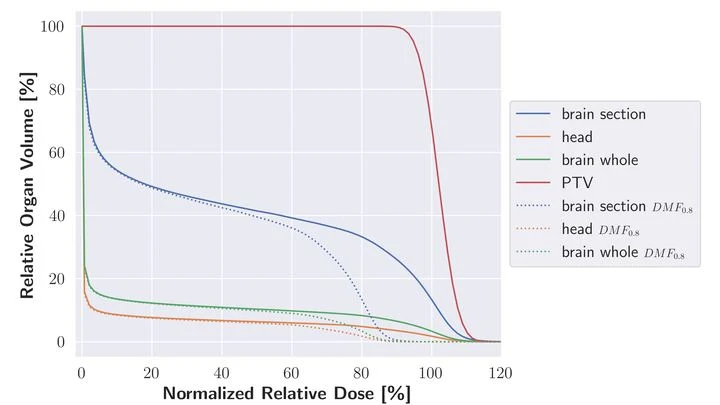
A garden hose shoots a thin, powerful jet. If you sweep it across the yard, you can water the whole bed without flooding the path. That's roughly how the new approach to treating deep tumors works: instead of a broad radiation field, you take a narrow beam of electrons accelerated to nearly the speed of light and scan it across the tumor like a jet of water.
A deuterium molecule, two atoms of heavy hydrogen, falls apart under a laser pulse. One electron is ripped away, leaving an ion behind. At that moment, they are still linked: the direction of one immediately tells you which way the other went. This link is called quantum entanglement.
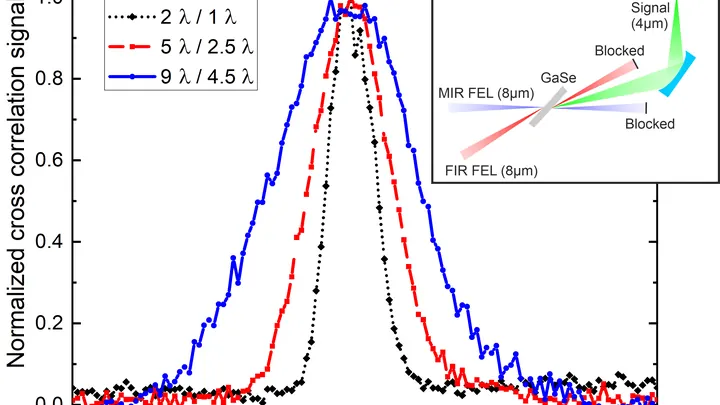
The infrared laser at the Fritz Haber Institute now works like a conductor with two batons. Previously, it produced a single beam in the mid-infrared range, where molecules vibrate.
An ordinary aluminum pot on a stove doesn't emit molecules you can catch with light. But if you take aluminum and an aluminum salt, heat them together in a small oven, you get a stream of aluminum fluoride molecules, like steam from a kettle's spout, except instead of water droplets, tiny particles fly out.
An electron beam in an accelerator is like a flock of birds: it flies in a tight group, but over time it spreads out. To keep particles together, heavy magnets are usually used. Here they did without them — the beam squeezed itself.
Ordinary light is like a crowd in a square: each photon moves on its own, bumping into others and scattering. But in some media, photons start running together like a pack of dogs: they bunch up. Scientists have built a random fiber laser where light particles gather into especially dense clusters.
Entangled photons are like two couriers marching in lockstep: their quantum states, particularly polarization, are synchronized so that measuring one instantly determines the state of the other, even at a distance. In a material, this synchronization gets disrupted.
A powerful laser strikes a tiny target, and it instantly turns into a cloud of scorching gas — plasma. Within this cloud, magnetic fields spontaneously arise. Like invisible hands, they prevent heat from freely escaping the hot core.
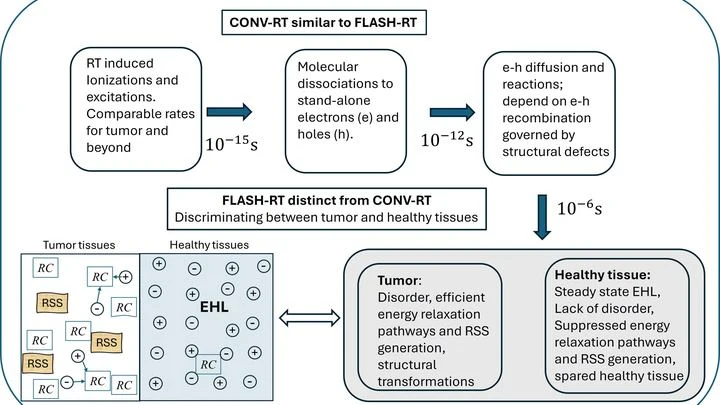
Two cities: one with neat, straight streets, the other with a tangle of alleys. If you send a powerful flood of water through both, in the first the water quickly drains away through channels, while in the second it swamps everything. That's roughly how tissues behave under ultrafast radiation therapy, known as FLASH.
A typical accelerator is like an assembly line where electrons are the workpieces. To get the desired X-ray pulse, the workpiece is fine-tuned after it's already on the line: squeezed, filtered, corrected. In the new work, engineers decided to take a different approach — shaping the workpiece before it even hits the conveyor.
At LCLS-II, electrons are knocked out of a metal by a short laser pulse.
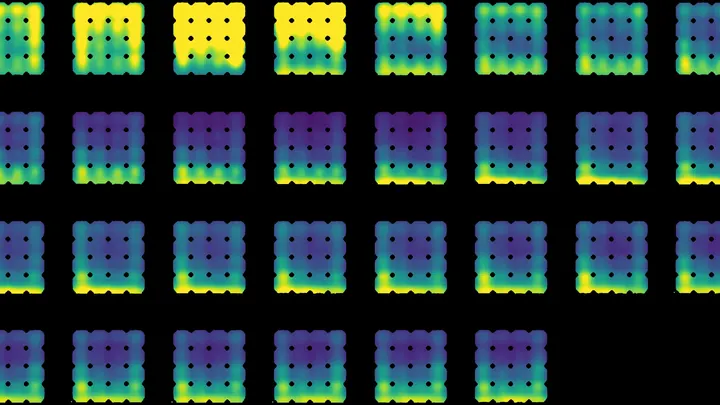
Radio waves surround us, but our eyes can't see them. This new sensor, the size of a fingernail, turns them into a colored patch on a tiny screen.
Inside the chip is a layer of liquid crystals — the same kind used in phone displays. Among them are embedded thin ferromagnetic nanowires. When a radio wave arrives, the nanowires heat up quickly.
Laser light is like a perfectly aligned row of soldiers on parade: all waves oscillate in the same plane. Such light is called polarized. In a new study, physicists have for the first time produced polarized gamma rays by colliding electrons with a powerful laser pulse.
In a piece of manganese oxide just a few atomic layers thick, electrons behave like a crowd on an escalator: each moves by its own rules, but together they create a common flow. Physicists shone soft X-rays on such a film and knocked electrons out.
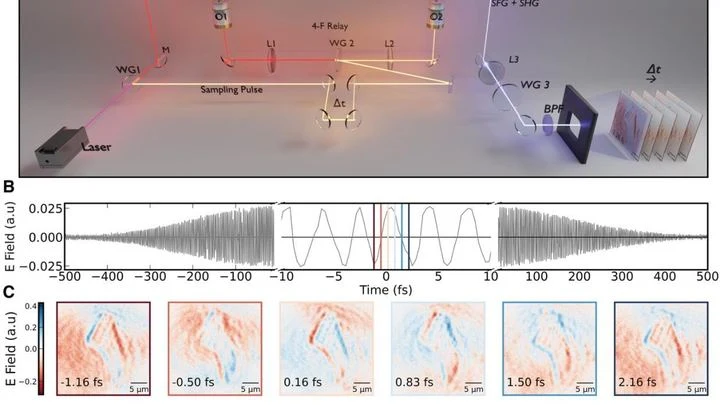
Light is not just a beam but a wave with an electric field that changes at a speed unimaginable to ordinary clocks. Until now, this field could only be measured at a single point, like taking temperature with a single thermometer. Now researchers have created a method that shows the entire field at once, like a thermal imager showing a heat map.
The 'fish-eye' lens is an unusual piece of glass: its refractive index changes from the center to the edge so that any ray emitted from any point is focused to the point directly opposite. Making such a lens from ordinary glass is nearly impossible, but physicists found a workaround.
Modern X-ray light sources are like an orchestra without a conductor: electrons in the beam fly every which way, and the radiation comes out blurry. The new idea is to make electrons line up in neat rows with a spacing of a few nanometers. Then the light they emit becomes coherent, like a laser beam.
Sunlight is a turbulent stream carrying inseparable pairs of droplets. That’s what quantum entanglement looks like: two particles are so connected that a fluctuation in one instantly resonates in the other. In the past, creating such pairs required a 'calm pool' — a perfectly tuned laser beam.
An ordinary free-electron laser is like a musical instrument with a single string: it can play only one note until you change its design. To get a different wavelength, you have to retune magnets or accelerate electrons harder. That's expensive and bulky.
An electron beam can be compared to the light from a laser pointer: if it diverges, the spot on the wall quickly spreads out. In the lab, physicists created such a narrow beam that it remained thin over a long distance, like the beam of a good pointer.
An ordinary rubber pad dampens vibration the way a thick blanket muffles sound: the thicker and heavier, the better. Engineers have long dreamed of a material that is light yet "eats" oscillations as well as a massive damper.
Magnetic resonance is like a tuning fork that rings only at its own note. Each molecule has its own frequency, and from that you can tell what the molecule is and what state it's in. But previously, this tuning fork was listened to through a thick wall: the signal was blurred, and you couldn't make out the exact note.
A random fiber laser is a thin glass thread through which light travels, but instead of reflecting off mirrors, it reflects off the tiniest irregularities in the fiber itself. Such a laser doesn't produce a steady beam: its light flickers and flares like a candle flame in a draft.
Igniting a miniature sun is a long-held dream of humanity. Typically, scientists try to confine scorching plasma (a gas of charged particles) at temperatures of hundreds of millions of degrees. But plasma tends to escape magnetic traps, and confinement comes at enormous cost.
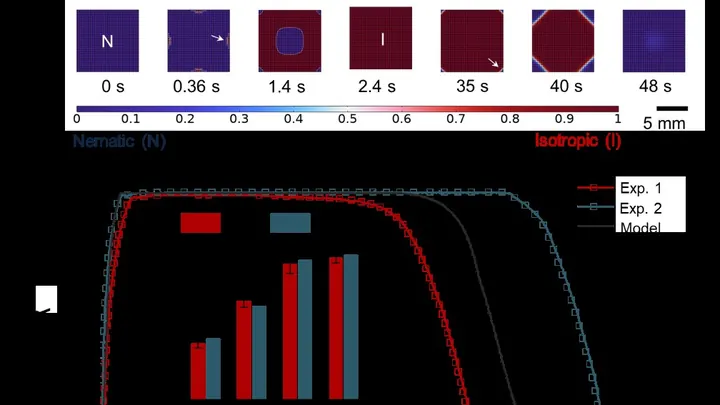
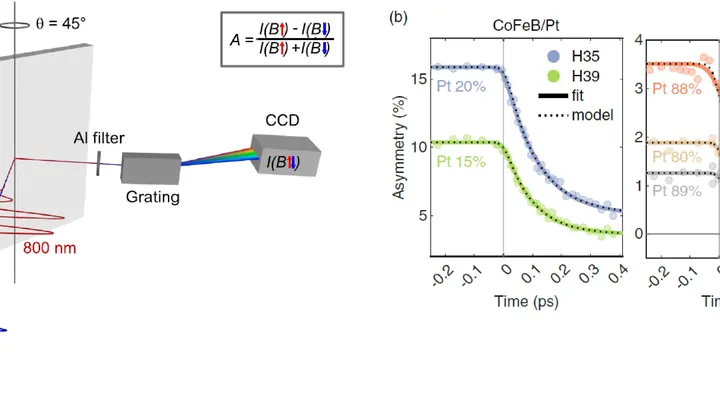
A fridge magnet holds on thanks to tiny internal arrows: each one like a miniature compass. If you hit the metal with an ultrashort flash of light, these arrows start to jitter chaotically, and magnetism melts away in a millionth of a billionth of a second. Previously, such 'melting' was too fast to observe.
A laser on a lithium niobate crystal comes to life with a current of 40 milliamps. Its light splits into two streams, each passing through a six-millimeter waveguide, where twin photon pairs are born. One stream rotates the polarization of its twins, after which both flows merge into a common channel.