An infraredlaser is a laser that emits light in the infrared portion of the electromagnetic spectrum, with wavelengths typically ranging from about 700 nanometers to 1 millimeter. In the context of molecular physics, infrared lasers are powerful tools for exciting and probing molecular vibrations because the energy of infrared photons matches the energy differences between vibrational quantum states of molecules. This allows scientists to selectively trigger specific vibrational modes and observe how molecules respond.
History
The first infraredlasers were developed in the 1960s, shortly after the invention of the laser itself. The helium-neon laser (1961) and the carbon dioxide laser (1964) were among the earliest to emit in the infrared. The use of infrared lasers for molecular spectroscopy expanded rapidly with the development of tunable sources like optical parametric oscillators in the 1970s.
How it works
When an infraredlaser pulse hits a molecule, its electric field interacts with the molecule's dipole moment, driving transitions between vibrational energy levels. By tuning the laser's wavelength, researchers can target specific bonds (e.g., C-H, O-H, C=O) and excite them to higher vibrational states. The subsequent relaxation, often via emission or energy transfer, can be detected to reveal molecular structure, dynamics, and interactions. In pump-probe experiments, two infrared pulses are used: one to excite and another to probe the system at a controlled delay, mapping out ultrafast processes.
In practice
Infraredlasers are used in environmental monitoring (detecting trace gases), medical diagnostics (e.g., breath analysis), and industrial process control. In research, they enable time-resolved studies of chemical reactions and protein dynamics.
Fun fact
The carbon dioxide laser, a type of infrared laser, is so efficient that it can cut through steel, yet it is also used in delicate eye surgeries because its wavelength is strongly absorbed by water in tissue.
For three days straight, a laser blasted a jet of gas, and every second it produced a beam of electrons with the energy of a tiny lightning bolt. Previously, such beams could only be produced in huge halls where the accelerator takes up an entire building. Now the whole setup fits in a room and ran without a glitch for 72 hours.
A protein is like a tiny machine that switches on and off on command. The command arrives when another molecule sticks to it, like a key in a lock. The protein then changes shape and passes the signal along. But exactly how the signal travels inside the protein has long been a mystery.
A laser is like a tuning fork that rings at a single note. But even in complete silence, its sound trembles slightly. Previously, it was thought that this tremor, random kicks from spontaneous emission of light by atoms inside the laser, was the main limit to precision.
A typical laser is a cavity where light bounces between mirrors and gets amplified. But you can ditch the mirrors and make light circulate inside a tiny particle smaller than the light wave itself. That's how the new lasers work: nanoparticles of indium phosphide sitting on perfectly smooth gold.
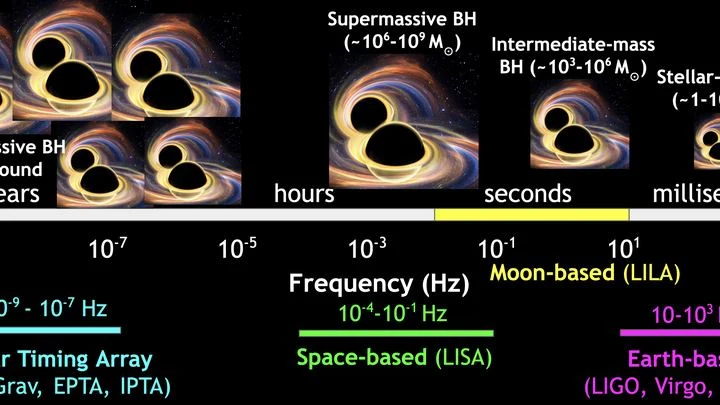
A translator records a multi-hour conversation. If they try to hold the entire dialogue in their head, they're bound to garble details by the end. That's roughly how gravitational observatories work: they listen to the 'conversation' of massive bodies spiraling together.
The Universe is pervaded by an invisible substance — ultralight dark matter, which doesn't collide with ordinary matter but can tremble like a taut string. Its oscillations alter the world's most fundamental properties: the electron charge, the speed of light — as if the tuning of a single cosmic note slightly drifts.
Light can be more than just a beam: it can be a precision ruler. If you take very short pulses, shorter than a fly's wingbeat, and fire them one after another, you get an optical comb: a set of colors spaced at exactly equal intervals, like the teeth of a comb. This rainbow lets you measure distances, time, and the composition of materials with unimaginable accuracy.
Gravitational waves are ripples in the fabric of space, like circles on water from a thrown stone. On Earth, they are drowned out by traffic, tides, and earthquakes, like a storm beating on a lake, making it impossible to notice faint splashes. The LILA project moves the detector to the Moon, where windless silence reigns.
An ordinary laser emits narrow lines, like a string that sounds only one note. For spectroscopy, this is inconvenient: if a substance absorbs light between the lines, you might miss it.
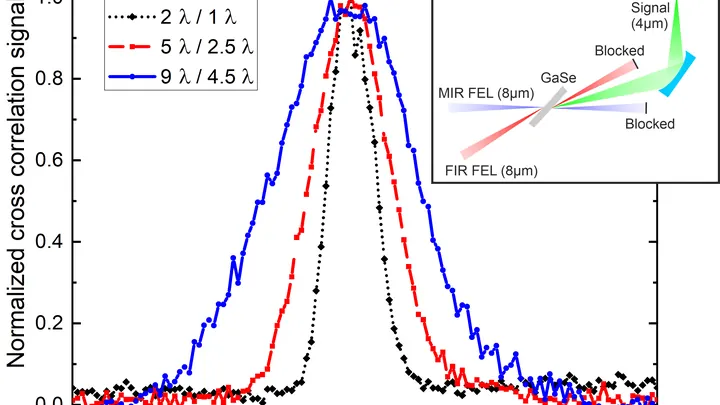
The infrared laser at the Fritz Haber Institute now works like a conductor with two batons. Previously, it produced a single beam in the mid-infrared range, where molecules vibrate.
A distant quasar appears as four points of light arranged in a cross. This is how the gravity of a galaxy lying along our line of sight distorts the view: it acts like imperfect glass, multiplying the image. Each point is the same object, but its light travels different paths.
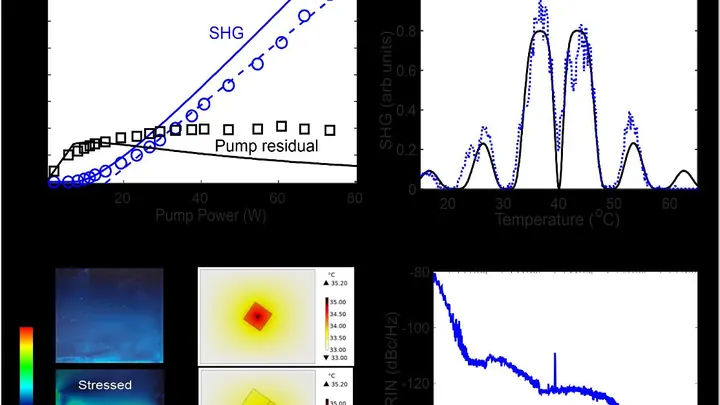
The laser based on diamond converts almost half of the pump energy into bright yellow light — an efficiency of 47.7%, a record for such devices. But the main advantage is not the power, but the exceptional purity of the color: the beam is so monochromatic that it can be compared to a musical instrument playing just one note without the slightest wavering.
If a supermassive black hole lives at the center of a galaxy, it heats the infalling gas to incredible temperatures. That gas glows, and we see it as a quasar — the brightest beacon in the universe. But how do you measure the size of the light source itself?
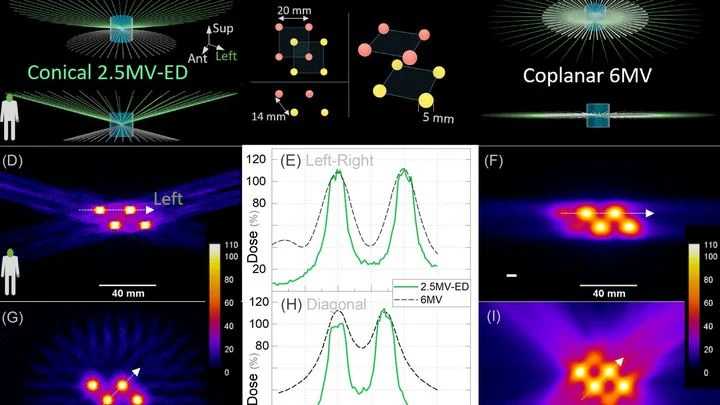
Radiation therapy is like shooting at a small target with a very large-caliber rifle: even a precise shot hits a large area around it. The thickness of the 'trace'—called the penumbra — is 2–3 millimeters in standard machines. For a tumor in the lung, that's not a big deal, but next to a nerve or a blood vessel, those millimeters decide whether a person stays healthy.
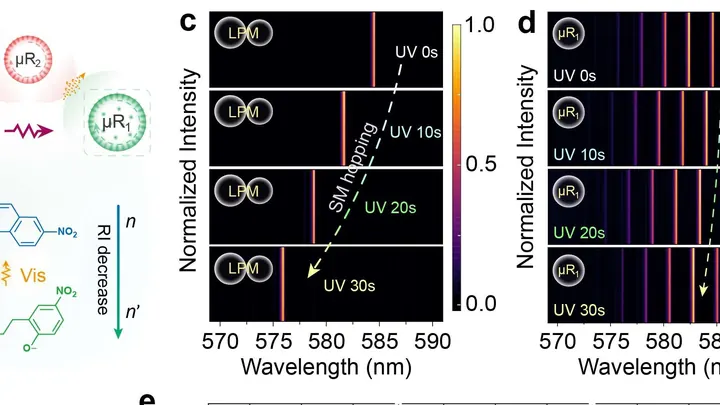
Two liquid droplets hanging side by side begin to sing in unison. One droplet is like a string tuned to a certain pitch, and together they form a laser that shines with a single, pure color. That's how a new type of sensor, a liquid photonic molecule, works.
The secret is that the droplets are slightly different in size.
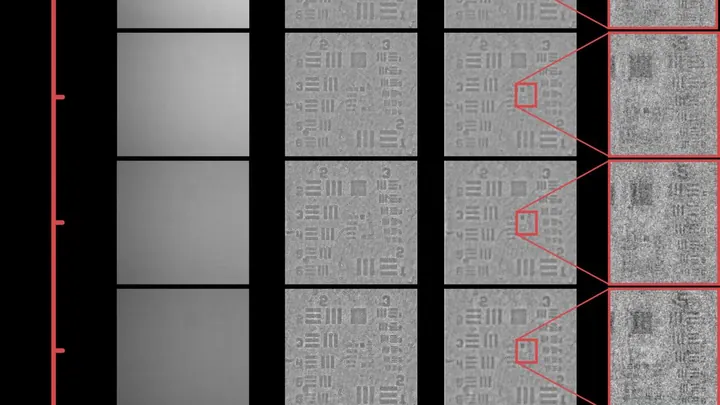
Light in murky water behaves like a person in thick fog: every step is a collision, and the picture blurs. That's why a regular microscope can't see through skin or milk. Engineers found a workaround — look in the infrared range, where light collides less with particles.
The laser in question is not a thin beam but a whole running track for light. Inside the optical fiber, two ultrashort pulses race: one clockwise, the other counterclockwise. Each pulse is a single flash lasting billionths of a second.
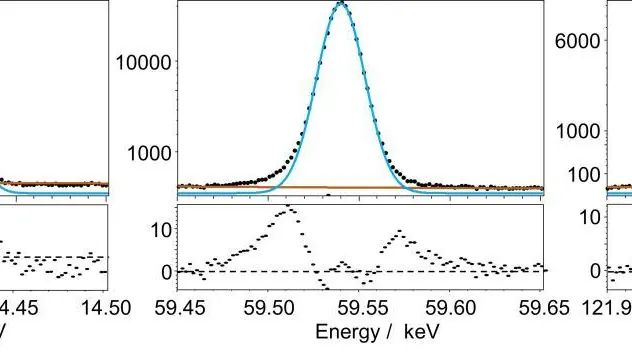
Gamma rays are the most energetic flashes of light born deep within atoms. Their energies are like fingerprints: each radioactive element has its own pattern. But measuring that pattern with high precision is like weighing a grain of sand on a scale sitting on a vibrating truck.
The new setup works like an ultra-sensitive thermometer.
A laser beam usually quivers slightly, like a plucked string. In optical clocks, that quiver turns into timing errors. Engineers swapped the shaky light for steady light, and rubidium vapor clocks started ticking five times more evenly.
An ordinary laser emits a single color, like a single note on a piano. But to find molecules in the air, you need an instrument that quickly sweeps across many colors, like a musician playing a scale. Such a laser is called tunable, and the faster it changes color, the faster you can 'sniff' the air.
In the cold clouds between the stars, where new suns are born, invisible chemical work is underway. Simple molecules collide, swap atoms, and assemble into chains that may later become part of planets. One such chain is the NCCO+ ion, made of nitrogen, two carbons, and oxygen.
Ultraviolet light with a wavelength of about 300 nanometers is invisible to the eye, but it can destroy the DNA of microbes, make certain substances glow, and carry information. Until now, lasers in this range were bulky, expensive, or short-lived.
In giant particle accelerators, particles fly at nearly the speed of light and smash head-on. But sometimes one beam is slightly denser than the other, like someone stepping onto a packed escalator the wrong way. Then collisions become uneven, and detectors start 'flickering,' throwing off measurements.
A conventional thermal camera is like a thermometer that slowly heats up and cools down. It shows where heat is well, but it can't keep up with fast motion. The new sensor works differently: it counts individual quanta of heat, like a droplet counter during rain.
You can trap light in a cage smaller than a speck of dust. Photonic crystals are lattices that stop light from scattering and force it to run in circles. Previously, such structures were grown on a bulky substrate, making them too large for living cells.
A thermal imager typically works like a thermometer with a sensor array: it measures how much each pixel heats up and turns that into a picture. But this method has a limit — the device's own noise obscures faint heat.
A quantum computer is like an orchestra that can only perform in complete silence. The slightest noise, and the delicate melody falls apart. For quantum devices, heat is that noise: even faint infrared radiation from nearby components heats up the qubits and erases their quantum states.
The theory of gravity by Einstein — general relativity — rarely intersects with quantum physics in direct experiments. Here, scientists built a 50-kilometer glass labyrinth on a table and sent single photons through it.
In 1976, Canadian physicist Bill Unruh asked a simple question: what does an observer see when accelerating through empty space? The answer turned out to be strange: emptiness ceases to be empty. An accelerating observer bathes in thermal radiation with a temperature proportional to the acceleration.