Scales That Hear an Echo in a Drop express
Quartz microbalances are thin plates that vibrate at a frequency of five million times per second. When a drop of liquid lands on the plate, the vibration changes: from these changes, you can determine the drop's mass and its elasticity. But in small drops, an unexpected effect arises: the sound that the plate sends into the liquid reflects off the drop's upper surface and returns. This creates an echo that tugs at the plate and confuses the readings.
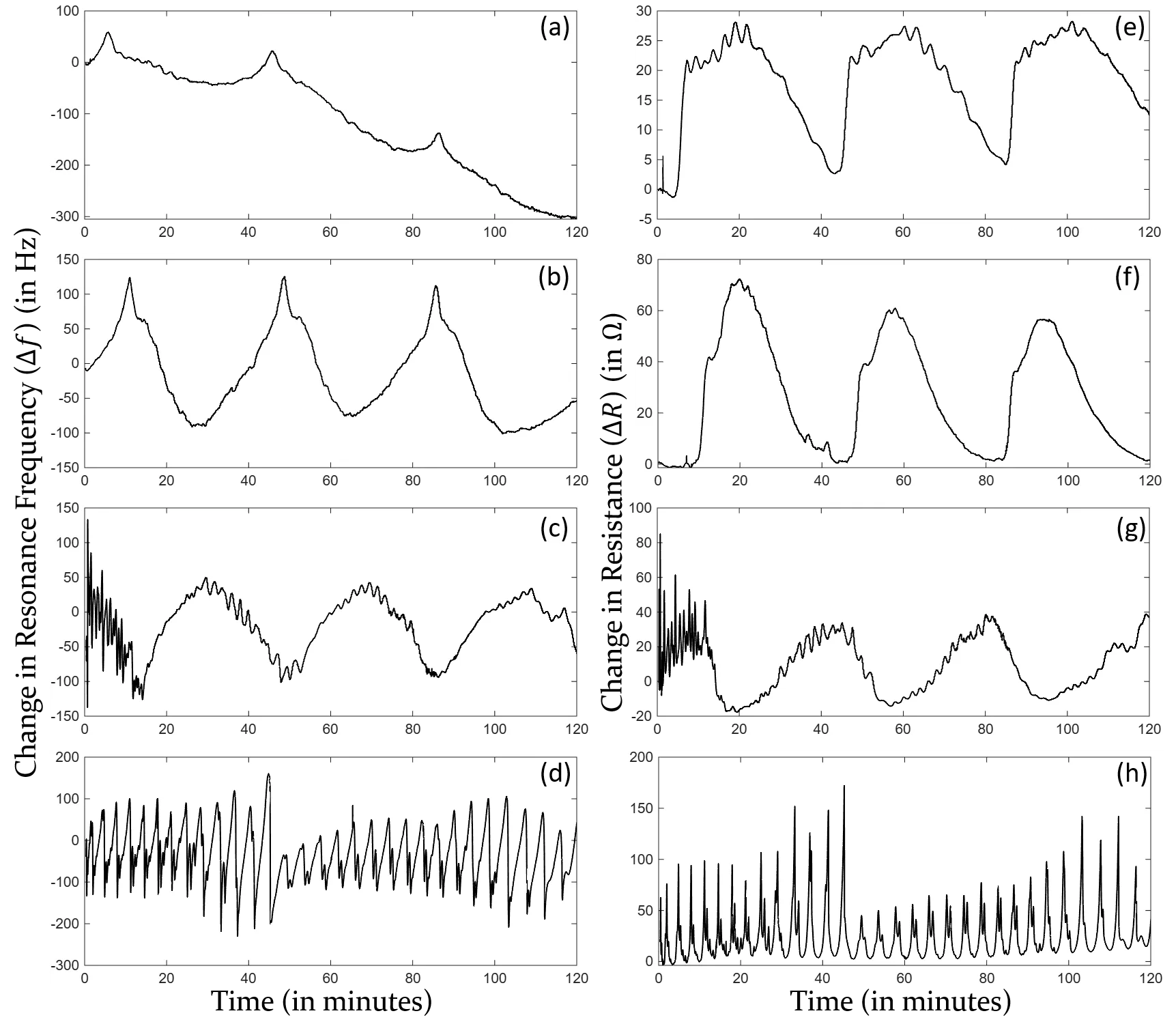
The scientists took two common cell culture media — DMEM and RPMI-1640—and dropped them onto the scales in different volumes. It turned out that the echo depends on the volume: in small drops (about 40 minutes per echo cycle), it is slow, while in larger drops, it is fast (about 5 minutes). The vibration amplitude changed by 100–150 hertz in frequency and by 40–60 ohms in resistance. There is a time shift between the frequency and resistance oscillations — approximately 10 minutes.
Now biologists who monitor cells with such scales can subtract the echo from their measurements in advance. Otherwise, they might mistake the reflected sound for a signal from the cells themselves and draw incorrect conclusions.
Original abstract
as written by the authors arXiv:2604.17403
Quartz Crystal Microbalance (QCM) sensors are widely used to study biological and soft-matter interfaces due to their exceptional sensitivity to mass loading and interfacial mechanical properties. While classical QCM theory assumes predominantly shear-wave coupling into a semi-infinite Newtonian liquid, finite liquid thickness and acoustic reflections give rise to pronounced compressional (longitudinal) wave effects that strongly modulate both resonance frequency and motional resistance. Such compressional acoustic-wave responses should be properly accounted for when sensing in the liquid phase, for instance when working with cell suspensions. In this work, we systematically investigate compressional-wave responses in cell culture media including DMEM and RPMI-1640 across varying droplet volumes using a 5 MHz AT-cut QCM. Time-resolved measurements are analyzed using four parameters: the time period of compressional acoustic waves (Tca), the time associated with a phase shift between resonance frequency and resistance oscillations (Tp), the peak-to-peak shifts in frequency ({\Delta}fpp) and resistance ({\Delta}Rpp). DMEM and RPMI-1640 both exhibit strong volume-dependent periodic oscillations. At lower volumes, they exhibit low-frequency oscillations with a time period of approximately 40 minutes. However, as volume increases, the oscillations gradually evolve into high-frequency oscillations with a time period Tca of approximately 5 minutes. The peak-to-peak shifts ({\Delta}fpp) and ({\Delta}Rpp) are approximately 100-150 Hz and 40-60 {\Omega}, respectively. The resonance frequency and resistance oscillations also exhibit a phase shift Tp of approximately 10 minutes. These results highlight that compressional-wave artifacts occur even in simple cell culture media, necessitating their explicit consideration when interpreting QCM data in the presence of cells.
Quartz microbalances are so sensitive that they can detect one billionth of a gram — about the weight of a single bacterium.