An echo is a sound or other signal that returns to the listener after being reflected off a surface or barrier. In physics, the term extends beyond acoustics to any wave phenomenon—electromagnetic, seismic, or even quantum—where a delayed copy of the original signal arrives due to reflection. The delay and intensity of the echo carry information about the distance and nature of the reflecting object, making it a fundamental tool for probing environments that are otherwise inaccessible.
History
The study of echoes dates back to antiquity, with early explanations by Greek philosophers. The first systematic scientific investigation was conducted by the German physicist August Toepler in the 19th century, who used the schlieren method to visualize sound waves and their reflections.
How it works
When a wave encounters a boundary between two media with different properties, part of its energy is reflected back. The reflected wave travels back to the source, arriving after a time equal to twice the distance to the barrier divided by the wave's speed. In acoustics, this is why you hear a distinct repetition of your voice in a canyon or a large hall; in radar and sonar, the same principle is used to locate objects by measuring the round-trip time of pulses.
In practice
Echo principles are used in sonar for underwater navigation and fishing, in medical ultrasound imaging, and in radar systems for aircraft and weather detection.
Fun fact
In bats, echolocation is so precise that they can detect objects as thin as a human hair, using echoes to navigate and hunt in complete darkness.
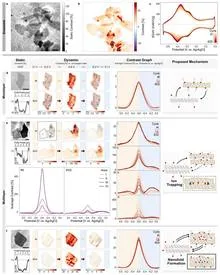
A stack of pages that has been flipped through many times remembers it: some sheets lie flat, others stick up, and creases remain here and there. Layered materials behave much the same way when ions enter them.
In a dark room, a spark jumps between two wires, and for an instant, there is light. Physicists have done something similar, but a million times smaller: at the boundary of two transparent crystals, they drew a conducting path and left a break just a few atoms wide. When a direct voltage was applied across this tiny gap, it began to glow.
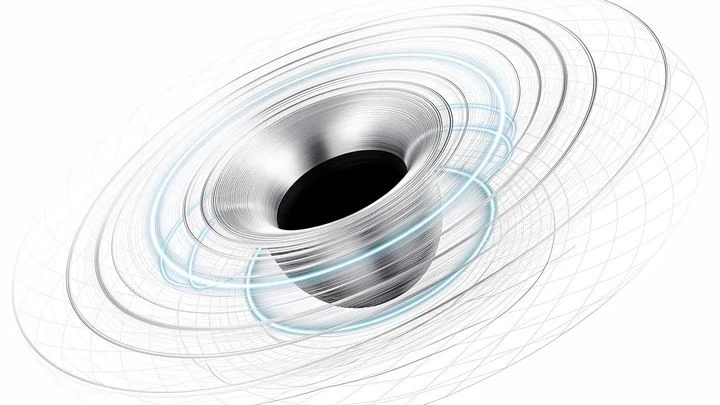
When two black holes merge, ripples spread across the fabric of spacetime — gravitational waves. But what if one of them isn't a run-of-the-mill black hole but something else — an exotic compact object?
Two neutron stars whirl in a close dance, each feeling the tidal field of its partner. It's like the Moon raising oceans on Earth, but here it's spacetime itself and the star's matter that deform. Astrophysicists call this tidal deformation — a measure of how much an object 'bends' under the gravitational pull of its companion.
Human hearing is wired so that the brain prioritizes familiar patterns — a friend's voice, the patter of rain, a car horn. But a new system works on a different principle: it registers any sound burst, even one never encountered before.
Imagine a river at a rapid: the current accelerates until no wave can go against the flow. So it is with gas near a black hole: reaching the speed of sound, it locks itself in — an acoustic black hole is born, a twin of the gravitational abyss. Here the event horizon is woven from a flow faster than its own sound.
Civilizations in the Universe are separated not just by distance, but by the vast gulf of time. Hunting for their traces is like archaeology: instead of palace ruins, we find clouds of cosmic dust.
A pebble tossed into a pond sends ripples spreading in all directions. Now imagine the pond itself suddenly turning into jelly — instantly, faster than the wave can complete a single crest. Some ripples would keep spreading but change their spacing, while others would unexpectedly turn around and run back toward the point of impact, as if time were flowing backward for them.
The galaxy is like a city at night: most windows shine steadily, but sometimes a skyscraper lights up all its lights and then goes dark. Just like that, according to a new hypothesis about planets around alien stars (exoplanet), we might first notice another civilization — by a short but blinding flash that could mark its demise.
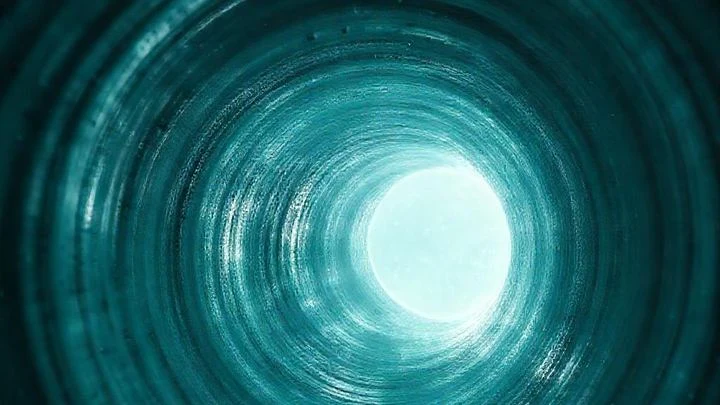
A wormhole is a tunnel that pierces through curved space and connects distant regions of the Universe. Recently, Juan Maldacena and his colleagues proposed a working model of such a hole based on a special combination of spatial curvature and quantum particles.
An old aviation instrument sometimes sticks: the needle catches on the scale and doesn't move, even though the plane is already changing altitude. Engineers found a simple solution: add a slight vibration. The shaking doesn't hinder; on the contrary, it helps the needle break free and show the truth.