A Diamond That Learned to Conduct Electricity
Diamond is the hardest natural material and usually does not conduct electricity. But if you add a few foreign atoms to its crystal lattice, it can become a semiconductor, like silicon in computer chips.
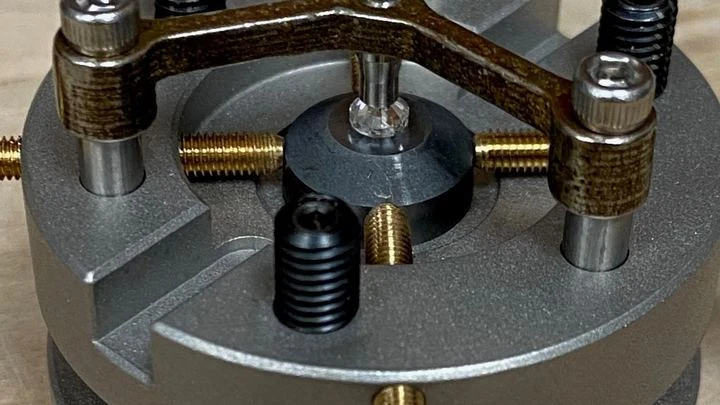
A device that compresses small samples between two diamond anvils to generate extreme pressures.A diamond anvil cell is a device used to generate extremely high pressures by squeezing a small sample between two diamond tips. Diamonds are used because they are the hardest known material and transparent to a wide range of electromagnetic radiation, allowing scientists to probe the sample with light, X-rays, and other probes while under pressure. This tool has enabled experiments at pressures exceeding those at the center of the Earth.
The diamond anvil cell was invented in the late 1950s by Alvin Van Valkenburg and his colleagues at the National Bureau of Standards, building on earlier work with simpler anvil devices.
The sample is placed in a small hole in a metal gasket, which sits between two diamond anvils. Turning a screw or using a mechanical press forces the diamonds together, compressing the sample. The pressure can reach millions of atmospheres, altering the material's properties, such as turning hydrogen into a metallic state or changing the structure of ice.
It is used to study the behavior of materials under extreme conditions, such as the interiors of planets, and to synthesize new materials like superhard ceramics or exotic forms of ice.
Despite the immense pressures, the diamonds themselves remain intact because they are compressed uniformly, and the pressure is applied to a very small area.