The hertz (Hz) is the SI unit of frequency, defined as one cycle per second. It quantifies how often a periodic event repeats in a given time interval, from the vibration of atoms in a crystal to the oscillations of light waves. In physics, it is the standard measure for anything that cycles—sound waves, radio signals, or the ticking of atomic clocks—and its precision is crucial for experiments that probe the fundamental structure of matter.
History
The unit was named after Heinrich Hertz, who experimentally confirmed the existence of electromagnetic waves in the 1880s. It was formally adopted as the SI unit in 1960, replacing the earlier term 'cycles per second.'
How it works
One hertz means exactly one complete oscillation or cycle occurs every second. For higher frequencies, multiples like kilohertz (10^3 Hz), megahertz (10^6 Hz), and gigahertz (10^9 Hz) are used. In practice, frequency is measured by counting cycles over a known time, often using electronic counters or interferometric techniques that compare against a stable reference, such as a cesium atomic clock.
In practice
Hertz is used everywhere from tuning musical instruments and setting radio station frequencies to calibrating the ultra-precise optical clocks that underpin GPS and tests of fundamental physics, as in the cited research on helium-4 nuclei and nuclear clocks.
Fun fact
The frequency of the microwave radiation used in atomic clocks is about 9.2 billion hertz, and measuring it to 48 hertz precision—as in the helium-4 study—means detecting a change of just five parts in a billion.
Systems:SICGSOne hertz is one cycle per second, defined as the reciprocal of the second.
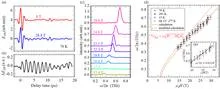
A taut string sounds higher when you pull it tighter. Magnetization in an antiferromagnet behaves similarly: the stronger the external field, the faster it oscillates. But in chromium oxide crystals, something goes awry.
In fields from 20 to 30 tesla, the resonance frequency grows more slowly than it should.
The two states of a strontium atom are like twins running down the same track, but one is slightly higher than the other. Usually, the light used to manipulate atoms pushes one twin harder and the other more weakly. Here, they chose a wavelength of 813 nanometers—'magic'—where both get the same kick.
The ticking of atomic clocks is like the beat of a metronome, but instead of a pendulum, it's the oscillation of electrons in an atom. Two such clocks — one using an ytterbium ion, the other using strontium atoms — were made to tick side by side, and their rhythms were compared.
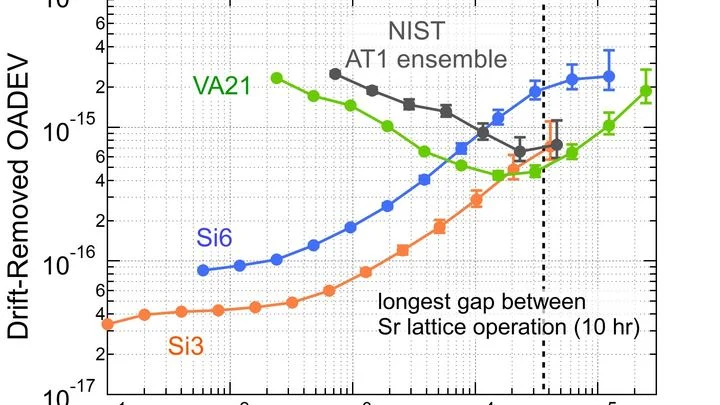
The world's most precise stopwatch still runs with one eye on an old pendulum. Hydrogen masers — the best radio-frequency flywheels (devices that keep the rhythm between comparisons with a reference)—accumulate error because noise between ticks leaks into the final signal.
Atomic nuclei are rarely perfect spheres. More often, they resemble a slightly squashed ball — the electric charge inside is unevenly distributed, and protons may shift a bit, creating a tiny 'pear-shaped' bulge.
A pendulum that almost nothing can knock off balance (not shaking, not heat, not magnetic fields) because it is hidden in the very heart of the atom. That is the kind of pendulum physicists used when they first switched on a nuclear clock. Previously, the best clocks, optical ones, relied on electron transitions.
In the basements of four European institutes stood seven devices: each can be compared to a tuning fork of unimaginable precision. But instead of sound, they emit 'ticks' made of light: oscillations of a laser locked to a specific frequency by atoms of strontium, ytterbium, or mercury.
A clock isn't just hands. Every atomic nucleus is a natural metronome: it oscillates with nearly perfect regularity. If you lift one such metronome a couple of meters, its rhythm speeds up ever so slightly — that's time warping, as predicted by Einstein.
A laser strikes the crystal, and it responds with flashes of light, like a bell ringing after a blow. But if the bell is warm, its sound wavers and fades. Same here: the crystal's atoms constantly jitter from heat, and this jitter disrupts the electrons' smooth flight, making the light dim and blurry.
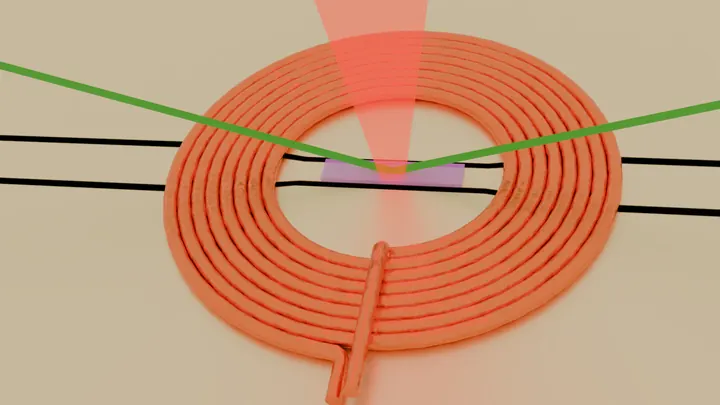
A tiny defect in a diamond crystal works like a sensitive antenna. When a magnetic field oscillates nearby, this defect, a nitrogen vacancy, responds by glowing. Previously, to hear the signal, you had to accumulate many repeated measurements, like listening to a whisper with your ear pressed against a door. Now a single short "look" suffices.
The helium atom is like a tiny solar system: electrons orbit the nucleus, but their orbits are governed by strict rules. Scientists have learned to observe these motions with incredible precision.