A Star Sings in Three Voices express
The binary star TIC 287869463 is a close pair: one star pulsates like a bell, while the other's gravity stretches it like an ocean tide. Usually, pulsations travel across a star as waves, but here one wave has frozen in place.
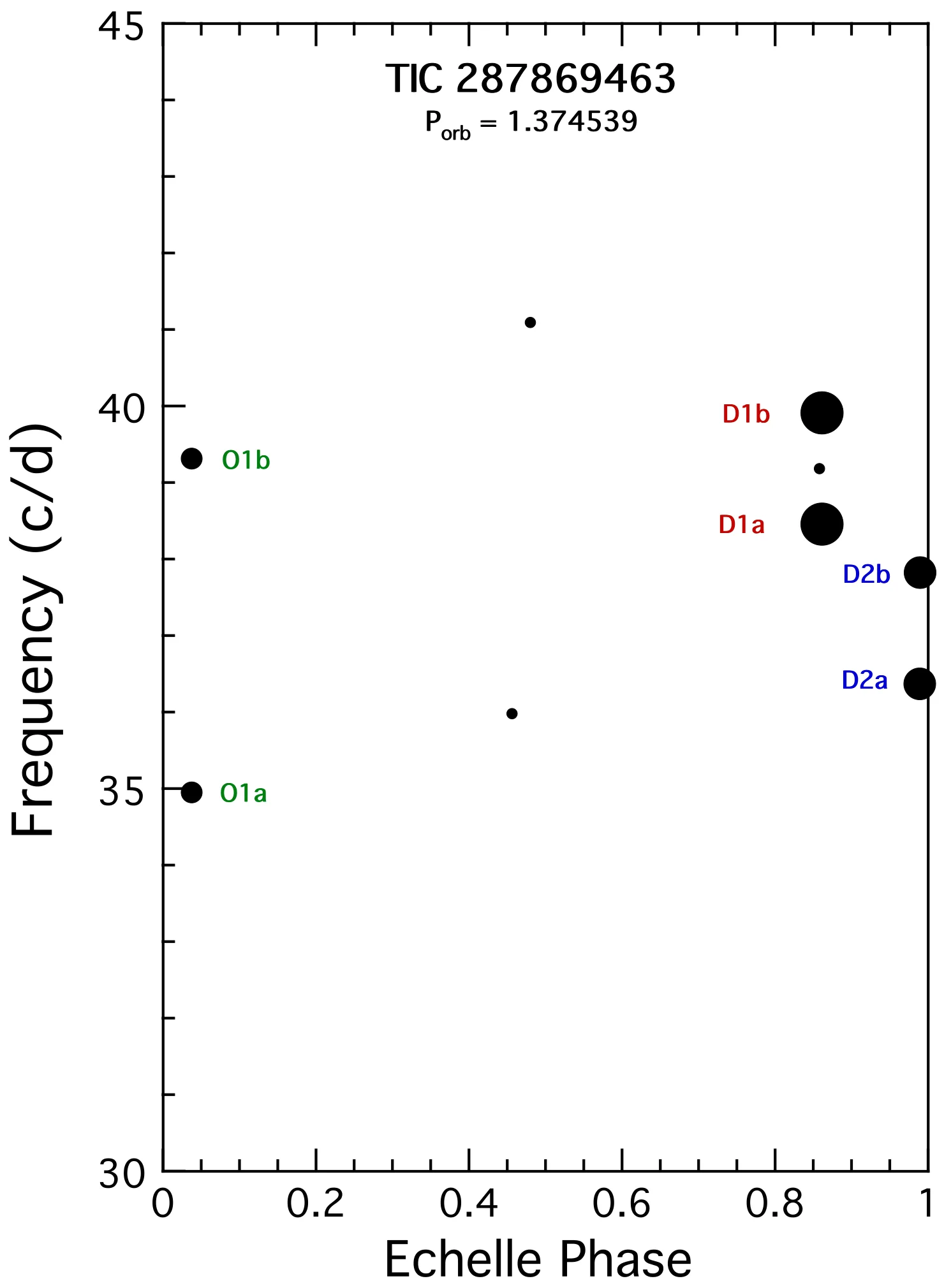
Astronomers sifted through three years of data from the TESS telescope — light from 50,000 stellar pairs. In this system, they found two pulsation frequencies shifted by exactly six orbital revolutions. This shift indicates that the oscillation pattern resembles a three-petaled flower anchored to the star's surface.
The pulsation frequencies are slowly increasing, but the difference between them remains constant, like two voices in a duet rising in pitch while always singing in unison at a fixed interval. This means that tidal forces, rotation, and the centrifugal effect have together reshaped the star's internal oscillations, creating a new, stable pattern.
The discovery helps piece together different types of "tilted" pulsators that astronomers had found before. They all appear to be different combinations of the same basic waves, aligned along the axis connecting the two stars.
The frequency shift matched the orbital period to better than one part in a hundred thousand, like two metronomes ticking in sync, drifting apart by only a second per day.