Tidal force is the differential gravitational pull that stretches and squeezes an object when it is in a non-uniform gravitational field. It arises because gravity weakens with distance, so the side of an object closer to a massive body feels a stronger pull than the far side, leading to deformation. This force is responsible for ocean tides on Earth, the tidal locking of moons, and the tidal disruption of celestial bodies that venture too close to a planet or black hole.
History
The concept was first analyzed by Isaac Newton in his Principia (1687) to explain ocean tides. Later, Pierre-Simon Laplace developed a more complete dynamical theory of tides in the 18th century.
How it works
Consider an object of finite size in a gravitational field. The gravitational acceleration varies across the object, creating a net stretching along the line connecting the object and the source, and a compression perpendicular to it. Mathematically, the tidal force is the gradient of the gravitational field, described by the tidal tensor. For a spherical body, this results in a prolate (cigar-shaped) deformation, which can lead to internal heating or even breakup if the force exceeds the object's self-gravity.
The Moon's tidal force on Earth is slowly increasing the length of our day by about 2.3 milliseconds per century, while also pushing the Moon away at 3.8 centimeters per year.
It is easier to turn a jar lid by gripping its edge than its center. Layered crystals such as graphite behave similarly when one layer is twisted relative to another: the resistance arises not from the whole contact area but only from its rim.
In 1934 Jean Leray proved that the Navier–Stokes equations always have solutions "in a generalized sense". Whether a solution stays smooth or can break down into a singularity he could not tell, and nobody could for ninety years. In 2000 the Clay Institute made the question one of its seven Millennium Prize problems.
A spotlight with an adjustable beam width sweeps along the shore. Its light is the long ocean waves that are born in the surf zone and spread in both directions: toward the beach and out to the open sea. Previously, this spotlight was considered a point source, but the actual breaking zone, where short waves break, has a finite width, and it changes as the wave front advances and retreats.
In 2017, detectors picked up a gravitational wave from the collision of two neutron stars. Just 1.7 seconds later, telescopes saw a flash of gamma-ray burst from the same spot. That tiny delay became a treasure for physicists.
Two neutron stars whirl in a close dance, each feeling the tidal field of its partner. It's like the Moon raising oceans on Earth, but here it's spacetime itself and the star's matter that deform. Astrophysicists call this tidal deformation — a measure of how much an object 'bends' under the gravitational pull of its companion.
Two balls dropped from different heights fall to the ground with different accelerations. In space, things are more complicated: even emptiness makes bodies move differently.
A branch falls into a whirlpool. It gets spun and broken, but sometimes a powerful fountain of water bursts from the center. Similarly, a black hole tears apart a passing star, and occasionally a blinding plasma jet, a jet, shoots into space.
Dwarf galaxies orbiting the Milky Way look as if they’ve survived a gravitational storm. Their stellar bodies are stretched, scattered by tidal tails, and heated from within.
A wormhole is a tunnel connecting two distant regions of the universe. If such a wormhole existed and were traversable, a particle inside it would feel not only gravity but also a force from its own electric field. This force depends on how spacetime is curved around it.
A black hole, like a spinning wheel, twists a cloud of light particles, axions, around itself. These particles are the leading candidates for dark matter. The cloud follows the laws of quantum mechanics, resembling a giant atom: there are levels, and there are transitions between them.
When two neutron stars circle each other, they don't remain rigid spheres. The partner's gravity stretches each star, creating tidal bulges — much like the Moon raises ocean tides on Earth. But unlike water, here it's superdense matter that deforms: a teaspoon of this stuff weighs billions of tons.
When two superdense stars circle in a tight dance, the space around them shudders. This shudder, gravitational waves, is caught by giant detectors on Earth. But deciphering the signal is tricky: you need to figure out what exactly you're dealing with — a pair of black holes or neutron stars.
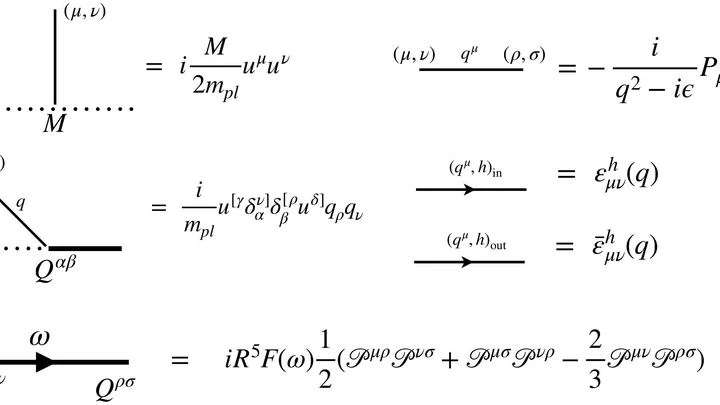
When a piano falls into an abyss, we think about the abyss. We don't think about the piano's cover. In much the same way, astrophysicists have for decades studied extreme close encounters between small bodies and massive black holes. They focused on the black hole itself and what orbits it. But what the 'bullet'—the small object heading toward doom — is wearing, almost no one asked.
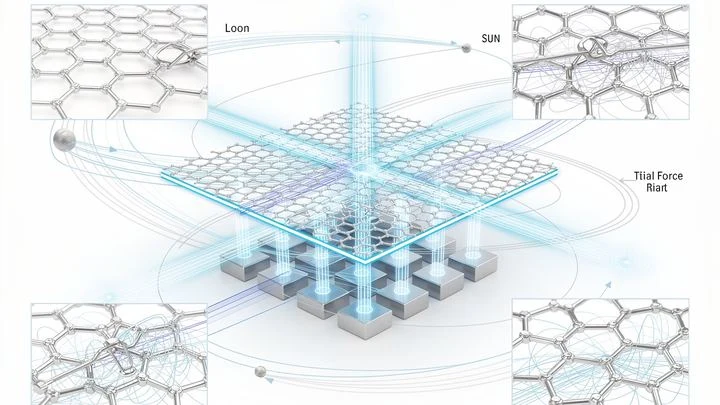
In the quiet of a laboratory, a graphite flake hovers above a magnetic grid. This is not just a demo of diamagnetism's magic — it's listening to the Universe. Like a spider casting its web to catch vibrations from an invisible world, this flake has become a gravitational web.
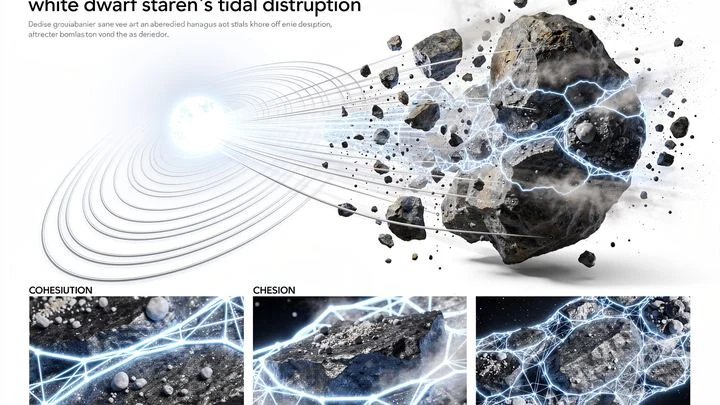
When a telescope catches the light of a distant white dwarf, the spectrograph sometimes fishes out heavy elements — calcium, iron, magnesium. These metals could not have stayed in the thin atmosphere of the stellar remnant; they are the traces of recently fallen planetary debris.
In the usual picture, a black hole is a featureless pit in spacetime. But if a shell of matter vibrates around it, the gap between the edge of the abyss and this shell becomes a resonant cavity.
Stephen Hawking imagined that the universe was born not from an explosion, but by smoothly emerging from a quantum 'nothing.' In worlds with concave geometry (anti-de Sitter space), such a birth acquires a rim, like the hoop of a drum.
In a pot of boiling soup, churning currents carry heat to the walls, and the soup cools. In a tokamak, a huge magnetic bottle for plasma, the same thing happens: turbulent eddies carry energy outward, hindering the ignition of a fusion reaction. But sometimes the plasma seems to find a way to calm itself.
A thrown stone arcs along a clean trajectory, but an electron's position in an atom is smeared out like fog. The transition from one to the other is a puzzle. New work shows that the fuzziness disappears not because of an observer, but because of the particle's own gravity.
A coin spinning on a table is a familiar sight. At first it rotates quickly, then it tilts, and its rattling becomes faster and faster. In the last seconds it seems to hover: the rotation slows, but the coin just won't finally lie flat. This final moment is a real puzzle for physicists.
Ring-shaped reefs, atolls, are usually explained like this: corals grow along the edge of a volcanic island while the island slowly sinks. What's left is a hollow ring that can stretch for kilometers. But satellite images show similar rings around very small reefs where there are no volcanoes and no subsidence.
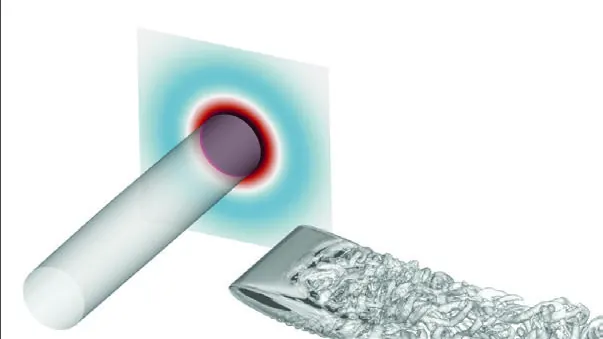
A sudden gust hits a wing, and a huge vortex swirls above it. Such a vortex can abruptly change lift, making the plane's nose dip. Engineers have long sought ways to predict these vortices, but complexity gets in the way: fast airflow is full of small chaotic eddies.
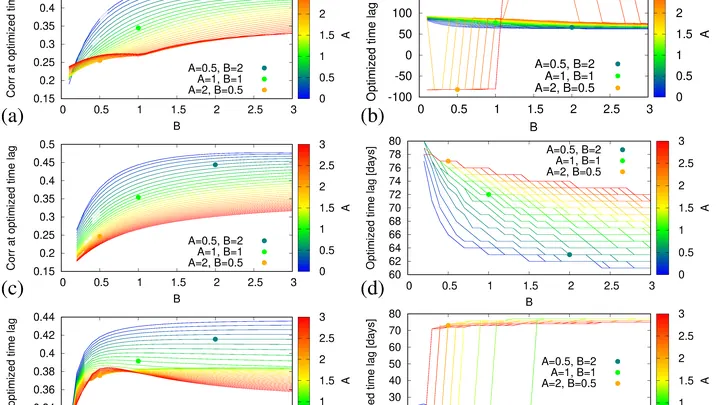
The Sun is not a calm sphere but a boiling cauldron that follows its own rhythms. Roughly every 11 years, its activity peaks: more dark spots appear on its surface, and streams of charged particles fly into space. But hidden within this grand cycle is a shorter one — about 1.7 years.
The center of a galaxy is a bustling metropolis where a giant black hole often snatches inattentive stars. But telescopes caught a flare in a quiet suburb, tens of thousands of light-years from the core. This gave away a wandering black hole — an invisible predator, flung out of the center after an ancient galaxy collision.
A spider web is not just a sticky net but a delicate instrument that responds to the weather. When the air becomes humid, spider silk threads shorten and twist, like a wet towel being wrung from both ends. Previously, it was thought that the thread twists because the proteins inside are arranged in a spiral. But no direct evidence for such an arrangement was found.
In the quantum world, an object can be in several places at once. Yet in everyday life we see things strictly in their places. The reason is gravity. A massive star under its own weight inevitably collapses into a black hole or a neutron star, but it can't be both at the same time.