Tilt, in the context of stellar systems, refers to the angle between a star's rotation axis and the orbitalplane of its planets or circumstellar disk. This angle, also known as obliquity, is a fundamental parameter that describes the geometry of a planetary system. A tilt of 0° means the planets orbit in the same plane as the star's equator, while a tilt of 90° indicates a polar orbit, and 180° would be a retrograde orbit. The tilt of a star's rotation axis relative to its disk can reveal important information about the system's formation history, including past gravitational interactions or planetary migration.
History
The measurement of stellar obliquity became possible in the late 1990s with the discovery of exoplanets and the development of the Rossiter-McLaughlin effect, which was first used to measure the tilt of a star-planet system in 2000.
How it works
The tilt is determined by measuring the star's rotation velocity and the orientation of its rotation axis, often through spectroscopic observations that detect the Doppler shift of spectral lines across the stellar disk. By comparing this with the orbitalplane of the planets, determined through transit observations or direct imaging, astronomers can calculate the obliquity. A significant tilt suggests that the system has undergone dynamical processes such as planet-planet scattering, Kozai-Lidov oscillations, or interactions with a binary companion, which can tilt the orbital plane relative to the star's spin axis.
In practice
Measuring stellar tilt helps astronomers understand the formation and evolution of planetary systems, including the migration of hot Jupiters and the dynamical history of multi-planet systems.
Fun fact
Our own Sun has a tilt of about 7° relative to the orbitalplane of the planets, which is relatively small, but some exoplanetary systems have been found with tilts exceeding 90°, meaning the planets orbit backwards relative to their star's rotation.
In 2015, the LIGO detectors caught the first ripple of spacetime from a black hole merger. Since then, hundreds of such events have piled up, each carrying the imprint of its ancestry: whether the holes were born together from a single pair of stars or met by chance in a dense cluster. The difference shows in the direction of their spin axes.
Hot gas spirals inward, falling onto an invisible superdense object. Such a disk resembles a giant whirlpool, but it is often tilted: its axis does not align with the rotation axis of the central body. The gravity of the massive object makes the disk wobble slightly, like a spinning top losing its balance.
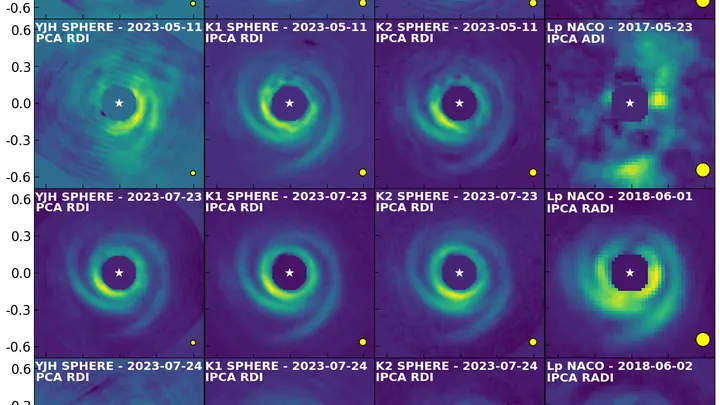
460 light-years away, around the star HD 135344B, a dense disk of gas and dust is swirling. It looks like a giant vinyl record that someone has cracked: a gap yawns in the disk, and across it, like a slender bridge, stretches a dust filament.
A planet the size of Neptune wandered too close to its star. The star begins to pull the planet's outer layers onto itself — gas streams off the planet like water from an overflowing bucket. This process is called Roche-lobe overflow (astronomers use this term for the boundary beyond which a star can tear material away from a planet).
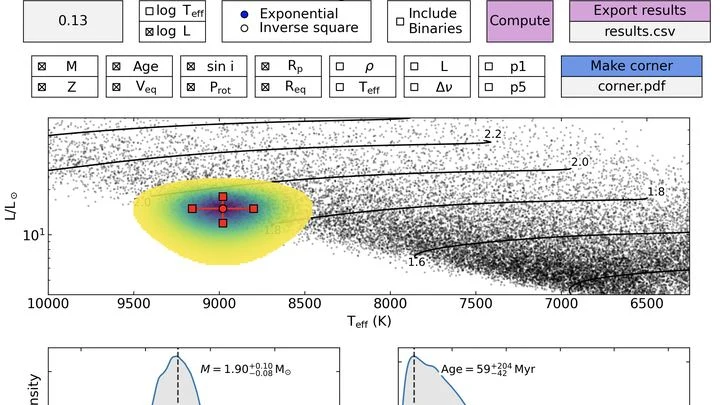
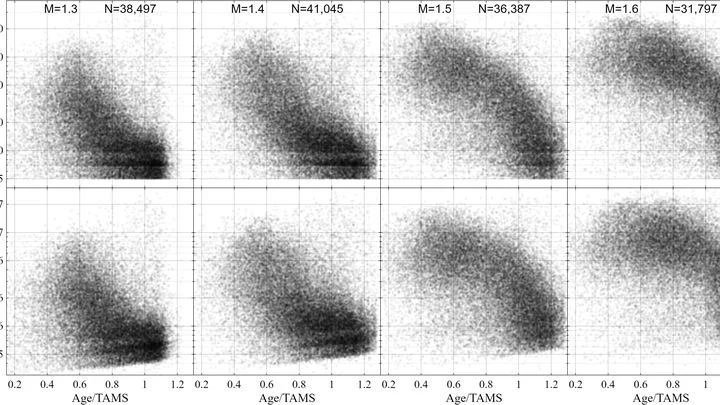
Imagine a person in an old photograph standing in a crowd while spinning — guessing their age would be nearly impossible. That's roughly how astronomers determine the ages and masses of distant stars, and they often get it wrong. For stars slightly heavier than the Sun (from 1.4 to 2.5 solar masses), standard methods like chemical-composition 'clocks' work poorly.
At the edge of the solar system, where the Sun is barely brighter than other stars, icy boulders, trans-Neptunian objects, circle around. Their orbits resemble hoops scattered by someone. But look closer: twelve of these hoops are not just floating in the void.
The carousel spins all the horses in one direction, but one stubbornly gallops against the flow. That's exactly how the planet TOI-1710 b behaves around its star. Using the HARPS-N and GIANO-B instruments, astronomers measured its tilt at 149 degrees. That's nearly a 180-degree flip, meaning the planet orbits "backward" relative to the star's rotation.
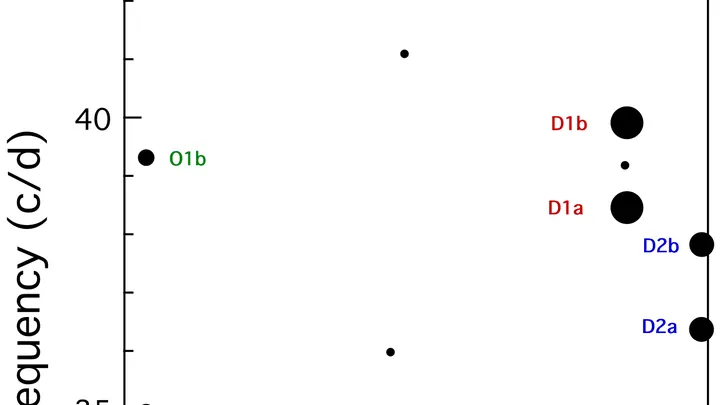
The binary star TIC 287869463 is a close pair: one star pulsates like a bell, while the other's gravity stretches it like an ocean tide. Usually, pulsations travel across a star as waves, but here one wave has frozen in place.
Astronomers sifted through three years of data from the TESS telescope — light from 50,000 stellar pairs.
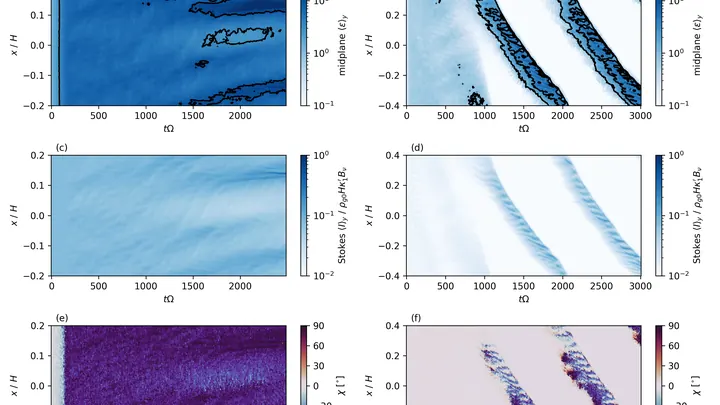
Around young stars, disks of gas and dust swirl — the building blocks for future planets. Inside these disks, dust grains don't just fly randomly: they align along invisible lines of gas flow. Recently, astronomers noticed that dust grains in such disks behave like badminton shuttlecocks — always turning their long side into the wind.
Stars on the outskirts of galaxies rotate unexpectedly fast. According to Newton, the farther from the center, the slower the motion should be, like in a round dance, where the outer dancers move more slowly. But in reality, stellar outskirts race along almost as fast as the core, resembling a giant carousel: on it, the outer horses fly faster so as not to fall behind the inner ones.
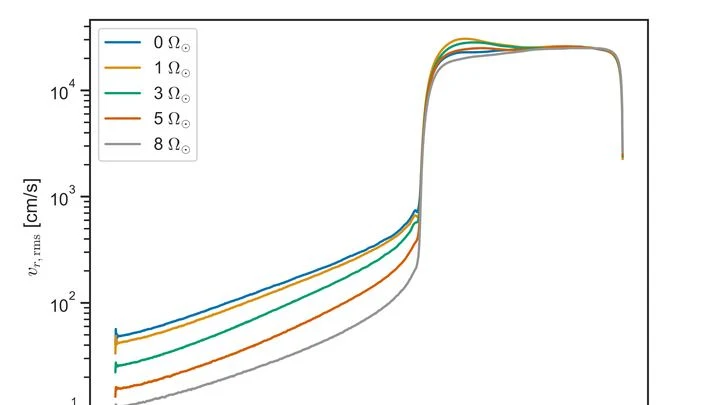
A star like the Sun hums like a bell: sound waves inside make its surface tremble ever so slightly. From this trembling, astronomers, like doctors reading a pulse, infer the star's temperature, density, and age. But the Kepler telescope spotted an oddity: many stars that spin fast and are covered in spots show no trembling at all. It's as if they've lost their voice.
The young star RY Tau is like a finicky spinning top. Around it whirls a flat disk of gas and dust — the leftovers of the cloud from which the star was born. The star pulls some of the disk's matter toward itself like a vacuum cleaner, and flings some back out in a narrow wind cone like a fountain.
A stag beetle the size of a fingernail stands on the ground with its legs spread wider than its own height. An elephant as tall as a room, on the other hand, towers above the ground like a tower. Why is that? Both animals walk on the same ground, but they see it differently. For a beetle, each pebble is a boulder, while for an elephant, it's a grain of sand.
The Gaia space telescope has measured how fast more than a hundred thousand stars spin. It turns out that a star's rotation speed depends on its temperature. For stars cooler than 6500 degrees, the surface moves at 10–20 kilometers per second.
Three distant giant planets circle their stars so closely that a year on them lasts just a few Earth days. These worlds are called hot Jupiters, and their orbits are a real puzzle: how did they end up right next to the star if they were born far away, in the cold outskirts of the system? One key clue is the angle at which a planet orbits relative to the star's rotation.
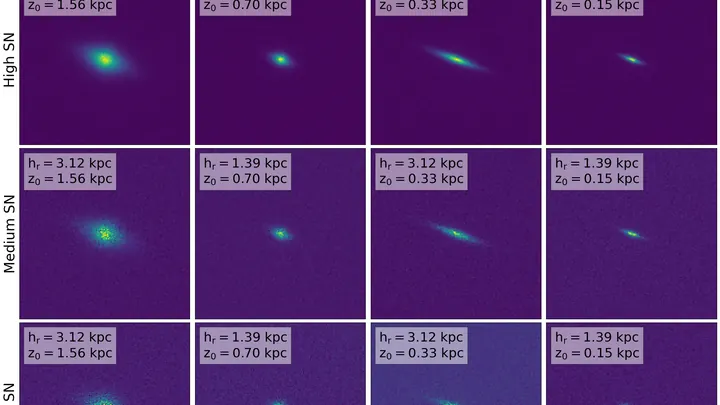
The James Webb Space Telescope peered 11 billion years back in time and spotted galaxies turned edge-on toward us. To measure their thickness, scientists devised a clever method: they calculated it the same way you'd measure the thickness of a slightly tilted pancake, not a perfectly flat one. Previous estimates were imprecise because they assumed an ideal angle.
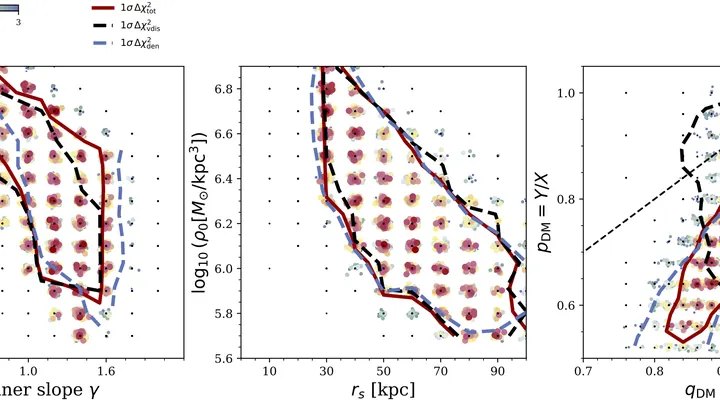
The Milky Way's stellar disk is like a glowing pinwheel, and тёмное вещество is an invisible cloud around it. For the first time, its shape has been precisely measured. Astronomers tracked the motions of millions of stars and built a 3D map of the тёмное гало out to 160,000 light-years.
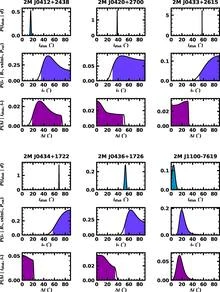
A spinning top tilted over a table, with a dusty pancake swirling around it. That is what a young stellar system looks like when the star's spin axis and the plane of its protoplanetary disk do not align. Until recently, astronomers did not know how common such a configuration is in nature.