A wave is a disturbance that propagates through a medium or through empty space, transferring energy and momentum from one point to another without the permanent transport of matter. Waves are ubiquitous in physics, from sound waves traveling through air, water waves on the ocean, to electromagnetic waves like light that can travel through a vacuum. They are characterized by properties such as wavelength, frequency, amplitude, and speed, and they can be described mathematically as oscillations that repeat in space and time.
History
The study of waves dates back to antiquity, but the modern mathematical treatment began with Christiaan Huygens in the 17th century, who proposed the wave theory of light. The wave equation was later developed by Jean le Rond d'Alembert in the 18th century.
How it works
Waves arise when a local disturbance causes neighboring particles or fields to oscillate, and this oscillation propagates outward. In mechanical waves (e.g., sound, water), the medium's particles vibrate about their equilibrium positions, transferring energy through collisions or elastic forces. In electromagnetic waves, oscillating electric and magnetic fields regenerate each other, allowing propagation through a vacuum at the speed of light. The wave equation, a partial differential equation, governs the behavior of most waves, and solutions can be superposed to create complex patterns like interference and diffraction.
In practice
Waves are fundamental to numerous technologies, including radio and television broadcasting, medical ultrasound imaging, earthquake detection (seismology), and fiber-optic communication.
Fun fact
The longest waves ever observed are ocean swell waves that can travel thousands of kilometers across the Pacific Ocean without losing much energy, arriving on distant shores with nearly the same height they had at their origin.
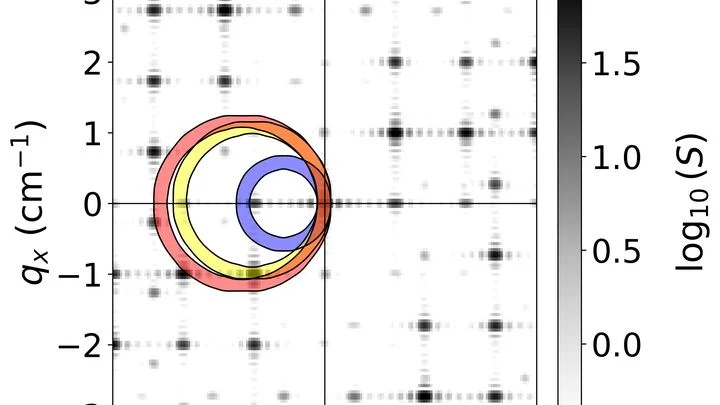
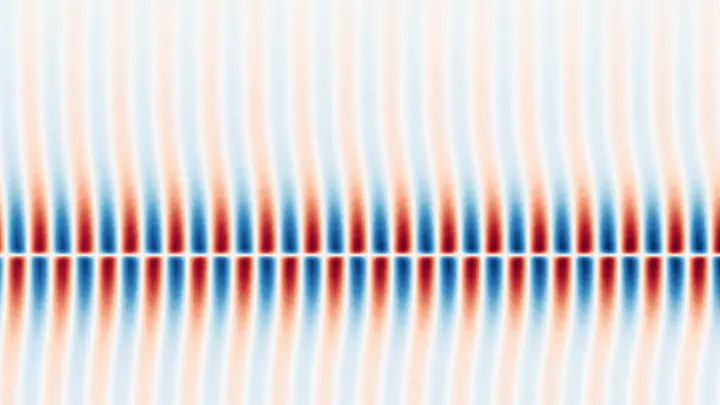
Waves on the water's surface usually break against any obstacle — a rock, a piling, an island. But what if you arrange obstacles so cleverly that the wave barely notices them? In a new study, scientists assembled a pattern of many points on the water, arranged according to special mathematical rules, and sent waves through them.
At the heart of a dying star, as its core collapses into a neutron sphere, an invisible storm is born. Trillions of neutrinos, particles that barely interact with matter, race through the scorching plasma. There are so many of them that they begin to influence each other, changing their 'flavors' (electron, muon, tau) like chameleons.
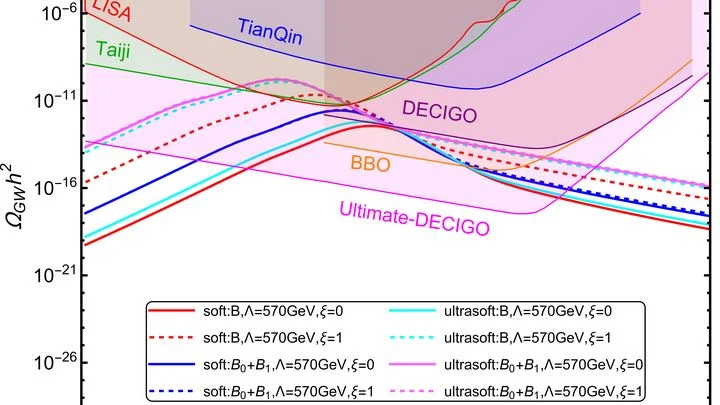
The first moments after the big bang: space expands rapidly — physicists call this period inflation. Inside this swelling fabric, like soap bubbles in a stream of air, regions of new vacuum begin to form — a first-order phase transition. Most bubbles pop or merge as soon as they appear.
A thrown stone sends ripples across water. A gravitational wave is the same kind of ripple, but in spacetime. It is produced, for example, by the merger of two black holes. In classical physics, this ripple is eternal: once created, it travels through the Universe without fading.
A lone fold runs across a taut sheet — a sharp drop in height that doesn't spread out but moves as a whole. Physicists call such a fold a 'kink'. If you give the sheet a sharp tug in one spot, ripples will travel across it. But in some media, these ripples don't disperse; instead, they gather into a clump and tremble in place for dozens or hundreds of cycles. Such a clump is an oscillon.
A stone falls into a pond, and ripples spread evenly in all directions. But some media behave as if the wave knows which way to turn, like water that only swirls clockwise. This asymmetry comes from odd viscosity and odd elasticity — properties of media with broken mirror symmetry.
A pebble tossed into a pond sends ripples spreading in all directions. Now imagine the pond itself suddenly turning into jelly — instantly, faster than the wave can complete a single crest. Some ripples would keep spreading but change their spacing, while others would unexpectedly turn around and run back toward the point of impact, as if time were flowing backward for them.
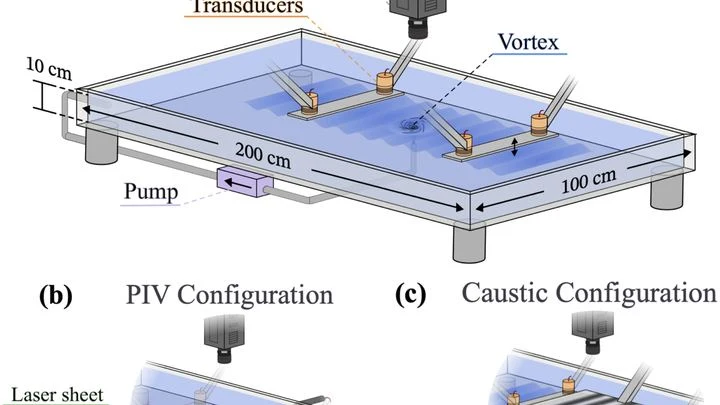
Water going down the drain swirls into a vortex. An everyday sight in the kitchen. But this very vortex turned out to be able to reproduce two effects that physicists usually associate with black holes and the rotation of planets.
The first effect is the shift of a wave as it goes around an obstacle.
Lymphatic vessels are one-way streets. Through them, fluid flows only forward thanks to tiny flap valves. These valves open in just one direction, creating asymmetry, directionality, without which the flow would stop.
In the lab, scientists modeled a vessel and sent compression waves along it, like a parade of gentle nudges.
In ordinary water, ripples from a thrown stone spread in even concentric circles. But imagine a liquid whose molecules are like tiny screws with a right-handed thread. In such a medium, the surface acts like a one-way street: waves can only travel in a certain direction.
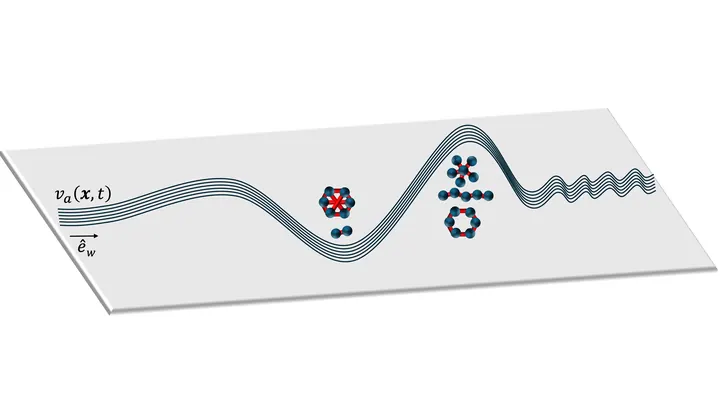
Polymers are long threads of carbon and hydrogen atoms. In living cells, they encounter streams of chemical signals that pulse like the surf. Long chains and closed rings behave like skilled surfers: they catch the wave and glide with it. Short fragments and tight coils, counterintuitively, move strictly against it.
Ahead of the bow shock that Earth creates in the solar wind, giant bubbles of rarefied gas sometimes appear. Inside them, particle density drops by factors, and electric fields start to tremble like a plucked string.
In the infant universe, right after the Big Bang, space was expanding rapidly, and the vacuum resembled a superheated liquid. When 'boiling' began, bubbles of true vacuum emerged. Expanding at the speed of light, they triggered gravitational waves — tremors of space itself that have reached us.
The ocean is like a layered cake: warm, light water on top, cold, heavy water below. Between the layers, at the interface, invisible waves roam. They don't lift crests like a storm; instead, they slowly rock the entire water column, as if someone were shaking a giant aquarium from within.
The hall is silent, but the conductor has already raised the baton. The orchestra is quiet, yet the score is changing. So it is in an optical resonator: there is no light, but the quantum vacuum—that emptiness filled with short-lived field fluctuations—is already conducting the…
A woven basket holds its shape not because it has a rigid frame, but because each strand is interlaced with its neighbors. Pull one out, and the pattern unravels, leaving a heap of twigs. Quantum mechanics, according to a new paper, works the same way: its elementary objects do not exist independently, but only in interweaving with each other.