Stellar pulsation refers to the regular, periodic expansion and contraction of a star's outer layers, which causes its brightness to vary over time. These oscillations are not random; they are driven by internal physical processes that make the star behave like a giant, ringing bell. The study of stellar pulsation is a powerful tool in astrophysics, as the period and amplitude of these oscillations reveal the star's internal structure, composition, and age—a field known as asteroseismology. It also underpins the cosmic distance ladder, as certain pulsating stars, like Cepheid variables, have a well-defined relationship between their pulsation period and intrinsic luminosity.
History
The first recognized pulsating star was Delta Cephei, discovered by John Goodricke in 1784, but the physical explanation came much later. The period-luminosity relation for Cepheids was discovered by Henrietta Swan Leavitt in 1908, and the theory of stellar pulsation was developed by Arthur Eddington in the 1910s-20s.
How it works
Pulsation occurs when a star's outer layers are not in perfect hydrostatic equilibrium. A perturbation, such as a slight change in opacity, can cause the layer to expand. As it expands, it cools and becomes more opaque, trapping radiation and causing it to heat up and expand further. Eventually, the expansion overshoots, and gravity pulls the layer back inward, compressing and heating it. The cycle repeats, with the star oscillating at a natural frequency determined by its size, mass, and internal structure. The driving mechanism often involves a layer of partially ionized helium that acts as a valve, alternately storing and releasing energy.
In practice
Stellar pulsation is used to measure distances to galaxies via Cepheid variables, and in asteroseismology to probe the internal structure of stars, including our Sun (helioseismology).
Fun fact
The Sun itself pulsates with a period of about 5 minutes, with millions of resonant modes, making it ring like a bell.
A star blinks every 38 seconds. This is no random twinkle: inside the white dwarf WD 0158−160, steady oscillations run like the beats of an invisible metronome. From the rhythm of those beats and the star's precise distance, astronomers have computed its mass and temperature — without ever looking at its spectrum.
Radio waves from a distant pulsar travel through the interstellar medium, encountering invisible magnetic structures the size of the distance from the Sun to Earth. One such structure is a current sheet, where the magnetic field abruptly changes direction, like a compass needle flipping from north to south.
Cepheids are stars that pulsate with remarkable regularity: their brightness changes like a lighthouse beam, and the pulsation period is linked to the star's average density. In binary systems where a Cepheid is eclipsed by its companion, astronomers can precisely measure the star's radius and mass.
After a supernova explosion, a dense ball the size of a city remains at the center — a newborn neutron star. It is hot, compressed, and rings like a bell after being struck. These tremors, the star's oscillations, emit gravitational ripples that sensitive detectors on Earth can catch.
A young star cluster resembles an orchestra before a concert: each instrument tunes up in its own way, and the overall hum seems like chaos. But if you listen closely, you can pick out individual notes.
The Sun is constantly struck by blows — magnetic reconnection in the plasma releases energy, making the corona flare up. After each such blow, magnetohydrodynamic waves linger in the plasma loops, like the fading ring of a bell.
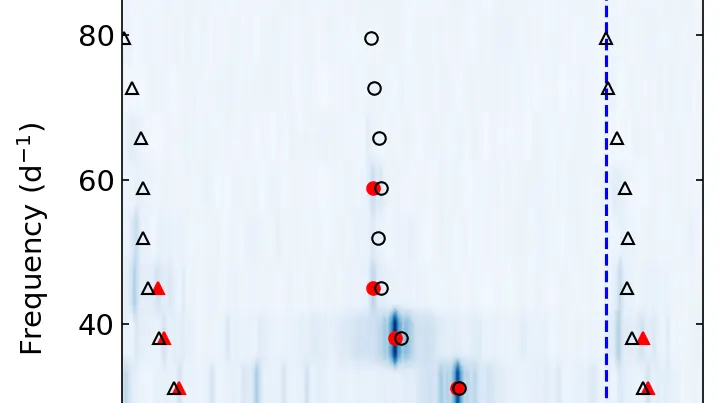
The binary star TIC 287869463 is a close pair: one star pulsates like a bell, while the other's gravity stretches it like an ocean tide. Usually, pulsations travel across a star as waves, but here one wave has frozen in place.
Astronomers sifted through three years of data from the TESS telescope — light from 50,000 stellar pairs.
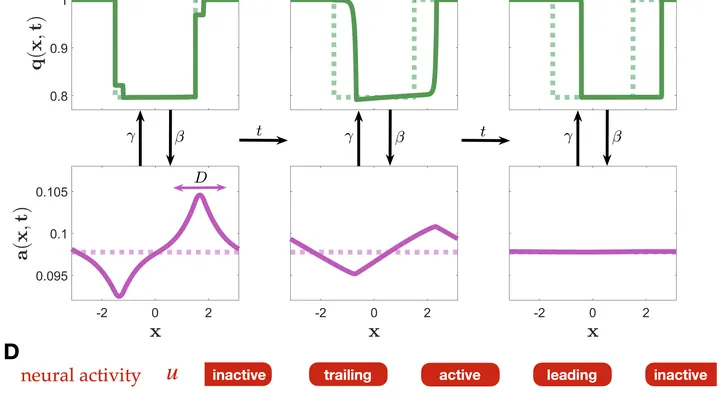
Holding a phone number in your head while you dial it: that's working memory. In the brain, a group of cells is responsible for this, sending signals to each other like people passing a bucket along a chain. But every transfer has a cost: it requires messenger substances that get used up.
Above the Sun's surface hang long ribbons of glowing gas — streamers. They look like giant harps stretched across the corona. When a wave runs along such a ribbon, it trembles and bends like a string after being plucked.
For a long time, it was thought that only a very fast ejection of material, one traveling at more than 500 kilometers per second, could launch such a wave.
A neutron star the size of a city spins faster than a kitchen blender, flinging particles around itself. A glowing cloud forms around it — called a pulsar halo. The shape of this cloud depends on invisible magnetic fields that, like ocean currents, steer the particles.
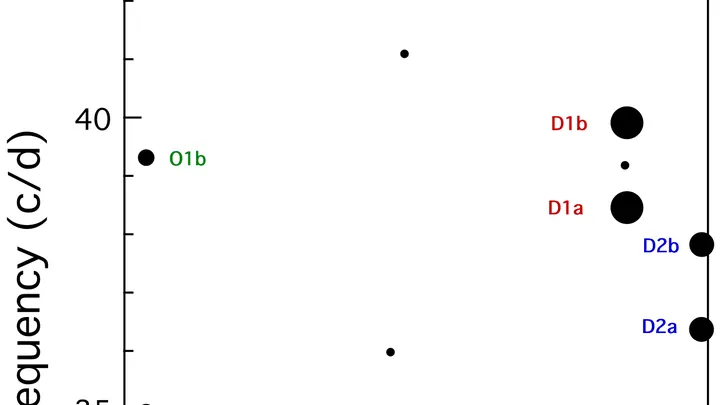
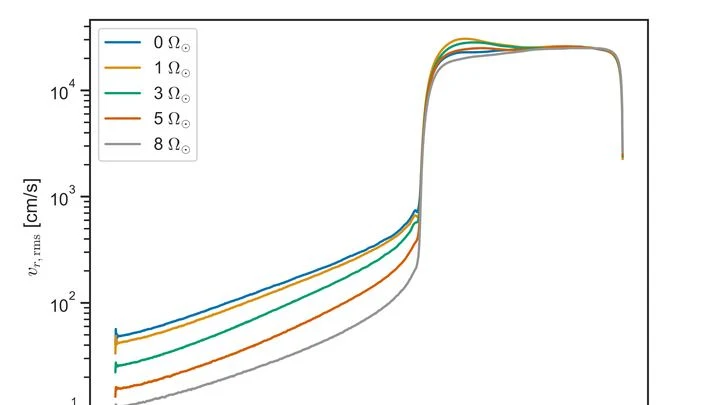
A star like the Sun hums like a bell: sound waves inside make its surface tremble ever so slightly. From this trembling, astronomers, like doctors reading a pulse, infer the star's temperature, density, and age. But the Kepler telescope spotted an oddity: many stars that spin fast and are covered in spots show no trembling at all. It's as if they've lost their voice.
Scientists have described a new type of invisible star that behaves like a breathing lens. Such a star is made of ultralight boson particles (not yet discovered). Its gravity causes spacetime curvature — this is the lens, which rhythmically expands and contracts, as if breathing.